


Mapping changes in forests around the world


Lesson details
Learning outcome
I can research the significance of forests to local communities.
Key learning points
- Maps can give us information about the location and extent of forests globally.
- Some parts of the world, such as the Amazon, are experiencing deforestation.
- Satellite imagery can be used to identify how much deforestation has happened.
- Deforestation impacts on local and global communities in many different ways.
Keywords
Indigenous - Indigenous describes people who are the original inhabitants of a place, rather than people who moved there from somewhere else
Hectare - A hectare is a measurement of land. Each hectare is 10,000 square metres
Satellite image - A satellite image is a photograph taken from high above using a satellite
Deforestation - Deforestation is the complete removal of trees
Common misconception
Trees are a renewable resource and can just be cut down then replanted without any negative impact.
It can take hundreds of years for some woodland to become established with the same benefits. It is important to protect the global forests that we currently have.
Teacher tip
The NASA Earth Observatory website has lots of articles showcasing how satellite images have been useful in the protection of the Amazon rainforest.

Licence

Lesson video
Loading...
Prior knowledge starter quiz
6 Questions
Q1.Climate zones are areas that have similar .
Q2.Match the key word to its definition.

Q3.What is the boreal forest climate like?
Q4.The most common boreal tree species are deciduous and evergreen conifers such as:
Q5.Which continent does not contain any temperate deciduous forest?
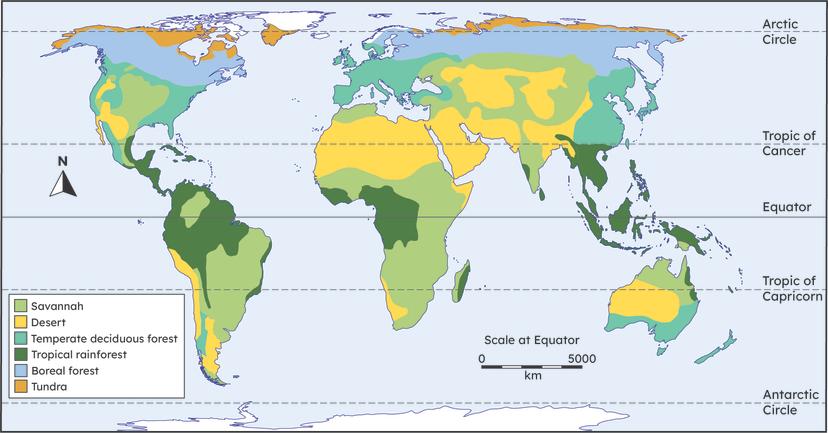
Q6.Which forest biome is being described here:
"This biome is home to over half the world’s plants and animal species."
Assessment exit quiz
6 Questions
Q1.What is deforestation?
Q2.__________ describes people who are the original inhabitants of a place, rather than people who moved there from somewhere else.
Q3.How much land is covered by forests globally?
Q4.Over the last 10,000 years, the world has __________ one-third of its forests.
Q5.Most of the world's woodland is...
Q6.Order the type of woodland starting with the largest proportion.
To help you plan your 5 geography lesson on: Mapping changes in forests around the world, download all teaching resources for free and adapt to suit your pupils' needs...
To help you plan your 5 geography lesson on: Mapping changes in forests around the world, download all teaching resources for free and adapt to suit your pupils' needs.
The starter quiz will activate and check your pupils' prior knowledge, with versions available both with and without answers in PDF format.
We use learning cycles to break down learning into key concepts or ideas linked to the learning outcome. Each learning cycle features explanations with checks for understanding and practice tasks with feedback. All of this is found in our slide decks, ready for you to download and edit. The practice tasks are also available as printable worksheets and some lessons have additional materials with extra material you might need for teaching the lesson.
The assessment exit quiz will test your pupils' understanding of the key learning points.
Our video is a tool for planning, showing how other teachers might teach the lesson, offering helpful tips, modelled explanations and inspiration for your own delivery in the classroom. Plus, you can set it as homework or revision for pupils and keep their learning on track by sharing an online pupil version of this lesson.
Explore more key stage 2 geography lessons from the Local and global: why are trees and forests important? unit, dive into the full primary geography curriculum, or learn more about lesson planning.