Myths about teaching can hold you back
- Year 6
Explain how to compare pairs of non-related fractions by comparing to a half
I can explain how to compare pairs of non-related fractions by comparing to a half.
- Year 6
Explain how to compare pairs of non-related fractions by comparing to a half
I can explain how to compare pairs of non-related fractions by comparing to a half.
Lesson details
Key learning points
- In fractions equivalent to a half, the numerator is half the value of the denominator.
- When the numerator is more than half the value of the denominator, the fraction is greater than a half.
- When the numerator is less than half the value of the denominator, the fraction is less than a half.
Keywords
Proper fraction - A proper fraction is a fraction where the numerator (the top number) is less than the denominator (the bottom number).
Order - To order things means to put things into their correct place following a set rule.
Common misconception
Pupils struggle to compare fractions to a half as they mainly consider it in its simplest form.
Encourage pupils to visualise their fractions on a number line. Also spend time thinking about the relationship between the numerator and the denominator in fractions equivalent to one-half and use this generalisation to help moving forward.
To help you plan your year 6 maths lesson on: Explain how to compare pairs of non-related fractions by comparing to a half, download all teaching resources for free and adapt to suit your pupils' needs...
To help you plan your year 6 maths lesson on: Explain how to compare pairs of non-related fractions by comparing to a half, download all teaching resources for free and adapt to suit your pupils' needs.
The starter quiz will activate and check your pupils' prior knowledge, with versions available both with and without answers in PDF format.
We use learning cycles to break down learning into key concepts or ideas linked to the learning outcome. Each learning cycle features explanations with checks for understanding and practice tasks with feedback. All of this is found in our slide decks, ready for you to download and edit. The practice tasks are also available as printable worksheets and some lessons have additional materials with extra material you might need for teaching the lesson.
The assessment exit quiz will test your pupils' understanding of the key learning points.
Our video is a tool for planning, showing how other teachers might teach the lesson, offering helpful tips, modelled explanations and inspiration for your own delivery in the classroom. Plus, you can set it as homework or revision for pupils and keep their learning on track by sharing an online pupil version of this lesson.
Explore more key stage 2 maths lessons from the Comparing fractions unit, dive into the full primary maths curriculum, or learn more about lesson planning.
Licence
Prior knowledge starter quiz
6 Questions
Q1.Double 16 is equal to
Q2.Tick the largest fraction.
Q3.Half of 500 is
Q4.Tick the fractions that represent one half.
Q5.Use the correct symbol to compare: $$ {3} \over {6}$$ ___ $$ {4} \over {12}$$
Q6.Use the correct symbol to compare: $$ {2} \over {6}$$ ___ $$ {3} \over {9}$$
Assessment exit quiz
6 Questions
Q1.What is the relationship between the numerator and the denominator of a fraction that is equivalent to one half?
Q2.Tick the fractions that represent one half.
Q3.Tick the fractions greater than one half.
Q4.Tick the fractions less than one half.
Q5.Order the fractions from largest to smallest.
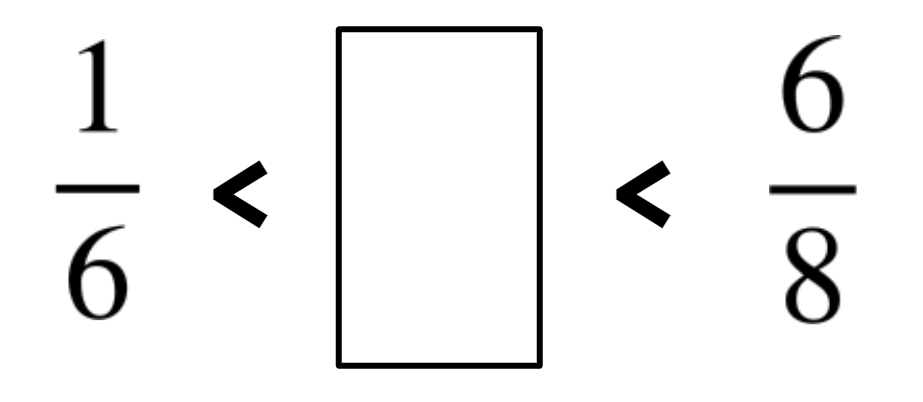
Q6.Tick the fractions that would fit in the equation.