


Use knowledge of division to solve problems


Lesson details
Learning outcome
I can use knowledge of division to solve problems.
Key learning points
- When solving division problems, sometimes a remainder is recorded as the number left over.
- When solving division problems, sometimes a remainder can be ignored.
- When solving division problems, sometimes an extra group is made to include the remainder.
- The question asked in the problem shows whether we should ignore or include the remainder.
Keywords
Remainder - A remainder is the amount left over after division when the dividend does not divide exactly by the divisor.
Common misconception
Children may struggle to visualise how the remainder relates to the question asked in the problem, or may solve the equation without relating back to the question asked.
Encourage them to write the division equation for the problem and say what each part represents, focusing particularly on the role of the remainder and how it relates to the question asked.
Teacher tip
Encourage children to develop the habit, once they have recorded and solved the equation, of asking if the question the problem poses has been answered. Discuss different questions that can be asked for the same context and practise changing the answer required by changing the question asked.

Licence

Lesson video
Loading...
Prior knowledge starter quiz
6 Questions
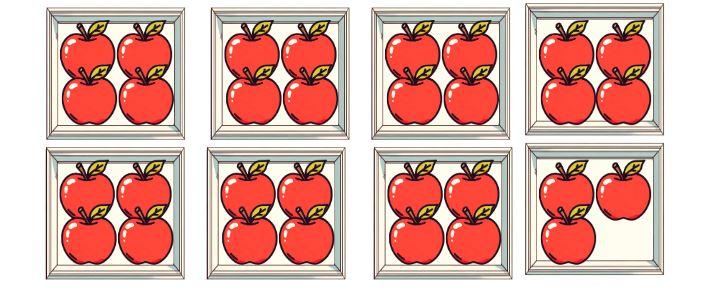
Q1.Sofia has 31 apples and is putting them into boxes of 4 apples. How many full boxes of apples will there be?

Q2.58 ÷ 6 = 9 r 4 This equation represents a division problem. Which of the following would be possible answers to the problem?
Q3.There are 105 children at the school picnic. 11 children can sit on each picnic blanket. How many blankets are needed so that all children can sit down?
Q4.At the picnic, each large bottle of water can fill 9 glasses. How many bottles are needed to fill 88 glasses?
Q5.In an art lesson, 52 children need a paint brush. Brushes come in packs of 12 How many full packs are needed for all children to have a paintbrush?
Q6.Children are put into groups of 7 to play a team game. If there are 65 children, how many full teams of 7 are there?
Assessment exit quiz
6 Questions
Q1.75 children are going on a trip to the farm. Each minibus can hold 9 children. How many minibuses are needed to take all of the children? minibuses.
Q2.Sofia feeds 55 different cows on the farm. There are 8 cows in each enclosure. How many enclosures did she visit?
Q3.There are 70 bags of different animal feed which are shared equally between 6 of the groups. How many bags does each group receive? bags.
Q4.In the rabbit house, 44 carrots are shared equally between 7 rabbits. How many carrots does each rabbit receive? carrots
Q5.The farmer gives trailer rides around the farm. Each trailer has room for 12 children. How many trailers are needed for 75 children to ride? trailers.
Q6.There are 44 children waiting to see the pigs. Only 8 children are allowed into the barn at a time. How many of the groups that go into the barn contain 8 children?
To help you plan your 4 maths lesson on: Use knowledge of division to solve problems, download all teaching resources for free and adapt to suit your pupils' needs...
To help you plan your 4 maths lesson on: Use knowledge of division to solve problems, download all teaching resources for free and adapt to suit your pupils' needs.
The starter quiz will activate and check your pupils' prior knowledge, with versions available both with and without answers in PDF format.
We use learning cycles to break down learning into key concepts or ideas linked to the learning outcome. Each learning cycle features explanations with checks for understanding and practice tasks with feedback. All of this is found in our slide decks, ready for you to download and edit. The practice tasks are also available as printable worksheets and some lessons have additional materials with extra material you might need for teaching the lesson.
The assessment exit quiz will test your pupils' understanding of the key learning points.
Our video is a tool for planning, showing how other teachers might teach the lesson, offering helpful tips, modelled explanations and inspiration for your own delivery in the classroom. Plus, you can set it as homework or revision for pupils and keep their learning on track by sharing an online pupil version of this lesson.
Explore more key stage 2 maths lessons from the Division with remainders unit, dive into the full primary maths curriculum, or learn more about lesson planning.