Choose exam board for KS4 Computer Science (GCSE)
Choose exam board for KS4 English
Choose exam board for KS4 French
Choose exam board for KS4 Geography
Choose exam board for KS4 German
Choose exam board for KS4 History
Choose tier for KS4 Maths
Choose exam board for KS4 Music
Choose exam board for KS4 Physical education (GCSE)
Choose exam board for KS4 Religious education (GCSE)
Choose exam board for KS4 Spanish

      Use knowledge of multiplication and division to solve scaling problems in a range of contexts
      Lesson details

      Learning outcome

      You can use knowledge of multiplication and division to solve scaling problems in a range of contexts

      Key learning points

      1. Multiplication and division are used to convert between measurements on a map or plan and those in real life.
      2. Working with scale can involve fractions of measures.
      3. Two scales can look different but be equivalent.

      Keywords

      • Scale - A scale is used to show how the distances on a map or plan relate to distances in real life

      • Scaling - Scaling is the operation of changing one value to another using multiplication or division, using the same factor or divisor

      • Double number line - A double number line is used to show the relationship between two values, in this case, the distances on the plan and those in real life

      Common misconception

      Failing to spot the change in unit of measure between the scale and real life.

      Describe the scale and identify the unit of measure used on the map or plan and the unit of measure used in real life.

      Teacher tip

      Encourage pupils to estimate the real life measures, pacing out real life distances where appropriate to make sense of what the scale drawing or map is representing.

      Licence

      This content is © Oak National Academy Limited (2025), licensed on Open Government Licence version 3.0
      except where otherwise stated. See Oak's terms & conditions
      (Collection 2).

      Lesson video

      Loading...

      Prior knowledge starter quiz

      6 Questions

      Q1.
      What number is 12 times the size of 4?

      Correct Answer: 48, forty eight, forty-eight

      Q2.
      What is $$12 \times 30$$ equal to?

      36
      306
      Correct answer: 360
      3,600

      Q3.
      How many 50s are there in 200?

      2
      3
      Correct answer: 4
      5
      6

      Q4.
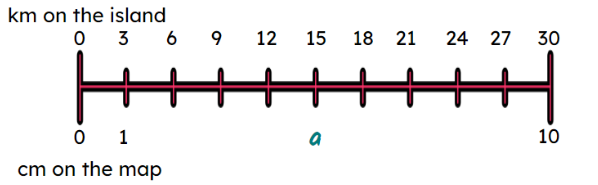
      What is the value of a on this double number line?

      An image in a quiz
      Correct Answer: 5, five

      Q5.
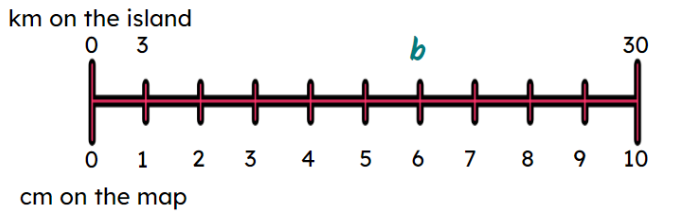
      What is the value of b on this double number line?

      An image in a quiz
      Correct Answer: 18, eighteen, 18 km

      Q6.
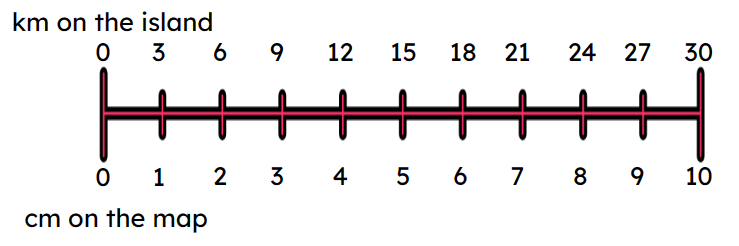
      If you continued this number line, what distance on the map would represent 45 km on the island?

      An image in a quiz
      Correct Answer: 15 cm, fifteen cm

      6 Questions

      Q1.
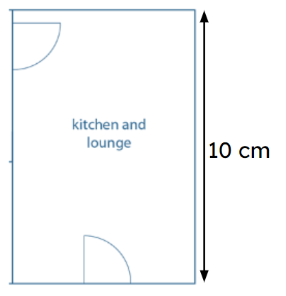
      How long is this room if the scale for the plan is 1 cm on the plan for every 50 cm in real life?

      An image in a quiz
      10 m
      50 m
      Correct answer: 5 m
      4 m

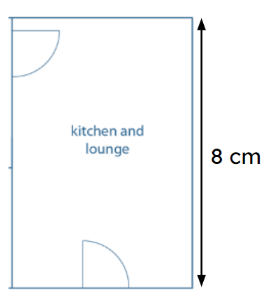
      Q2.
      How long is this room if the scale for the plan is 1 cm on the plan for every 50 cm in real life?

      An image in a quiz
      10 m
      40 m
      5 m
      Correct answer: 4 m

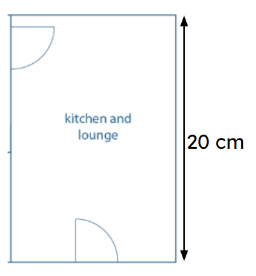
      Q3.
      How long is this room if the scale for the plan is 1 cm on the plan for every 50 cm in real life?

      An image in a quiz
      Correct answer: 10 m
      20 m
      5 m
      4 m

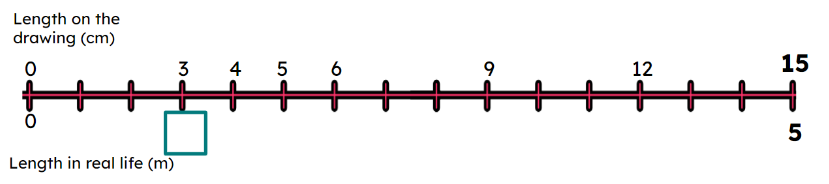
      Q4.
      What value goes in the green box to represent a distance in metres in real life?

      An image in a quiz
      0.5
      Correct answer: 1
      1.5
      2
      3

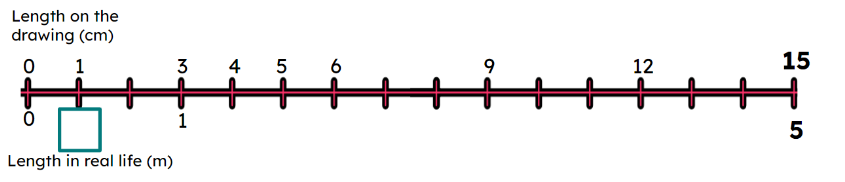
      Q5.
      What value goes in the green box to represent a distance in metres in real life?

      An image in a quiz
      Correct answer: one third
      one fifth
      1
      3
      5

      Q6.
      On a map with a scale of 1cm : 20km, what length on the map would represent 10km?

      2cm
      Correct answer: 0.5cm
      10cm

      To help you plan your 6 maths lesson on: Use knowledge of multiplication and division to solve scaling problems in a range of contexts, download all teaching resources for free and adapt to suit your pupils' needs...