Myths about teaching can hold you back
- Year 6
Solve problems with two unknowns in a range of contexts
I can solve problems with two unknowns in a range of contexts.
- Year 6
Solve problems with two unknowns in a range of contexts
I can solve problems with two unknowns in a range of contexts.
Lesson details
Key learning points
- Some problems with two unknowns have only one solution.
- Some problems with two unknowns have many solutions.
- Some problems with two unknowns have an infinite number of solutions.
Keywords
Represent - To represent something means to show something in a different way.
Common misconception
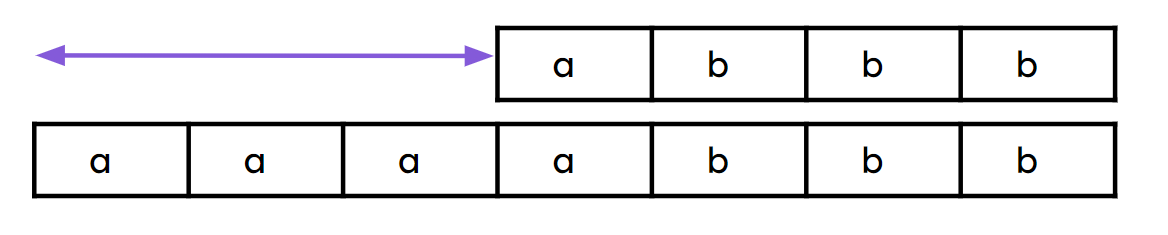
When representing problems with more than two unknowns, pupils draw bar models all starting from the same end point and with the variables in any order.
Encourage pupils to draw their bar models with the variables lined up underneath one another wherever possible. The bar model may not line up form the left, but this can help to identify the differences between each model.
To help you plan your year 6 maths lesson on: Solve problems with two unknowns in a range of contexts, download all teaching resources for free and adapt to suit your pupils' needs...
To help you plan your year 6 maths lesson on: Solve problems with two unknowns in a range of contexts, download all teaching resources for free and adapt to suit your pupils' needs.
The starter quiz will activate and check your pupils' prior knowledge, with versions available both with and without answers in PDF format.
We use learning cycles to break down learning into key concepts or ideas linked to the learning outcome. Each learning cycle features explanations with checks for understanding and practice tasks with feedback. All of this is found in our slide decks, ready for you to download and edit. The practice tasks are also available as printable worksheets and some lessons have additional materials with extra material you might need for teaching the lesson.
The assessment exit quiz will test your pupils' understanding of the key learning points.
Our video is a tool for planning, showing how other teachers might teach the lesson, offering helpful tips, modelled explanations and inspiration for your own delivery in the classroom. Plus, you can set it as homework or revision for pupils and keep their learning on track by sharing an online pupil version of this lesson.
Explore more key stage 2 maths lessons from the Solving problems with two unknowns unit, dive into the full primary maths curriculum, or learn more about lesson planning.
Equipment
Licence
Prior knowledge starter quiz
6 Questions
Q1.1 apple and 2 bananas cost £1.85 3 apples and 2 bananas cost £2.75 Complete the equations to represent this. a + 2b = £1.85 and + 2b = £2.75
Q2.Which pair of equations represent the image?

Q3.Match the mass in kilograms to its equivalent mass in grams.
1.205 kg -
1,205 g
1.25 kg -
1,250 g
1.025 kg -
1,025 g
Q4.£10 is shared between 8 people. How much does each person get? Write your answer in pounds. £
Q5.If four peaches cost £3.40, what is the cost of one peach? Give your answer in pence. p
Q6.1 apple and 2 bananas cost £1.85 3 apples and 2 bananas cost £2.75 What is the cost of one banana? Give your answer in pence.
Assessment exit quiz
6 Questions
Q1.1 eraser (a) and 3 pencils (3b) cost £1.75 4 erasers (4a) and 3 pencils (3b) cost £2.50 Which statements are true?

Q2.1 eraser (a) and 3 pencils (3b) cost £1.75 4 erasers (4a) and 3 pencils (3b) cost £2.50 Find the cost of one eraser. p

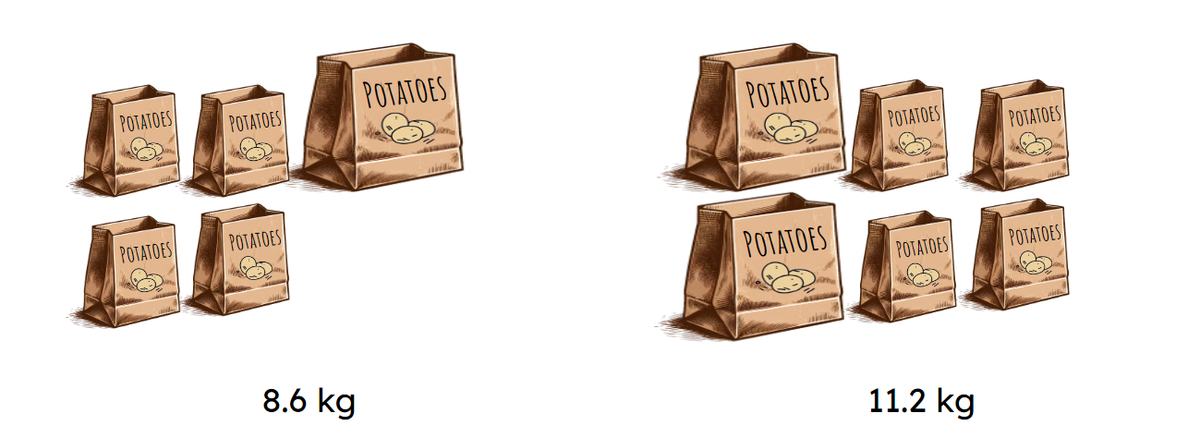
Q3.The masses of some groups of large and small bags of potatoes are shown here. What is the mass of the large bag? kg

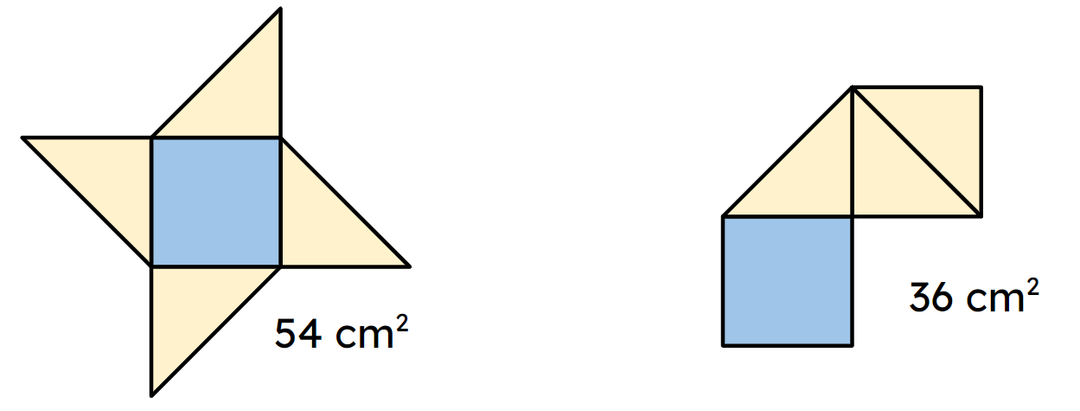
Q4.Two different designs are made with the same square and triangular tiles. The area of the whole design is given. What is the area of one triangular tile? $$cm^2$$

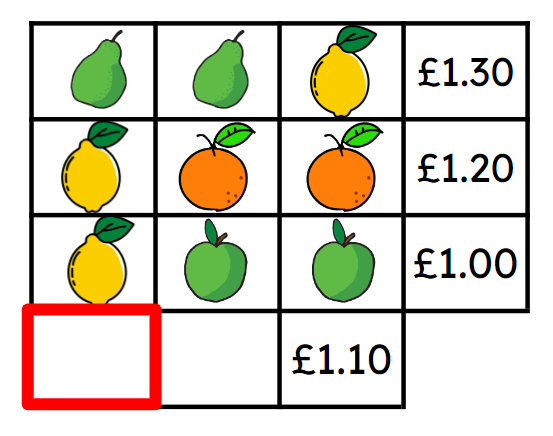
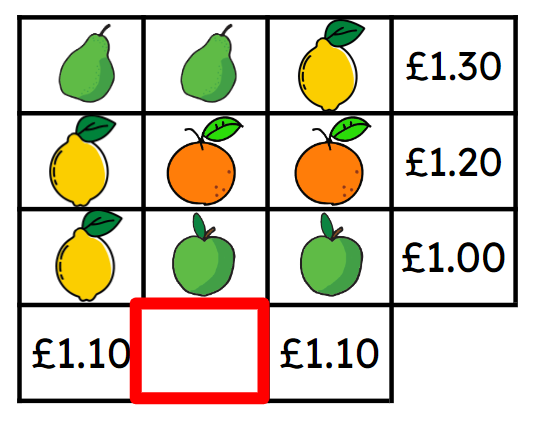
Q5.Lucas knows that the cost of 1 lemon is 30 p. What is the missing total highlighted? Give your answer in pounds. £

Q6.Lucas knows that the cost of 1 lemon is 30 p and the cost of 1 pear is 50 p. What is the missing total highlighted? Give your answer in pounds. £