Myths about teaching can hold you back
- Year 11•
- Higher
- Year 11•
- Higher
Combinations
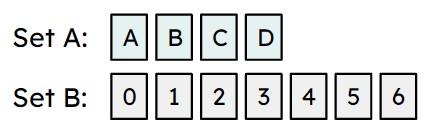
I can derive the product rule for counting, including when to divide by 2.
These resources were made for remote use during the pandemic, not classroom teaching.
Switch to our new teaching resources now - designed by teachers and leading subject experts, and tested in classrooms.
Lesson details
Key learning points
- By systematically listing the outcomes for two or more events, a pattern begins to emerge
- This pattern can be generalised so that counting possible outcome combinations is quicker
- Whether the order of the outcomes matters affects the number of possible outcomes
- If order does not matter then repetition can be accounted for when considering the total number of outcomes
Keywords
Trial - A trial is a single, predefined test.
Outcome - An outcome is a result of a trial.
Systematically - When listing outcomes systematically, they are listed in such a way as to ensure all outcomes are recorded.
Common misconception
When using the product rule, pupils may be unsure whether they should divide the product by 2.
Pay extra attention to the context of the problem. If the order of the two outcomes is irrelevant, then you should divide by two. If each of the two outcomes is allocated to a separate event (e.g. 1st and 2nd) then do not divide by 2.
To help you plan your year 11 maths lesson on: Combinations, download all teaching resources for free and adapt to suit your pupils' needs...
To help you plan your year 11 maths lesson on: Combinations, download all teaching resources for free and adapt to suit your pupils' needs.
The starter quiz will activate and check your pupils' prior knowledge, with versions available both with and without answers in PDF format.
We use learning cycles to break down learning into key concepts or ideas linked to the learning outcome. Each learning cycle features explanations with checks for understanding and practice tasks with feedback. All of this is found in our slide decks, ready for you to download and edit. The practice tasks are also available as printable worksheets and some lessons have additional materials with extra material you might need for teaching the lesson.
The assessment exit quiz will test your pupils' understanding of the key learning points.
Our video is a tool for planning, showing how other teachers might teach the lesson, offering helpful tips, modelled explanations and inspiration for your own delivery in the classroom. Plus, you can set it as homework or revision for pupils and keep their learning on track by sharing an online pupil version of this lesson.
Explore more key stage 4 maths lessons from the Conditional probability unit, dive into the full secondary maths curriculum, or learn more about lesson planning.
Licence
Prior knowledge starter quiz
6 Questions
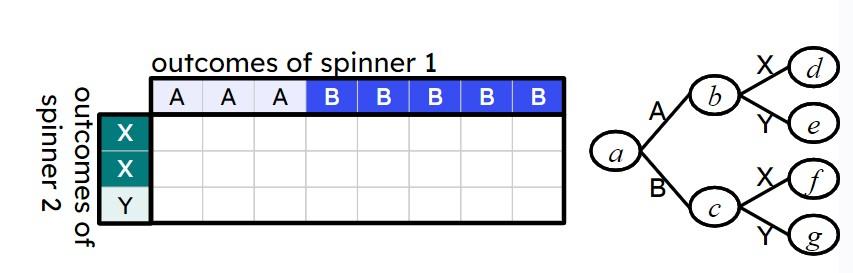
Q1.Two spinners are spun once each. The table shows the outcomes for each spinner. Match each value from the frequency tree to its value.

$$a$$ -
24
$$c$$ -
15
$$e$$ -
3
$$g$$ -
5
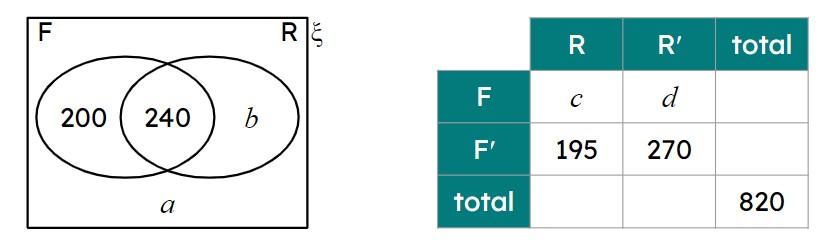
Q2.An investigation into some rhubarb plants aims to see if using a special fertiliser (F) increases the chance of the plant yielding rhubarb (R). The diagrams show the results. $$b$$ = .

Q3.An investigation into some rhubarb plants aims to see if using a special fertiliser (F) increases the chance of the plant yielding rhubarb (R). The diagrams show the results. $$c$$ = .

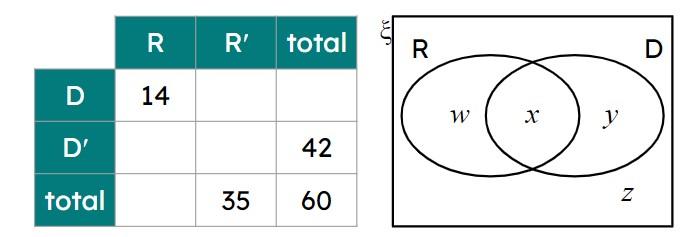
Q4.An investigation across 60 days explores whether days with rain (R) were more likely to see deer (D) in urban areas. The value of $$y$$ is .

Q5.An investigation across 60 days explores whether days with rain (R) were more likely to see deer (D) in urban areas. The value of $$z$$ is .

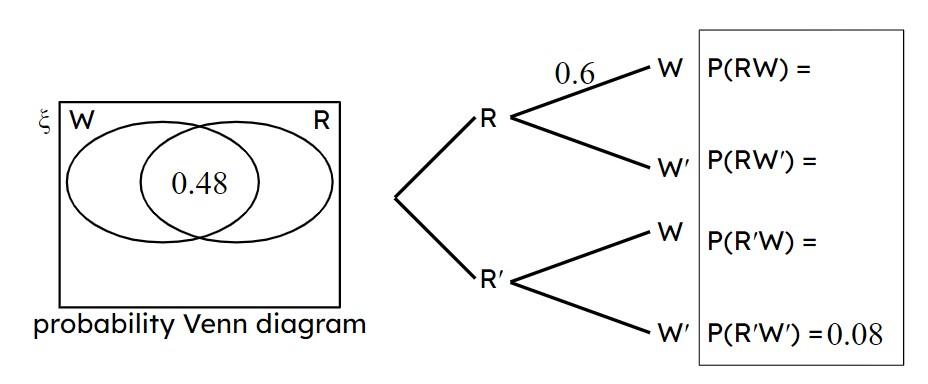
Q6.A game developer tested to see whether a playable character was more likely to win (W) with a rebalance (R) of the character’s stats or not. P(R'W) = .

Assessment exit quiz
6 Questions
Q1.There are 4 children sat around one table and 8 children sat around another table. The teacher chooses 1 child from each table. In how many different ways could the teacher do this?
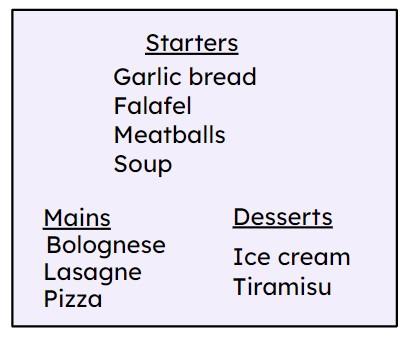
Q2.Here is a restaurant menu for three courses. A customer can choose one starter, one main course and one dessert in different ways.

Q3.The restaurant runs out of tiramisu. A customer can choose one starter, one main course and one dessert in different ways now.

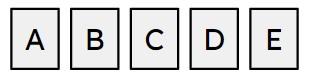
Q4.Alex has a pack of 5 cards. He deals one card to himself and deals one card to Sam. In how many different ways can this happen?

Q5.Izzy has a pack of 7 cards. She takes 2 cards at random from the pack. In how many different ways can this happen?

Q6.Alex draws 2 different cards from set A and 2 different cards from set B. There are different ways of doing this.