


New
New


Lesson 6 of 10
New
New
- Year 9
Levers
I can identify levers and describe their purpose and how they work.
Lesson details
Key learning points
- Levers can multiply a small force into a larger force.
- Levers can multiply a small movement into a larger movement.
- There are different types of lever, each with the pivot in a different position.
Keywords
Lever - A lever is a simple machine designed to use the turning effect of a force.
Effort - The force applied to a lever is called the effort.
Load - The force produced by a lever is called the load.
Pivot - A lever will rotate around a pivot.
Force multiplier - If a lever produces a larger load force than the effort force, it is a force multiplier.
Common misconception
Pupils confuse the term moment with ideas about time or movement.
Use the term ‘turning effect’ in this lesson whilst ideas are being introduced and consolidated.
Pupils should try out as many types of lever as are available, identifying the load, effort and pivots.

Teacher tip

Equipment

Licence
This content is © Oak National Academy Limited (2026), licensed on Open Government Licence version 3.0 except where otherwise stated. See Oak's terms & conditions (Collection 2).
Lesson video
Loading...
Prior knowledge starter quiz
6 Questions
Q1.The point at which a lever rotates called the .
The point at which a lever rotates called the .
Q2.Which of the following act as levers?
Which of the following act as levers?
springs
ropes
Q3.Why is it easier to steer a bicycle with wide handlebars rather than one with narrower handlebars?
Why is it easier to steer a bicycle with wide handlebars rather than one with narrower handlebars?
the grips will be better
the effort force will be closer from the pivot
they are more aerodynamic
the pivot is closer to the centre
Q4.A lever that produces a larger load force than the effort force is called a force .
A lever that produces a larger load force than the effort force is called a force .
Q5.Why does a spanner acts as a force multiplier?
Why does a spanner acts as a force multiplier?
The grip holds the bolt tightly so it does not slip.
The effort force is closer to the pivot than the load force.
The handle makes the spanner easy to grip so a large force is produced.
Q6.A screwdriver is being used to open a tin of paint. Which statements are correct?
A screwdriver is being used to open a tin of paint. Which statements are correct?
The effort force is very close to the pivot.
The effort and load forces must be equal and opposite.
Assessment exit quiz
6 Questions
Q1.Match the key words with the explanations.
Match the key words with the explanations.

Q2.Where is the pivot on a wheelbarrow?
Where is the pivot on a wheelbarrow?
where the soil is placed
close to the handle bars
at the point where the wheel touches the floor
Q3.The figure shows an open door. Which statement is correct?
The figure shows an open door. Which statement is correct?
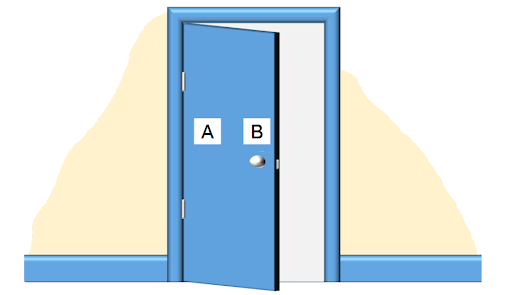
A smaller force is needed to close the door pushing at A instead of B.
The same size force is needed to close the door pushing at A and at B.
The door is most easily closed by pushing very close to the hinges.
Q4.What term is used for a lever that produces a larger load force than the effort force applied?
What term is used for a lever that produces a larger load force than the effort force applied?
a force producer
a force increaser
a force adder
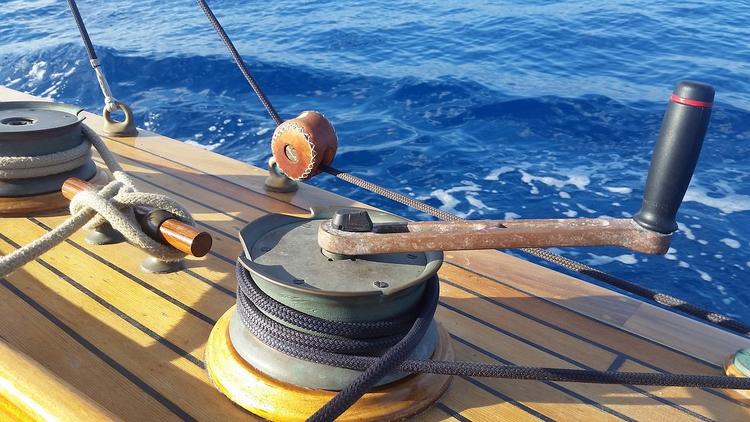
Q5.The figure shows a winch used to pull on a rope. The winch is operated by pulling the handle around the pivot in the middle.
Which feature make this lever a force multiplier?
The figure shows a winch used to pull on a rope. The winch is operated by pulling the handle around the pivot in the middle.
Which feature make this lever a force multiplier?
It rotates easily.
The effort force is applied close to the pivot.
The load force is produced a large distance from the the pivot.
Q6.How can the load force produced by a crowbar be increased?
How can the load force produced by a crowbar be increased?

decreasing the distance from the effort force to the pivot
increasing the distance from the load force to the pivot
