


Calculate change when purchasing several items


Lesson details
Learning outcome
I can calculate change when purchasing more than one item.
Key learning points
- Calculating change can be thought of as finding the difference between the cost and the amount of money given.
- If you are buying several items, you can add the total cost and then find the change.
- If you are buying several items, you can subtract each item one at a time.
Keywords
Minuend - The minuend is the number being subtracted from.
Subtrahend - A subtrahend is a number subtracted from another.
Common misconception
Errors in column addition can occur when pupils fail to align their digits properly.
Encourage pupils to align their decimal points before setting out the rest of the calculation.
Teacher tip
Using a bar model when representing money problems involving change is an excellent way for pupils to conceptualise the problem, allowing them to see they can use addition as well as subtraction when calculating change.

Licence

Lesson video
Loading...
Prior knowledge starter quiz
6 Questions
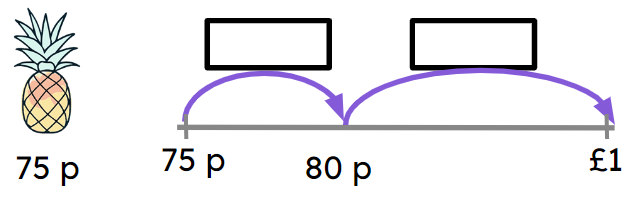
Q1.What is the change when paying for this item with a £1 coin? Use the number line to help you.
Q2.I buy a drink for 57 p. How much change do I receive from £1?
Q3.£1.99 + £3.50 =
Q4.I buy a sandwich that costs £2.35 and pay with a £10 note. How much change do I get from £10? Remember to write your answer using correct notation.
Q5.A book costs £10. I have saved £8.76. How much more do I need to save? Remember to write your answer using correct notation.
Q6.In the number sentence £10 − £2.50 = £7.50, which part is the subtrahend?
Assessment exit quiz
6 Questions
Q1.Match the parts of the number sentence with the correct definitions. £5 − £3 = £2

Q2.Use the subtracting and subtracting again strategy to solve this problem: Andeep had £5. He bought some sweets for 30 p and a comb for 50 p. How much money has he got left?
Q3.Calculate the change I would receive from £5 if I bought one item for £1.70 and one for 55 p. Use the 'adding first' strategy. Remember to write your answer using correct notation.
Q4.Calculate the change I would receive from £10 if I bought one item for £5.55, one for £1.25 and one for 50 p. Use the 'adding first' strategy. Remember to write your answer using correct notation.
Q5.The class has raised £200 to spend on a party. They spend £41.82 on pizzas, £14.15 on drinks and £16.95 on decorations. How much do they have left to spend on the entertainment?
Q6.Andeep has £350 in his bank account. He buys a video game costing £39.99, a controller costing £29.99 and an online subscription costing £19.99. How much is left in his account?
To help you plan your 4 maths lesson on: Calculate change when purchasing several items, download all teaching resources for free and adapt to suit your pupils' needs...
To help you plan your 4 maths lesson on: Calculate change when purchasing several items, download all teaching resources for free and adapt to suit your pupils' needs.
The starter quiz will activate and check your pupils' prior knowledge, with versions available both with and without answers in PDF format.
We use learning cycles to break down learning into key concepts or ideas linked to the learning outcome. Each learning cycle features explanations with checks for understanding and practice tasks with feedback. All of this is found in our slide decks, ready for you to download and edit. The practice tasks are also available as printable worksheets and some lessons have additional materials with extra material you might need for teaching the lesson.
The assessment exit quiz will test your pupils' understanding of the key learning points.
Our video is a tool for planning, showing how other teachers might teach the lesson, offering helpful tips, modelled explanations and inspiration for your own delivery in the classroom. Plus, you can set it as homework or revision for pupils and keep their learning on track by sharing an online pupil version of this lesson.
Explore more key stage 2 maths lessons from the Money: apply efficient strategies when calculating with money unit, dive into the full primary maths curriculum, or learn more about lesson planning.