


Use the divisibility rules to find multiples of 3


Lesson details
Learning outcome
I know the divisibility rule for multiples of 3 and can use it with 3- and 4-digit numbers.
Key learning points
- Numbers that can be divided by 3 and leave no remainder are divisible by 3
- To find the digit sum of a number, add the digits in the number together so the digit sum of 17 is 1 + 7 which equals 8
- For a number to be divisible by three, the dgit sum of the number must be a divisible by 3
Keywords
Digit sum - The sum of the digits of a number is called its digit sum.
Divisible / Divisibility - Divisibility is when division of a number results in another whole number. A number is divisible by another if it can be shared exactly with no remainder.
Multiple - A multiple is the result of multiplying a number by another whole number.
Common misconception
Lack of understanding of key terms such as: 'digit,' 'number.'
Explain clearly the difference between the two key terms and encourage children to test the divisibility rule on both 3 digit and 4 digit numbers.
Teacher tip
Encourage children to test the divisibility rule starting with 2 digit numbers then moving on to 3 and 4 digit numbers. By this point fluency in 3 times tables will support children in solving these problems. Continue to chorally rehearse the 3 times tables.

Licence

Lesson video
Loading...
Prior knowledge starter quiz
6 Questions
Q1.What single number fits into this gap to make this correct? 15 ÷ 3 = ___
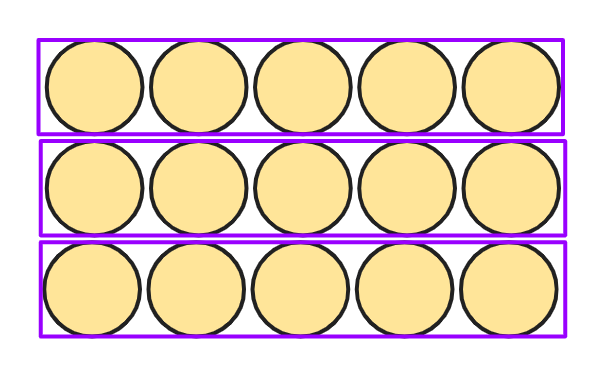
Q2.Order the multiples of 3 from the highest to lowest.
Q3.Identify the multiples of 3
Q4.Match the expressions to the products.

Q5.Andeep has 36 guinea cards and shares them between 3 friends. How many cards does each friend get?
Q6.A bakery has baked 270 cupcakes. They are packed into boxes of 3 Which calculations will help to solve this problem?
Assessment exit quiz
6 Questions
Q1.Select the multiples of 3
Q2.What is the digit sum for 249?
Q3.Match the numbers to their digit sum.
Q4.Is 3,021 a multiple of 3?
Q5.Is 6,413 a multiple of 3?
Q6.Is 432 a multiple of 3?
To help you plan your 4 maths lesson on: Use the divisibility rules to find multiples of 3, download all teaching resources for free and adapt to suit your pupils' needs...
To help you plan your 4 maths lesson on: Use the divisibility rules to find multiples of 3, download all teaching resources for free and adapt to suit your pupils' needs.
The starter quiz will activate and check your pupils' prior knowledge, with versions available both with and without answers in PDF format.
We use learning cycles to break down learning into key concepts or ideas linked to the learning outcome. Each learning cycle features explanations with checks for understanding and practice tasks with feedback. All of this is found in our slide decks, ready for you to download and edit. The practice tasks are also available as printable worksheets and some lessons have additional materials with extra material you might need for teaching the lesson.
The assessment exit quiz will test your pupils' understanding of the key learning points.
Our video is a tool for planning, showing how other teachers might teach the lesson, offering helpful tips, modelled explanations and inspiration for your own delivery in the classroom. Plus, you can set it as homework or revision for pupils and keep their learning on track by sharing an online pupil version of this lesson.
Explore more key stage 2 maths lessons from the Relationship between the 3 and 6 times tables and tests of divisibility unit, dive into the full primary maths curriculum, or learn more about lesson planning.