


Use the additive relationship to rearrange addition equations


Lesson details
Learning outcome
I can rearrange addition equations.
Key learning points
- Equations can be represented using part-part-whole or bar models.
- The sum is the whole and the addends are parts.
- Equations can be written starting with the addends or with the sum.
Keywords
Addend - An addend is a number added to another.
Sum - The the total when numbers are added together.
Equation - An equation shows that one number or calculation is equal to another.
Common misconception
Pupils may struggle starting equations with the sum. They may think = means 'the answer is..'
Ensure that children understand that 'equals' means that the equation balances (i.e. both sides have the same value.) This could be achieved through using balance scales and attaching the idea of equals with balance.
Teacher tip
Encourage pupils to use the terms 'sum' and 'whole' interchangeably. They should understand that an addend is a part. For extra challenge, pupils can find more than one answer to the open-ended problems in Task B, where they are only given the sum.

Licence

Lesson video
Loading...
Prior knowledge starter quiz
6 Questions
Q1.What is 15 + 10 =

Q2.What is 400 + 100 = ___
Q3.What is 5 + 3 + 5 =
Q4.What is 60 + 60 =
Q5.What is the missing number: 47 + 3 = ___
Q6.Which calculation gives the largest total?
Assessment exit quiz
6 Questions
Q1.What is the sum of 40 and 50?
Q2.What are the addends in this equation: 130 + 80 = 210
Q3.Which equations are represented by the bar model?
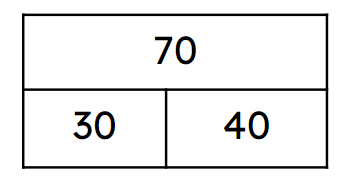
Q4.Look at the bar model. What is the missing sum?

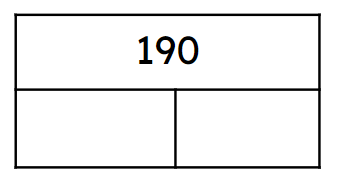
Q5.Which pairs of addends could complete the bar model?
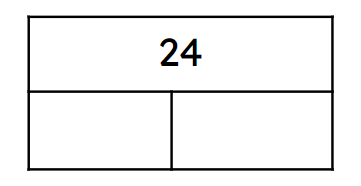
Q6.Which pairs of addends could complete the bar model?
To help you plan your 3 maths lesson on: Use the additive relationship to rearrange addition equations, download all teaching resources for free and adapt to suit your pupils' needs...
To help you plan your 3 maths lesson on: Use the additive relationship to rearrange addition equations, download all teaching resources for free and adapt to suit your pupils' needs.
The starter quiz will activate and check your pupils' prior knowledge, with versions available both with and without answers in PDF format.
We use learning cycles to break down learning into key concepts or ideas linked to the learning outcome. Each learning cycle features explanations with checks for understanding and practice tasks with feedback. All of this is found in our slide decks, ready for you to download and edit. The practice tasks are also available as printable worksheets and some lessons have additional materials with extra material you might need for teaching the lesson.
The assessment exit quiz will test your pupils' understanding of the key learning points.
Our video is a tool for planning, showing how other teachers might teach the lesson, offering helpful tips, modelled explanations and inspiration for your own delivery in the classroom. Plus, you can set it as homework or revision for pupils and keep their learning on track by sharing an online pupil version of this lesson.
Explore more key stage 2 maths lessons from the Understand additive relationships and apply them to rearrange equations unit, dive into the full primary maths curriculum, or learn more about lesson planning.