



Categories

Curriculum planning
3 February 2026Exploring the world with confidence: Oak’s Geography curriculum for primary and secondary classrooms

Graeme Schofield
Geography Subject Lead
Geography helps young people make sense of a rapidly changing world and their place in it. At Oak, we have developed a geography curriculum that gives teachers the confidence, time and tools to bring that world vividly to life.
Working with subject-expert organisations including the Geographical Association for key stages 1 to 3 and Geography Southwest for key stage 4, we have created a curriculum that draws on the latest thinking in geographical education and can be adapted to your pupils, your context and your classroom.
Explore the curriculum:
- Geography curriculum key stage 1-2
- Geography curriculum key stage 3-4 including GCSE AQA
- Geography curriculum key stage 3-4 including GCSE Edexcel B
Breadth and depth: a balanced geography curriculum
Oak’s geography curriculum balances thematic units with place-based studies to give pupils both a broad understanding of key geographical concepts and processes, and a deeper appreciation of the diversity within and between places.
For example, in key stage 2, pupils study topics such as settlement and mountains before applying these ideas to regions including Northern Italy and the Lake District.
In secondary, thematic units sit alongside regional studies such as China and the Middle East, helping pupils explore how physical and human processes shape different environments and lived experiences. This combination avoids simplified or single-story accounts and supports a more accurate understanding of the world.
Making sense of real-world issues
Powerful geography connects pupils’ understanding with real-world issues. Whether they are exploring an up-to-date case study such as the Myanmar earthquake or making a geographical decision about how to protect a community from river flooding, the Oak curriculum gives pupils meaningful opportunities to apply their knowledge to real situations.
This helps them see the relevance of geography and the value of the understanding they are developing. At key stage 4, dedicated lessons on geographical decision making support pupils to unpick complex issues and navigate them with confidence.
Geographical skills woven through every unit
Fieldwork from the very start
Developing geographical skills is crucial for enabling pupils to analyse spatial patterns and investigate the world for themselves. That is why fieldwork, mapwork and the use of GIS are woven through the curriculum from the very start.
Pupils begin developing fieldwork techniques in year 1, collecting simple data around the school grounds and using maps to help describe what they find. In key stage 2, pupils build on these foundations by using the fieldwork enquiry model in a range of contexts, for example, investigating how sustainable their school or local area is.
In the secondary curriculum, fieldwork lessons give pupils opportunities to investigate geographical processes and landscapes, helping them master a wider range of techniques and develop the confidence to carry out an enquiry independently.
GIS as a tool for geographical enquiry
Geographic Information Systems (GIS) are a powerful tool for geographical enquiry, so we have embedded their use throughout the curriculum. Maps from GIS platforms are used regularly in lessons to help pupils explain and interpret spatial patterns, and from key stage 2 onwards, units include GIS-focused lessons where accessible video modelling guides pupils through techniques step by step.
Whether they are planning for a holiday in a different time zone in year 6, visualising the geology of the UK in year 8 or analysing deforestation in year 10, pupils learn how GIS can deepen their understanding of place and geographical processes. This helps pupils use digital tools to think geographically and make sense of real-world patterns and processes.
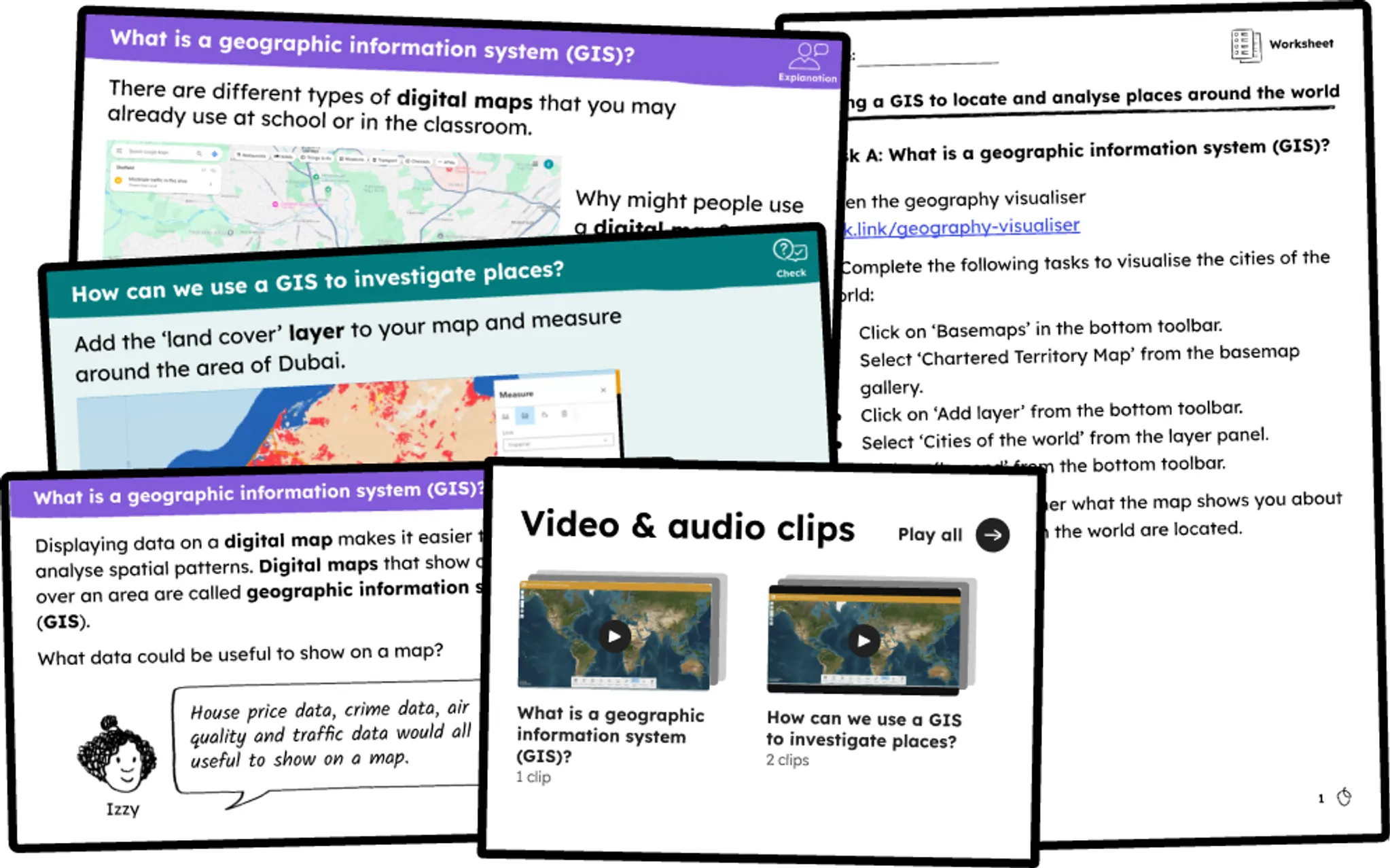
Resources from the year 7 lesson Using a GIS to locate and analyse places around the world from the unit Geography: what makes a geographer?
Climate change and sustainability as a central thread
Climate change has implications that touch every aspect of geography. This is why climate change and sustainability run as a central thread through our curriculum. The Curriculum and Assessment Review has highlighted the importance of these themes, and our curriculum already reflects this emphasis.
Units such as Sustainable world: does it matter how we live? in year 5 help pupils understand the concept of sustainability and how societies use and manage their resources.
Rather than teaching climate change as a stand-alone unit in key stage 3, we introduce the science of the greenhouse effect towards the end of our weather and climate unit so its impact can be explored across the curriculum. In regional units that focus on places such as India, pupils consider how climate change is affecting the country, and in thematic units that explore cities they investigate how rising temperatures and extreme weather are shaping urban environments.
Our final unit in year 9 focuses on the Anthropocene and considers whether humans have induced a new geological epoch through their collective environmental impact.
We recognise that learning about climate change can be overwhelming for young people. For this reason, we balance the curriculum carefully so pupils can see how more sustainable futures can be achieved through collective action, informed decision making and changes at different scales.
Resources you can shape to your context
Every Oak geography lesson is fully adaptable, giving teachers the flexibility to tailor content to their pupils and their place. Schools can adapt tasks to reflect their own local area, making links between pupils’ everyday experiences and the places studied in the curriculum. They can also adjust fieldwork activities to suit their environment or vary the level of challenge to meet different levels of prior knowledge. Teachers can use Oak’s lessons to fill gaps, strengthen existing schemes of work or build a coherent programme from scratch.
This flexibility supports teachers to deliver meaningful geography wherever they are, whether that means studying a local river, exploring the geography of a nearby city or carrying out fieldwork entirely within the school grounds. Oak’s geography curriculum encourages pupils to investigate, question and make sense of the complexities of our world. With rich resources, adaptable lessons, practical fieldwork and accessible GIS modelling, teachers are supported to deliver geography that is inspiring, accessible and rooted in real-world understanding.
Geography has never been more important, and Oak’s curriculum helps pupils build the understanding they need to make sense of a changing world. Use this form if you're interested to find out more about using our geography curriculum, or have questions, and we'll be in touch.