The origins of rock: rock ‘n’ roll


Copyrighted materials: to view and download resources from this lesson, you’ll need to be in the UK and
Lesson details
Learning outcome
I can identify the key features and can create a simple rock 'n' roll composition.
Key learning points
- Rock 'n' roll is an energetic style that developed in the 1950s from blues and country music.
- It incorporates key blues features including the 12-bar blues, walking bass and swing/shuffle rhythms.
- Driving rhythms and intense 'shouty' vocals help to give rock 'n' roll its distinctive style.
- Other key features include a fast tempo, vocal melodies with a small range of notes and a verse-chorus structure.
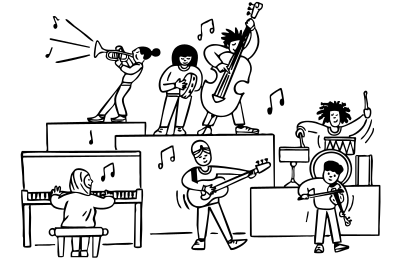
- Typical instrumentation includes vocals, electric guitar, piano, drum kit and bass guitar or double bass.
Keywords
Rock 'n' roll - Rock 'n' roll was an energetic style that developed in the 1950s from blues and country music.
Walking bass - A walking bass is a moving bass line that 'walks' up and down the notes of a chord.
Shuffle - A shuffle is a rhythmic pattern that uses swing quavers.
Driving rhythm - A driving rhythm is one that repeats fast notes to create a sense of energy.
Common misconception
Because rock 'n' roll often uses the 12-bar blues, this means it is just a type of blues.
Many styles use the 12-bar blues, including pop, rock, jazz and other styles. While rock 'n' roll is closely related to blues, its defining features are quite different, and its role as a commerical pop style is far from the origins of blues.
Teacher tip
This lesson can be the starting point for a rock 'n' roll composition for pupils if desired. Pupils could use the basic ideas as a basis for composition, adding melodic material, vocals and developing the texture and instrumentation.

Equipment
DAW and MIDI keyboard

Files needed for this lesson
Rock 'n' roll template 19.2 MB (ZIP)
Rock 'n' Roll guitar chords 1.1 MB (MP3)
Rock 'n' Roll walking bass 1.1 MB (MP3)
Rock 'n' Roll shuffle drum groove 1.1 MB (MP3)
Download these files to use in the lesson.
Licence

Sign in to continue
Our content remains 100% free, but to access certain copyrighted materials, you'll need to sign in. This ensures we’re both staying within the rules.
P.S. Signing in also gives you more ways to make the most of Oak like unit downloads!