


Risk factors for non-communicable diseases



Lesson details
Learning outcome
I can describe the effects of lifestyle factors on the incidence of non-communicable diseases at local, national and global levels.
Key learning points
- Risk factors affect the chance that a person will develop a non-communicable disease.
- Risk factors can be lifestyle factors, e.g. diet, smoking, environmental, e.g. air pollution, or genetic, e.g. alleles.
- Experiencing multiple factors can increase the likelihood a person will develop a particular disease.
- Interpreting data on non-communicable diseases and risk factors at local, national and global levels.
- The importance of peer review and communicating research on risk factors to a range of audiences.
Keywords
Non-communicable disease - a disease that cannot be passed from person to person
Risk factor - something that increases the chance of ill health
Correlation - a relationship or pattern between two or more variables
Peer review - a process of subjecting an author's work, research or ideas to the scrutiny of other experts in the same field
Common misconception
Pupils may think that any health claim by a product must be true.
Often no scientific research has been carried out on products claiming to be healthy.
Teacher tip
Whilst teaching the lesson, remind students that obesity levels are increasing year on year, nationally and globally.

Equipment
None required.

Content guidance
Depiction or discussion of sensitive content

Supervision
Adult supervision recommended

Licence

Lesson video
Loading...
Prior knowledge starter quiz
6 Questions
Q1.The instructions for an experiment or study are written in the ...
Q2.What is a risk factor?
Q3.True or false? A non-communicable disease can be passed from person to person.
Q4.Which diseases are non-communicable?
Q5.Which of the following are risk factors for heart disease?
Q6.True or false? Correlation is when one thing causes another.
Assessment exit quiz
6 Questions
Q1.Something that increases your chance of developing a disease is called a factor.
Q2.Match the risk factor to its type.

Q3.What is epidemiology the study of?
Q4.True or false? Eating more fibre is more likely to reduce the incidences of bowel cancer than eating less processed meat?
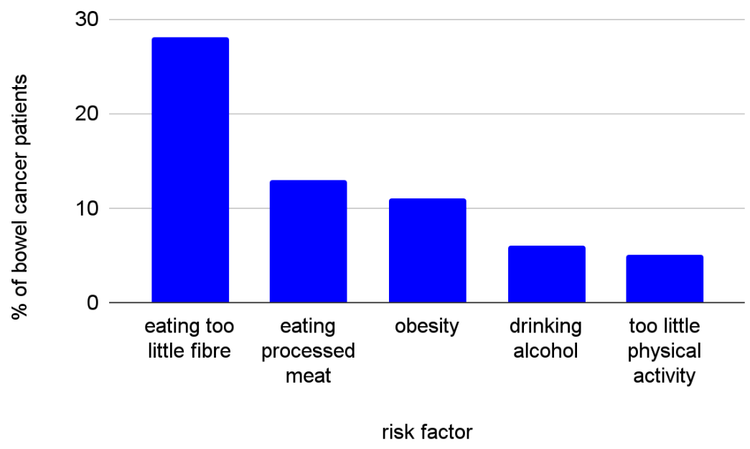
Q5.True or false? The more risk factors you have for a disease, the greater the chance of developing that disease.
Q6.What do peer reviewers check?
To help you plan your 10 biology lesson on: Risk factors for non-communicable diseases, download all teaching resources for free and adapt to suit your pupils' needs...
To help you plan your 10 biology lesson on: Risk factors for non-communicable diseases, download all teaching resources for free and adapt to suit your pupils' needs.
The starter quiz will activate and check your pupils' prior knowledge, with versions available both with and without answers in PDF format.
We use learning cycles to break down learning into key concepts or ideas linked to the learning outcome. Each learning cycle features explanations with checks for understanding and practice tasks with feedback. All of this is found in our slide decks, ready for you to download and edit. The practice tasks are also available as printable worksheets and some lessons have additional materials with extra material you might need for teaching the lesson.
The assessment exit quiz will test your pupils' understanding of the key learning points.
Our video is a tool for planning, showing how other teachers might teach the lesson, offering helpful tips, modelled explanations and inspiration for your own delivery in the classroom. Plus, you can set it as homework or revision for pupils and keep their learning on track by sharing an online pupil version of this lesson.
Explore more key stage 4 biology lessons from the Health and disease unit, dive into the full secondary biology curriculum, or learn more about lesson planning.