


Components of an ecosystem


Lesson details
Learning outcome
I can describe how changes in abiotic and biotic factors affect organisms in an ecosystem including how the size of predator and prey populations are cyclical.
Key learning points
- Ecosystems contain biotic and abiotic components.
- Changes in biotic and abiotic factors will affect communities within an ecosystem.
- Predators are consumers that eat prey.
- The population sizes of predators and prey increase and decrease in predator-prey cycles.
Keywords
Ecosystem - An ecosystem is made up of all the living organisms in a place, interacting with each other and their non-living surroundings.
Population - A group of organisms of the same type in the same place is called a population.
Community - A community is made up of all the organisms that live in the same place.
Biotic - Biotic factors are the living components of an ecosystem.
Abiotic - Abiotic factors are the non-living components of an ecosystem.
Common misconception
Varying the population size of an organism will not affect an ecosystem.
All organisms are important within an ecosystem. If one organism's population size changes, either as a result of a biotic factor (predation / disease) or an abiotic factor, it will affect all organisms within the ecosystem (to varying degrees).
Teacher tip
There are a number of simulations and role play activities that can be used to support pupils to understand how changes in populations of species can impact populations of other species.

Equipment
None.

Licence

Lesson video
Loading...
Prior knowledge starter quiz
6 Questions
Q1.The place where an organism lives which provides food, shelter and a place to reproduce is called a ...
Q2.Match the words with the correct definitions.

Q3.Which of the following organisms is a top predator in the food chain:
grass → rabbit → cat → owl.
Q4.How many consumers are in the following food chain?
Phtyoplankton → zooplankton → small fish → large fish → shark.
Q5.Ladybirds are eaten by birds. Birds are eaten by cats. Ladybirds eat greenfly. Greenfly eat lettuce. Which of the following is the correct food chain?
Q6.Match the word with the correct definition.
Assessment exit quiz
6 Questions
Q1.What is made up of all the living organisms in a place, interacting with each other and their non-living surroundings?
Q2.Which of the following are abiotic factors?
Q3.Which of the following are biotic factors?
Q4.Predators hunt and eat prey. As the number of prey individuals decreases, what will happen to the population of predators?
Q5.The greenfly population increases in summer when it is warm. This is because there is plenty of food so the greenfly reproduce quickly. Greenfly are food for ladybirds. Which statement is correct?
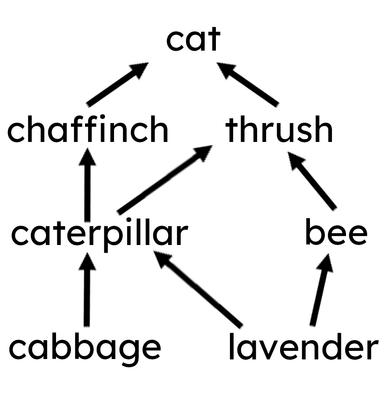
Q6.What will happen if the caterpillar population decreases?
To help you plan your 10 biology lesson on: Components of an ecosystem, download all teaching resources for free and adapt to suit your pupils' needs...
To help you plan your 10 biology lesson on: Components of an ecosystem, download all teaching resources for free and adapt to suit your pupils' needs.
The starter quiz will activate and check your pupils' prior knowledge, with versions available both with and without answers in PDF format.
We use learning cycles to break down learning into key concepts or ideas linked to the learning outcome. Each learning cycle features explanations with checks for understanding and practice tasks with feedback. All of this is found in our slide decks, ready for you to download and edit. The practice tasks are also available as printable worksheets and some lessons have additional materials with extra material you might need for teaching the lesson.
The assessment exit quiz will test your pupils' understanding of the key learning points.
Our video is a tool for planning, showing how other teachers might teach the lesson, offering helpful tips, modelled explanations and inspiration for your own delivery in the classroom. Plus, you can set it as homework or revision for pupils and keep their learning on track by sharing an online pupil version of this lesson.
Explore more key stage 4 biology lessons from the Living organisms and their environments unit, dive into the full secondary biology curriculum, or learn more about lesson planning.