


Producers, photosynthesis and consumers


Lesson details
Learning outcome
I can explain why the survival of consumers depends upon photosynthesis in producers.
Key learning points
- Producers use photosynthesis to make their own food in the form of glucose (a simple carbohydrate).
- Consumers can only get food by eating producers or other consumers; producers are the source of food for food chains.
- Consumers cannot use carbon and nitrogen from the environment to make biomass; they get them by eating producers.
- Producers and consumers use the carbohydrate from photosynthesis to make biomass for growth and as fuel for respiration.
- Consumers also depend upon producers to add oxygen to the atmosphere, which they use for aerobic cellular respiration.
Keywords
Producer - an organism that makes its own food
Photosynthesis - the process used by producers to make their own food via a series of chemical reactions
Biomass - the mass of biological material in one or more organisms
Cellular respiration - a chemical process that transfers energy for life processes, using glucose as a fuel
Consumer - an organism that eats other organisms for food
Common misconception
It is a common misconception that consumers (including humans) could survive without producers.
The dependence of consumers on photosynthesis in producers in explored in depth.
Teacher tip
Try to avoid teleology in pupils' thinking. Plants make food to keep themselves alive, not with any intention of feeding consumers. And they make oxygen as a waste product of photosynthesis, not with any intention of helping consumers to respire. But we evolved to make good use of these products!

Licence

Lesson video
Loading...
Prior knowledge starter quiz
6 Questions
Q1.Which word describes an organism that makes its own food?
Q2.Which organism in the food chain makes its own food?
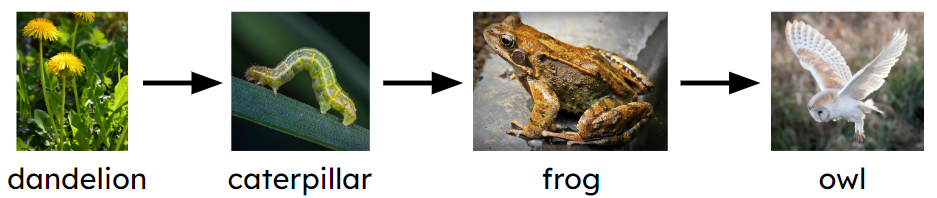
Q3.Which organisms in the food chain are carnivores?
Q4.Which organism in the food chain is a primary consumer?
Q5.Starting with the organism that makes its own food, put these organisms into the order they would appear in a food chain diagram.

Q6.What is the name of the chemical process that makes food in the cells of a producer?
Assessment exit quiz
6 Questions
Q1.Match each term to its correct meaning.

Q2.Photosynthesis in producers makes a sugar called glucose, which is a type of …
Q3.How do producers use the glucose they make?
Q4.Oxygen is added to the atmosphere by the process of in producers.
Q5.Humans are consumers. Where do consumers get the carbon they need to build biomass?
Q6.Plants are producers. Where do producers get the carbon they need to build biomass?

To help you plan your 10 biology lesson on: Producers, photosynthesis and consumers, download all teaching resources for free and adapt to suit your pupils' needs...
To help you plan your 10 biology lesson on: Producers, photosynthesis and consumers, download all teaching resources for free and adapt to suit your pupils' needs.
The starter quiz will activate and check your pupils' prior knowledge, with versions available both with and without answers in PDF format.
We use learning cycles to break down learning into key concepts or ideas linked to the learning outcome. Each learning cycle features explanations with checks for understanding and practice tasks with feedback. All of this is found in our slide decks, ready for you to download and edit. The practice tasks are also available as printable worksheets and some lessons have additional materials with extra material you might need for teaching the lesson.
The assessment exit quiz will test your pupils' understanding of the key learning points.
Our video is a tool for planning, showing how other teachers might teach the lesson, offering helpful tips, modelled explanations and inspiration for your own delivery in the classroom. Plus, you can set it as homework or revision for pupils and keep their learning on track by sharing an online pupil version of this lesson.
Explore more key stage 4 biology lessons from the Photosynthesis: requirements and products unit, dive into the full secondary biology curriculum, or learn more about lesson planning.