


The effect of light on water uptake by a plant: practical



Lesson details
Learning outcome
I can use a simple potometer to investigate the effect of light on water uptake by a plant.
Key learning points
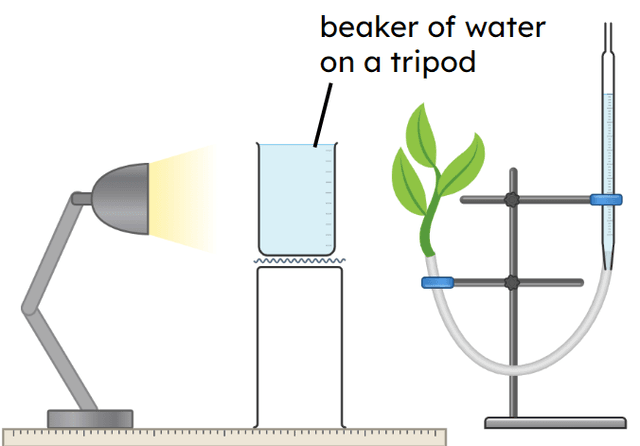
- Practical demonstration of the use of a simple potometer to measure water uptake by a leafy shoot.
- Use of a light source to vary light intensity.
- Use of appropriate apparatus to control temperature (e.g. a water tank as a heat shield between light and plant).
- Use of a simple potometer to measure water uptake by a plant at a range of light intensities.
- Rate of water uptake = change in volume of water ÷ time taken for volume to change
Keywords
Transpiration - the loss of water from a plant’s leaves
Potometer - a piece of equipment used to measure the rate of water uptake by a plant
Control - a variable which is kept constant between all experiments
Light intensity - the amount of light reaching a given area in a given time
Rate - a measure of how much change occurs per unit of time
Common misconception
Being able to explain the set up of a potometer is difficult because it has so many stages that are tricky.
The stages of setting up a potometer are broken down into four parts, checked for understanding, reinforced with a lab demonstration video and concluded with a cartoon task.
Teacher tip
Demonstrate the set up of a potometer, and perhaps if you have time, allow students to simulate parts or all of the set up process. Running the practical is optional, as it takes a while and can yield poor quality data.

Equipment
Optional: potometer, leafy shoot, clamps, clamp stand, large beaker, tripod, gauze, lamp, metre rule, timer.

Content guidance
Risk assessment required - equipment

Supervision
Adult supervision required

Licence

Lesson video
Loading...
Prior knowledge starter quiz
6 Questions
Q1.What do plants need to perform photosynthesis?

Q2.Which part of the plant is primarily responsible for water absorption?
Q3.What is the function of stomata in leaves?
Q4.What is transpiration?
Q5.What is the transportation stream?
Q6.How do you calculate the rate of a process?
Assessment exit quiz
6 Questions
Q1.What does a potometer measure?
Q2.How does light intensity affect the rate of water uptake in plants?
Q3.What is the formula to calculate the rate of water uptake?
Q4.Why is a beaker of water used in this experiment?
Q5.What are the roles of stomata in leaves?
Q6.During a potometer experiment lasting 20 minutes, the start reading was 0.5 cm³ and the end reading was 3.2 cm³. What is the rate of water uptake?
To help you plan your 11 biology lesson on: The effect of light on water uptake by a plant: practical, download all teaching resources for free and adapt to suit your pupils' needs...
To help you plan your 11 biology lesson on: The effect of light on water uptake by a plant: practical, download all teaching resources for free and adapt to suit your pupils' needs.
The starter quiz will activate and check your pupils' prior knowledge, with versions available both with and without answers in PDF format.
We use learning cycles to break down learning into key concepts or ideas linked to the learning outcome. Each learning cycle features explanations with checks for understanding and practice tasks with feedback. All of this is found in our slide decks, ready for you to download and edit. The practice tasks are also available as printable worksheets and some lessons have additional materials with extra material you might need for teaching the lesson.
The assessment exit quiz will test your pupils' understanding of the key learning points.
Our video is a tool for planning, showing how other teachers might teach the lesson, offering helpful tips, modelled explanations and inspiration for your own delivery in the classroom. Plus, you can set it as homework or revision for pupils and keep their learning on track by sharing an online pupil version of this lesson.
Explore more key stage 4 biology lessons from the Transport and exchange surfaces in plants unit, dive into the full secondary biology curriculum, or learn more about lesson planning.