


The role of the skin in thermoregulation


Lesson details
Learning outcome
I can describe the roles of various parts of the skin in controlling human body temperature.
Key learning points
- Human body temperature needs to be kept within a small range, around 37°C, to maintain body functions and health.
- Changes in the external environment can cause the internal body temperature to change.
- When temperature decreases, responses (erection of hairs, vasoconstriction) help to return body temperature to normal.
- When temperature increases, responses (sweating, vasodilation) help to return body temperature to normal.
Keywords
Vasoconstriction - The narrowing of blood vessels, reducing blood flow through them.
Insulation - A material that transfers energy by conduction very slowly or not at all.
Radiation - The process of emitting energy, often in the form of infrared waves, from an object.
Vasodilation - The widening of blood vessels, increasing blood flow through them.
Common misconception
Understanding why the physiological responses to higher or lower body temperatures occur is often confused, because although the processes themselves are familiar, the reasons behind them are not.
Detail has been included to explain carefully and one at a time the reasons for a range of physiological responses to high or low body temperature, and these are illustrated with clear, familiar diagrams.
Teacher tip
Apply water to skin and use a paper fan to show how evaporation removes heat from skin, then apply something warm, like a microwavable heat pad, to skin to show how hairs lie flat. Students will be familiar with these responses, so make sure you clearly emphasise the reasons behind them.

Equipment
None required.

Licence

Lesson video
Loading...
Prior knowledge starter quiz
6 Questions
Q1. is the maintenance of a constant, optimal internal environment in response to internal and external changes.
Q2.True or false? The skin is an organ.
Q3.Which important part of an enzyme can become misshapen when exposed to high temperatures?
Q4.What is radiation?
Q5.What is the optimum human body temperature?
Q6.How does the body react to a decrease in temperature?
Assessment exit quiz
6 Questions
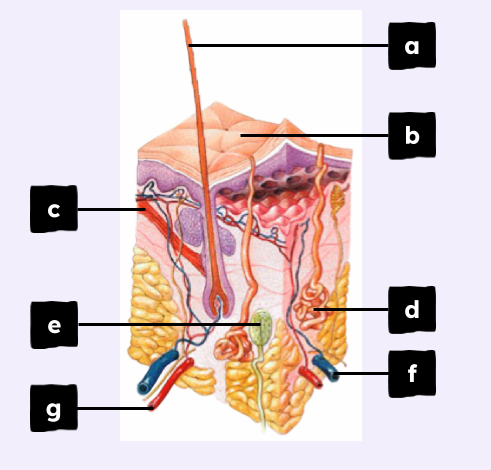
Q1.Match the label to the part of the skin.

Q2.True or false? Enzymes denature in hot and cold temperatures.
Q3.Which are the responses to an increase in body temperature?
Q4.Match the response to the effect it has.
Q5.The Oak pupils are discussing what happens when the human body gets too hot. Who is correct?




Q6.Which part of the skin produces sweat?
To help you plan your 11 biology lesson on: The role of the skin in thermoregulation, download all teaching resources for free and adapt to suit your pupils' needs...
To help you plan your 11 biology lesson on: The role of the skin in thermoregulation, download all teaching resources for free and adapt to suit your pupils' needs.
The starter quiz will activate and check your pupils' prior knowledge, with versions available both with and without answers in PDF format.
We use learning cycles to break down learning into key concepts or ideas linked to the learning outcome. Each learning cycle features explanations with checks for understanding and practice tasks with feedback. All of this is found in our slide decks, ready for you to download and edit. The practice tasks are also available as printable worksheets and some lessons have additional materials with extra material you might need for teaching the lesson.
The assessment exit quiz will test your pupils' understanding of the key learning points.
Our video is a tool for planning, showing how other teachers might teach the lesson, offering helpful tips, modelled explanations and inspiration for your own delivery in the classroom. Plus, you can set it as homework or revision for pupils and keep their learning on track by sharing an online pupil version of this lesson.
Explore more key stage 4 biology lessons from the Coordination and control: maintaining a constant internal environment unit, dive into the full secondary biology curriculum, or learn more about lesson planning.