


Enzymes: function, structure and specificity


Lesson details
Learning outcome
I can explain what an enzyme is and why the shape of an enzyme is important for how it works.
Key learning points
- Enzymes are proteins that act as catalysts, speeding up chemical reactions.
- Without enzymes, many reactions would happen too slowly to support life.
- Enzymes catalyse reactions essential to life, including digestion and reactions in photosynthesis and respiration.
- Each enzyme has a 3D shape with an active site that a specific substrate fits into.
- The lock and key model to explain enzyme-substrate interactions.
Keywords
Enzyme - A protein which acts as a biological catalyst.
Catalyst - A substance that speeds up the rate of a reaction without being used up.
Active site - The part of an enzyme where the substrate binds.
Substrate - The substance which is acted upon by the enzyme.
Model - Scientists use models as simpler representations of complex things and ideas.
Common misconception
That enzymes are used up in reactions, or that an enzyme can catalyse many different reactions.
Enzymes are not used up in the reactions that they catalyse, and that they can only catalyse one reaction, as explained by the lock and key hypothesis.
Teacher tip
If the part on activation energy is too complex, omit it from the lesson. Consider using plasticine modelling instead of drawing the labelled diagram, or having a number of padlocks and keys to try to sort out from each other.

Licence

Lesson video
Loading...
Prior knowledge starter quiz
6 Questions
Q1.What are the monomers of proteins?
Q2.Proteins are used in the body for and repair in the body.
Q3.What is a catalyst?
Q4.Scientists use as simpler representations of complex things and ideas.

Q5.Where do consumers in food webs get the nitrogen they need to make proteins?
Q6.True or false? Photosynthesis and respiration involve a series of chemical reactions.
Assessment exit quiz
6 Questions
Q1.Match each keyword to its meaning.

Q2.True or false? All enzymes are proteins.
Q3.Put the following steps in order to describe how an enzyme works.
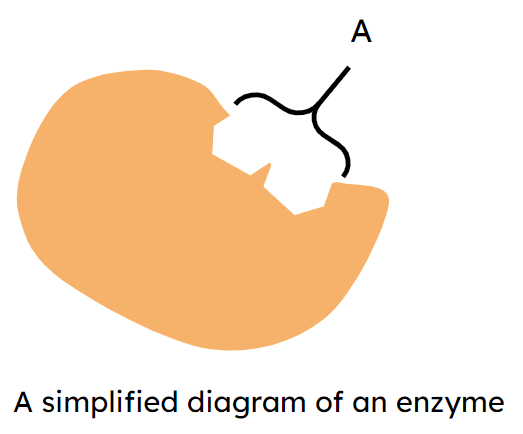
Q4.What part of the enzyme is A?
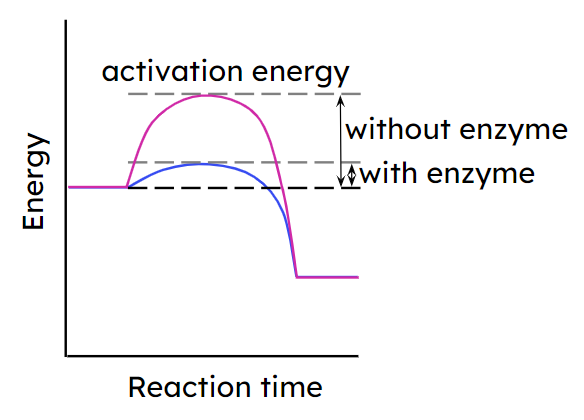
Q5.Who is correctly describing the effect of adding an enzyme on the activation energy of an enzyme controlled reaction?


Q6.In the lock and key model of enzyme action, what is the lock?
To help you plan your 10 biology lesson on: Enzymes: function, structure and specificity, download all teaching resources for free and adapt to suit your pupils' needs...
To help you plan your 10 biology lesson on: Enzymes: function, structure and specificity, download all teaching resources for free and adapt to suit your pupils' needs.
The starter quiz will activate and check your pupils' prior knowledge, with versions available both with and without answers in PDF format.
We use learning cycles to break down learning into key concepts or ideas linked to the learning outcome. Each learning cycle features explanations with checks for understanding and practice tasks with feedback. All of this is found in our slide decks, ready for you to download and edit. The practice tasks are also available as printable worksheets and some lessons have additional materials with extra material you might need for teaching the lesson.
The assessment exit quiz will test your pupils' understanding of the key learning points.
Our video is a tool for planning, showing how other teachers might teach the lesson, offering helpful tips, modelled explanations and inspiration for your own delivery in the classroom. Plus, you can set it as homework or revision for pupils and keep their learning on track by sharing an online pupil version of this lesson.
Explore more key stage 4 biology lessons from the Biological molecules and enzymes unit, dive into the full secondary biology curriculum, or learn more about lesson planning.