


Adapting a multistep chemical procedure for making a pure dry salt


Lesson details
Learning outcome
I can describe and explain adaptations to a multistage chemical procedure to alter or improve the quality of the product.
Key learning points
- Gently heating the acid speeds up the reaction, ensuring all acid reacts.
- The salt should be dried using an appropriate method (using filter paper, or in the oven).
- A pure sample should be prepared with equipment washed with distilled water to avoid contamination.
- Reacting a metal hydroxide with an acid also produces a salt and water.
- Reacting a metal carbonate with an acid can produce a desired salt with water, as well as carbon dioxide gas.
Keywords
Method - Describes how an experiment is carried out; it is a step-by-step procedure.
Apparatus - A piece of equipment that is designed for a particular use.
Evaluate - To evaluate something is to make a judgement about it with respect to a particular purpose.
Adapt - To make suitable for use or purpose, e.g. equipment or steps in an experimental procedure.
Common misconception
Pupils can sometimes mistake the excess base for the salt formed as it is a solid.
Emphasise at the beginning of the experiment what soluble means and that the salt will be initially obtained dissolved in water.
Teacher tip
Get the pupils to explain to each other why they are performing each step of the method. They need to understand why each step is performed.

Licence

Lesson video
Loading...
Prior knowledge starter quiz
6 Questions
Q1.What is a pure salt formed in a chemical reaction?
Q2.The chemical reaction between an acid and a metal oxide, which makes a salt and water, is an example of a reaction.
Q3.How do we know for sure that the reaction between an acid and an insoluble metal oxide is complete?
Q4.What is the general name given to a solid caught in filter paper after a filtration?
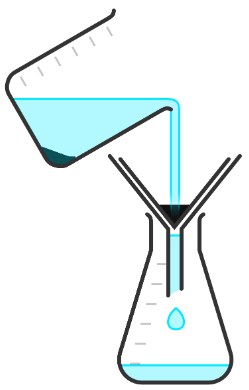
Q5.Evaporating water from a salt solution to leave a pure salt is called .
Q6.Match the following words, used to describe how to make pure salt samples, to their definitions.

Assessment exit quiz
6 Questions
Q1.What is the pH of a base?
Q2.What are the products of a reaction between a metal carbonate and an acid?
Q3.What are the main steps required to produce a pure salt when reacting a soluble base (alkali) with an acid?
Q4.What are the main steps required to produce a pure salt when reacting an insoluble base with an acid?
Q5.Adding an insoluble base to an acid in helps make sure that all of the acid has reacted to produce a neutral solution.
Q6.What helps to ensure that the salt produced in a reaction between an insoluble base and an acid is very pure?
To help you plan your 10 chemistry lesson on: Adapting a multistep chemical procedure for making a pure dry salt, download all teaching resources for free and adapt to suit your pupils' needs...
To help you plan your 10 chemistry lesson on: Adapting a multistep chemical procedure for making a pure dry salt, download all teaching resources for free and adapt to suit your pupils' needs.
The starter quiz will activate and check your pupils' prior knowledge, with versions available both with and without answers in PDF format.
We use learning cycles to break down learning into key concepts or ideas linked to the learning outcome. Each learning cycle features explanations with checks for understanding and practice tasks with feedback. All of this is found in our slide decks, ready for you to download and edit. The practice tasks are also available as printable worksheets and some lessons have additional materials with extra material you might need for teaching the lesson.
The assessment exit quiz will test your pupils' understanding of the key learning points.
Our video is a tool for planning, showing how other teachers might teach the lesson, offering helpful tips, modelled explanations and inspiration for your own delivery in the classroom. Plus, you can set it as homework or revision for pupils and keep their learning on track by sharing an online pupil version of this lesson.
Explore more key stage 4 chemistry lessons from the Making salts unit, dive into the full secondary chemistry curriculum, or learn more about lesson planning.