


Breaking and making bonds


Lesson details
Learning outcome
I can describe how bond making and breaking use or release energy.
Key learning points
- In all chemical reactions, bonds in the reactants need to be broken before the reaction can happen
- Energy must be supplied to break bonds in the reactants
- Energy is released when bonds in the products are formed
- The difference between the energy needed to break bonds and the energy released is the overall energy change
Keywords
Endothermic - An endothermic chemical reaction is a type of reaction in which energy is transferred from the surroundings to the products, e.g. photosynthesis.
Exothermic - An exothermic chemical reaction is a type of reaction in which energy is transferred from the reactants to the surroundings, e.g. combustion.
Activation energy - The minimum energy that the particles must have in order to react is known as the activation energy.
Common misconception
Pupils often confuse the ideas that bonds require energy to break i.e. endothermic process and that energy is released forming bonds i.e. exothermic process.
Bonds will not break unless energy is absorbed to do so. The formation of a bond releases energy to the surroundings.
Teacher tip
Use good examples of reactions and explain how the energy is provided to break the bonds and released making the bonds. Combustion is a good example as you provide energy to light the fuel and then energy is released as the reaction takes place.

Licence

Lesson video
Loading...
Prior knowledge starter quiz
6 Questions
Q1.What does an energy profile diagram show?

Q2.What occurs during a chemical reaction?
Q3.What is an exothermic reaction?
Q4.What is an endothermic reaction?
Q5.What is activation energy?
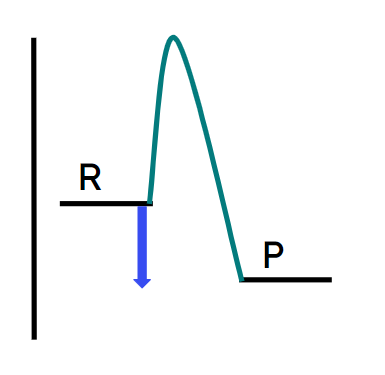
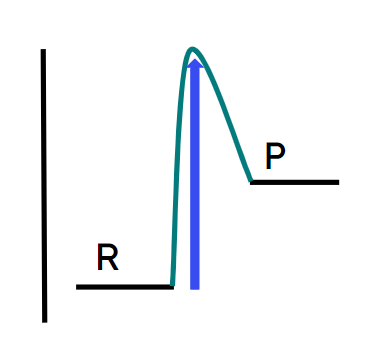
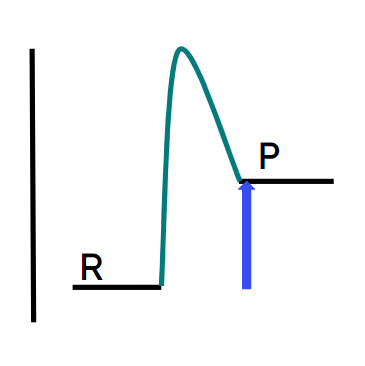
Q6.In which energy profile, does the blue arrow show the energy change of a exothermic reaction?
Assessment exit quiz
6 Questions
Q1.The overall energy change for an exothermic reaction is...
Q2.Photosynthesis absorbs 250 kJ of energy from the surroundings. Is this reaction endothermic or exothermic?
Q3.Given the following data: reactants energy = 200 kJ, products energy = 300 kJ, what is the overall energy change? Is the reaction endothermic or exothermic?
Q4.The decomposition of calcium carbonate requires 150 kJ of energy. What type of reaction is this?
Q5.Given the following data: reactants energy = 400 kJ, products energy = 250 kJ, what is the overall energy change? Is the reaction endothermic or exothermic?
Q6.During the combustion of methane, the reactants have an energy of 500 kJ and the products have an energy of 300 kJ. What is the overall energy change? Is the reaction endothermic or exothermic?
To help you plan your 10 chemistry lesson on: Breaking and making bonds, download all teaching resources for free and adapt to suit your pupils' needs...
To help you plan your 10 chemistry lesson on: Breaking and making bonds, download all teaching resources for free and adapt to suit your pupils' needs.
The starter quiz will activate and check your pupils' prior knowledge, with versions available both with and without answers in PDF format.
We use learning cycles to break down learning into key concepts or ideas linked to the learning outcome. Each learning cycle features explanations with checks for understanding and practice tasks with feedback. All of this is found in our slide decks, ready for you to download and edit. The practice tasks are also available as printable worksheets and some lessons have additional materials with extra material you might need for teaching the lesson.
The assessment exit quiz will test your pupils' understanding of the key learning points.
Our video is a tool for planning, showing how other teachers might teach the lesson, offering helpful tips, modelled explanations and inspiration for your own delivery in the classroom. Plus, you can set it as homework or revision for pupils and keep their learning on track by sharing an online pupil version of this lesson.
Explore more key stage 4 chemistry lessons from the Energy changes in reactions unit, dive into the full secondary chemistry curriculum, or learn more about lesson planning.