


What can communities do to help prevent crime?
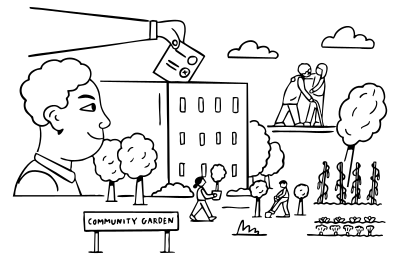


Lesson details
Learning outcome
I can explain what crime prevention strategies are and how communities use them to reduce crime and promote shared responsibility.
Key learning points
- There are different strategies that can be used to prevent crime, for example: educational, situational and deterrents.
- Educational crime prevention strategies reduce crime by educating people about the law and consequences of breaking it.
- Situational crime prevention strategies reduce crime by altering the situations in which crime can take place.
- Deterrents discourage people from committing crimes by making the consequences clear and the risks higher.
- Communities can use crime prevention strategies to reduce crime opportunities and foster shared responsibility.
Keywords
Crime - an illegal act that is punishable by law
Crime prevention strategy - a plan or set of actions designed to reduce the likelihood of crime occurring
Community - a group of people living in the same place or having a particular characteristic in common
Common misconception
Only the police can prevent crime.
Communities can also play a key role by using strategies like education, situational changes and deterrents to reduce crime and promote safety.
Teacher tip
Encourage pupils to think about real-world examples of crime prevention strategies in their own communities. This helps them connect the concepts to their lives and see the impact of community involvement in crime prevention.

Content guidance
Depiction or discussion of sensitive content
Depiction or discussion of peer pressure or bullying

Supervision
Adult supervision recommended

Licence

Lesson video
Loading...
Prior knowledge starter quiz
6 Questions
Q1.Complete the sentence: In England, information about youth crime goes from age up until the age of 17.
Q2.What am I describing? The different ways we share and receive information on a large scale; this includes things like television, radio, newspapers and the internet.
Q3.Match the sentence starter to its end.

Q4.Which of the following is not one of the actions suggested by the Hertsmere Young Researchers to tackle negative media perception of young people and crime?
Q5.Who am I describing? A public force that helps keep the community safe; they work to prevent and investigate crimes, enforce laws and maintain order in society.
Q6.Which of the following are the three main police powers used to tackle crime?
Assessment exit quiz
6 Questions
Q1.Match the sentence starter to the correct sentence end.
Q2.What am I describing? An illegal act that is punishable by law.
Q3.What am I describing? A group of people living in the same place or having a particular characteristic in common.
Q4.Which of the following best describes how communities can use crime prevention strategies?
Q5.Which of the following statements is true regarding crime prevention?
Q6.A youth mentoring programme could be an example of what type of crime prevention strategy?
To help you plan your 7 citizenship lesson on: What can communities do to help prevent crime?, download all teaching resources for free and adapt to suit your pupils' needs...
To help you plan your 7 citizenship lesson on: What can communities do to help prevent crime?, download all teaching resources for free and adapt to suit your pupils' needs.
The starter quiz will activate and check your pupils' prior knowledge, with versions available both with and without answers in PDF format.
We use learning cycles to break down learning into key concepts or ideas linked to the learning outcome. Each learning cycle features explanations with checks for understanding and practice tasks with feedback. All of this is found in our slide decks, ready for you to download and edit. The practice tasks are also available as printable worksheets and some lessons have additional materials with extra material you might need for teaching the lesson.
The assessment exit quiz will test your pupils' understanding of the key learning points.
Our video is a tool for planning, showing how other teachers might teach the lesson, offering helpful tips, modelled explanations and inspiration for your own delivery in the classroom. Plus, you can set it as homework or revision for pupils and keep their learning on track by sharing an online pupil version of this lesson.
Explore more key stage 3 citizenship lessons from the What is crime? unit, dive into the full secondary citizenship curriculum, or learn more about lesson planning.