


Factors affecting the rate of photosynthesis


Lesson details
Learning outcome
I can describe and explain the effects of various factors on the rate of photosynthesis.
Key learning points
- The rate of photosynthesis depends on factors including light, chlorophyll, water, temperature and carbon dioxide.
- A factor that when in short supply slows down or limits the rate of photosynthesis is called a limiting factor.
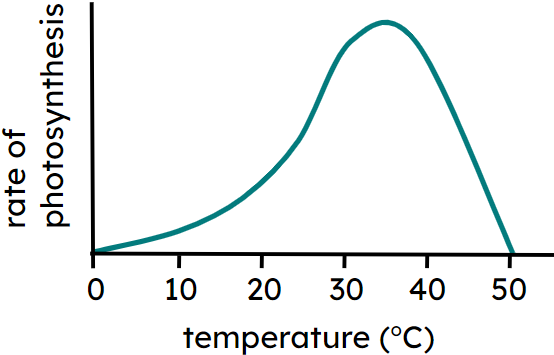
- Increased temperature increases photosynthesis rate up to the optimum (due to increased enzyme-substrate collisions).
- Above the optimum temperature, enzymes are denatured and rate of photosynthesis decreases.
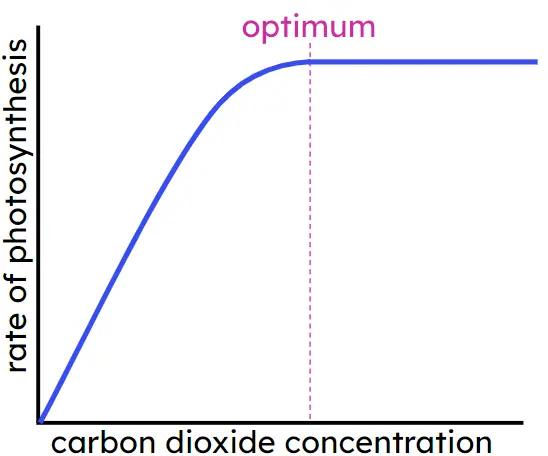
- Increased CO2 concentration increases rate of photosynthesis up to the optimum, when all enzyme active sites are full.
Keywords
Photosynthesis - The process used by producers to make their own food via a series of chemical reactions.
Rate - A measure of how much change occurs per unit of time.
Limiting factor - A condition that when in short supply slows down or limits the rate of photosynthesis.
Enzyme - A biological catalyst that speeds up a chemical reaction without itself being used up.
Optimum - The conditions where maximum rate of reaction occurs.
Common misconception
Students may mistakenly believe that only one factor can limit the rate of photosynthesis at any given time.
The lesson teaches that multiple factors, such as light intensity, carbon dioxide concentration, and temperature, can simultaneously influence the rate of photosynthesis.
Teacher tip
Pupils could develop their ideas about how they might design a greenhouse in a cold country to grow a tropical fruit or vegetable. Pupils would need to think about how to overcome limiting factors in their designs.

Equipment
None required.

Licence

Lesson video
Loading...
Prior knowledge starter quiz
6 Questions
Q1.Which of the following are reactants for photosynthesis?

Q2.What is the correct summary word equation for photosynthesis?
Q3.Where in the plant cell does photosynthesis occur?
Q4.What is the correct summary symbol equation for photosynthesis?
Q5.How is light energy absorbed by plants?
Q6.What effect does temperature have on enzyme activity?
Assessment exit quiz
6 Questions
Q1.What are the products of photosynthesis?
Q2.What is a limiting factor in photosynthesis?
Q3.What happens to the rate of photosynthesis at very high temperatures?
Q4.Why does the rate of photosynthesis decrease at high temperatures?
Q5.How does carbon dioxide concentration affect the rate of photosynthesis?
Q6.At carbon dioxide concentrations above the optimum, what limits the rate of photosynthesis?
To help you plan your 11 combined science lesson on: Factors affecting the rate of photosynthesis, download all teaching resources for free and adapt to suit your pupils' needs...
To help you plan your 11 combined science lesson on: Factors affecting the rate of photosynthesis, download all teaching resources for free and adapt to suit your pupils' needs.
The starter quiz will activate and check your pupils' prior knowledge, with versions available both with and without answers in PDF format.
We use learning cycles to break down learning into key concepts or ideas linked to the learning outcome. Each learning cycle features explanations with checks for understanding and practice tasks with feedback. All of this is found in our slide decks, ready for you to download and edit. The practice tasks are also available as printable worksheets and some lessons have additional materials with extra material you might need for teaching the lesson.
The assessment exit quiz will test your pupils' understanding of the key learning points.
Our video is a tool for planning, showing how other teachers might teach the lesson, offering helpful tips, modelled explanations and inspiration for your own delivery in the classroom. Plus, you can set it as homework or revision for pupils and keep their learning on track by sharing an online pupil version of this lesson.
Explore more key stage 4 combined science lessons from the Photosynthesis: factors affecting the rate unit, dive into the full secondary combined science curriculum, or learn more about lesson planning.