


Filtration


Lesson details
Learning outcome
I can describe how to carry out filtration and explain how it works.
Key learning points
- Filtration is a technique used to separate insoluble substances from a mixture with a liquid.
- Separation in filtration occurs due to the difference in size of particles.
- The terms 'filtrate' and 'residue' describe the components separated by the process of filtration.
Keywords
Filtration - Filtration is a technique to separate insoluble solids from a liquid by passing the mixture it is in through a filter.
Filtrate - A filtrate is the liquid component separated from a mixture as a result of filtration.
Residue - The insoluble component collected in the filter paper as a result of filtration is called the residue.
Component - A component refers to a part of something, e.g. a tyre on a car.
Common misconception
A funnel is the same as a filter.
A funnel streamlines movement, while a filter separates materials. Use everyday examples to highlight the difference, e.g. an oil funnel vs. an oil filter, or a coffee funnel vs. a coffee filter.
Teacher tip
Help pupils build science capital by linking to their understanding of filters in everyday life, e.g. sieves, colanders, tea bags, etc.

Equipment
See additional material.

Content guidance
Risk assessment required - equipment

Supervision
Adult supervision required

Licence

Lesson video
Loading...
Prior knowledge starter quiz
6 Questions
Q1.Which substances are insoluble (do not dissolve) in water?
Q2.A is a material that contains two or more different substances, which can be physically separated.
Q3.What mixture is formed when a substance dissolves in a liquid?
Q4.Match the following words to their meaning.

Q5.Which of the following are mixtures?
Q6.When a solid substance is insoluble, it can still form a mixture with a liquid. This mixture is called a ...
Assessment exit quiz
6 Questions
Q1.What is the purpose of filtration?
Q2.What do we call the liquid that passes through the filter in filtration?
Q3.What's the main difference between a funnel and a filter?
Q4.Place the steps of filtration in the correct order, starting with ensuring the mixture is thoroughly mixed.
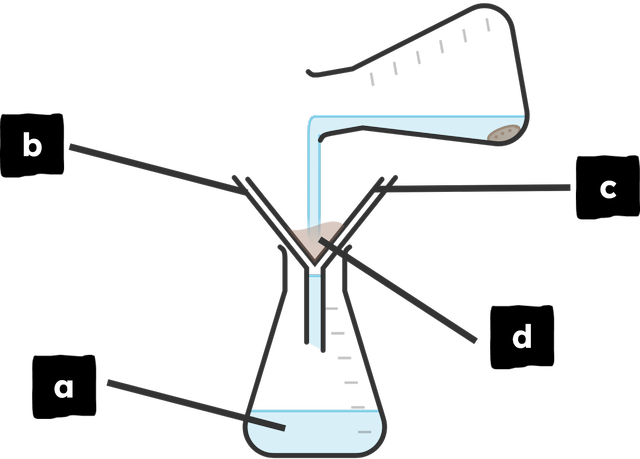
Q5.Match each label to the correct part of the diagram.
Q6.In filtration, the smallest particles will become part of the ...
To help you plan your 10 combined science lesson on: Filtration, download all teaching resources for free and adapt to suit your pupils' needs...
To help you plan your 10 combined science lesson on: Filtration, download all teaching resources for free and adapt to suit your pupils' needs.
The starter quiz will activate and check your pupils' prior knowledge, with versions available both with and without answers in PDF format.
We use learning cycles to break down learning into key concepts or ideas linked to the learning outcome. Each learning cycle features explanations with checks for understanding and practice tasks with feedback. All of this is found in our slide decks, ready for you to download and edit. The practice tasks are also available as printable worksheets and some lessons have additional materials with extra material you might need for teaching the lesson.
The assessment exit quiz will test your pupils' understanding of the key learning points.
Our video is a tool for planning, showing how other teachers might teach the lesson, offering helpful tips, modelled explanations and inspiration for your own delivery in the classroom. Plus, you can set it as homework or revision for pupils and keep their learning on track by sharing an online pupil version of this lesson.
Explore more key stage 4 combined science lessons from the Separating substances unit, dive into the full secondary combined science curriculum, or learn more about lesson planning.