


Tests for biological molecules


Lesson details
Learning outcome
I can carry out tests for biological molecules, including sugars, starch, proteins and lipids.
Key learning points
- A reagent called Benedict’s solution is used to test for reducing sugars, including glucose.
- A reagent called iodine solution is used to test for starch, a type of carbohydrate.
- A reagent called Biuret solution is used to test for protein.
- Ethanol (a type of alcohol) is used to test for lipids.
- Interpretation of qualitative food test results.
Keywords
Reagent - A chemical used to test for a type of biological molecule.
Qualitative - A test in which the result is based on an observation.
Quantitative - A test in which a measurement produces numerical data.
Common misconception
Mistakes on method, results confusion, and poor descriptions using inaccurate terminology.
Methods and results are described, demonstrated and tested throughout, and methods tried by pupils with results gathered and analysed. Repeated review of results occurs throughout the lesson, and methods and results are applied to novel questions.
Teacher tip
Allow the pupils to complete these practicals by themselves. Allow them to use coloured pencils to illustrate their note taking, and consider memory hooks like 'purple protein' to remember the test and its results.

Equipment
Distilled water, Benedict's solution, Biuret's solution, sodium hydroxide, iodine solution, ethanol, test/boiling tubes, bung, pipettes, 60ºC water bath, safety goggles.

Content guidance
Risk assessment required - equipment

Supervision
Adult supervision required

Licence

Lesson video
Loading...
Prior knowledge starter quiz
6 Questions
Q1.True or false? Proteins and carbohydrates are polymers.
Q2.Join the polymer to its monomer.

Q3.True or false? Enzymes are proteins.
Q4.Which of these is a use for lipids in an organism?
Q5.True or false? Animals store carbohydrate as glycogen.
Q6.What elements do carbohydrates contain?
Assessment exit quiz
6 Questions
Q1.Match the reagent to the nutrient it us used to test for?
Q2.What colour does iodine turn in the presence of starch?
Q3.What substance can be used to test for the presence of lipids?
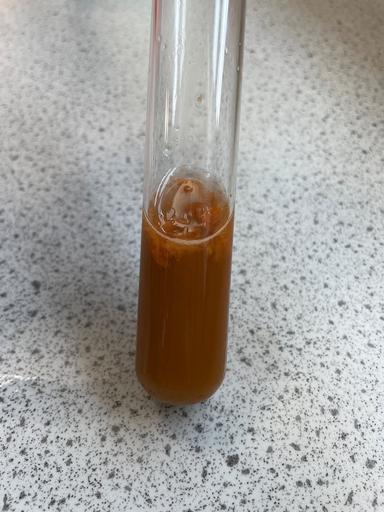
Q4.Is this a positive or a negative test for Benedict's solution?
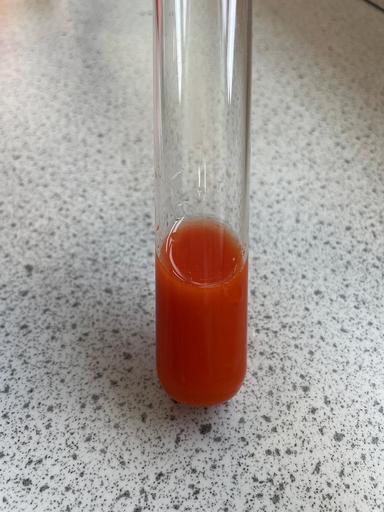
Q5.What colour does Biuret solution turn if it comes into contact with protein?
Q6.True or false? This food contains a small amount of reducing sugar?
To help you plan your 10 combined science lesson on: Tests for biological molecules, download all teaching resources for free and adapt to suit your pupils' needs...
To help you plan your 10 combined science lesson on: Tests for biological molecules, download all teaching resources for free and adapt to suit your pupils' needs.
The starter quiz will activate and check your pupils' prior knowledge, with versions available both with and without answers in PDF format.
We use learning cycles to break down learning into key concepts or ideas linked to the learning outcome. Each learning cycle features explanations with checks for understanding and practice tasks with feedback. All of this is found in our slide decks, ready for you to download and edit. The practice tasks are also available as printable worksheets and some lessons have additional materials with extra material you might need for teaching the lesson.
The assessment exit quiz will test your pupils' understanding of the key learning points.
Our video is a tool for planning, showing how other teachers might teach the lesson, offering helpful tips, modelled explanations and inspiration for your own delivery in the classroom. Plus, you can set it as homework or revision for pupils and keep their learning on track by sharing an online pupil version of this lesson.
Explore more key stage 4 combined science lessons from the Biological molecules and enzymes unit, dive into the full secondary combined science curriculum, or learn more about lesson planning.