


Development opportunities and challenges in the Kalahari Desert



Lesson details
Learning outcome
I can explain the opportunities and challenges of developing hot desert environments in the Kalahari Desert.
Key learning points
- The Kalahari Desert is an example of a hot desert.
- There are opportunities for development in the Kalahari Desert (mineral extraction, energy, farming, tourism).
- There are challenges for developing hot desert environments in the Kalahari (extreme temperatures, water supply).
Keywords
Arid - a climate with little to no rainfall
Indigenous - the people or animals that originally lived and may continue to live in a particular country or region
Mineral extraction - the process of removing valuable minerals from the earth
Tourism - the business of attracting and taking care of visitors to a place
Common misconception
Hot deserts are barren, lifeless areas with no real economic potential.
Deserts can have significant opportunities for economic development, for example mineral extraction, solar energy, tourism and irrigated farming.
Teacher tip
Set students the task of developing a fact file on this case study for homework, which they can then use for revision closer to the exam.

Licence

Lesson video
Loading...
Prior knowledge starter quiz
6 Questions
Q1.Less than how many millimetres of annual rainfall characterises a hot desert?
Q2.In a climate graph as shown, what type of graph displays rainfall?
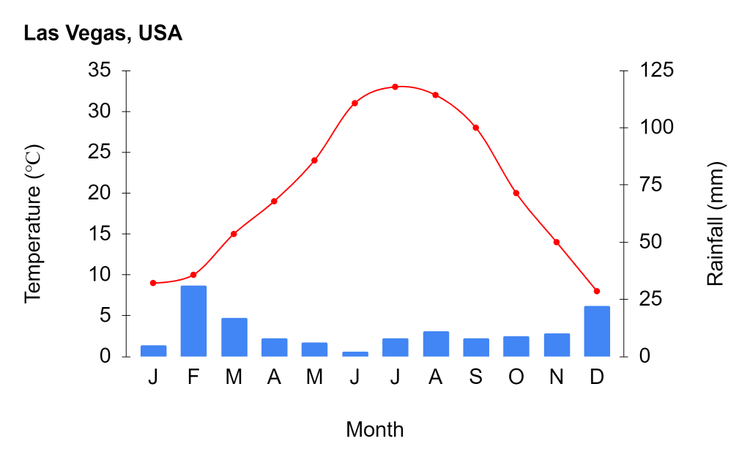
Q3.Looking at the climate graph of the desert in Las Vegas, identify the month which has the lowest rainfall.
Q4.Which industry would be involved in organising tours of hot deserts for people to photograph desert features and wildlife?
Q5.Which of these are positives of tourism in hot desert locations?
Q6.Which of these is a major challenge for human settlement in hot deserts?
Assessment exit quiz
6 Questions
Q1.Name the countries that the Kalahari desert is spread across.
Q2.Which of the following is a significant economic opportunity in the Kalahari Desert?
Q3.Which word means the people or animals that originally lived and may continue to live in a particular country or region?
Q4.Match each challenge in the Kalahari Desert with its impact on development.

Q5.Why does the Kalahari have such great potential for creating renewable energy such as solar power?
Q6.Which of the following is a key environmental challenge for development in the Kalahari Desert?
To help you plan your 10 geography lesson on: Development opportunities and challenges in the Kalahari Desert, download all teaching resources for free and adapt to suit your pupils' needs...
To help you plan your 10 geography lesson on: Development opportunities and challenges in the Kalahari Desert, download all teaching resources for free and adapt to suit your pupils' needs.
The starter quiz will activate and check your pupils' prior knowledge, with versions available both with and without answers in PDF format.
We use learning cycles to break down learning into key concepts or ideas linked to the learning outcome. Each learning cycle features explanations with checks for understanding and practice tasks with feedback. All of this is found in our slide decks, ready for you to download and edit. The practice tasks are also available as printable worksheets and some lessons have additional materials with extra material you might need for teaching the lesson.
The assessment exit quiz will test your pupils' understanding of the key learning points.
Our video is a tool for planning, showing how other teachers might teach the lesson, offering helpful tips, modelled explanations and inspiration for your own delivery in the classroom. Plus, you can set it as homework or revision for pupils and keep their learning on track by sharing an online pupil version of this lesson.
Explore more key stage 4 geography lessons from the Hot deserts unit, dive into the full secondary geography curriculum, or learn more about lesson planning.