Choose exam board for KS4 Computer Science (GCSE)
Choose exam board for KS4 English
Choose exam board for KS4 French
Choose exam board for KS4 Geography
Choose exam board for KS4 German
Choose exam board for KS4 History
Choose tier for KS4 Maths
Choose exam board for KS4 Music
Choose exam board for KS4 Physical education (GCSE)
Choose exam board for KS4 Religious education (GCSE)
Choose exam board for KS4 Spanish

Explain how to divide a non-unit fraction by a whole number
Lesson details

Learning outcome

I can explain how to divide a non-unit fraction by a whole number.

Key learning points

  1. Dividing a non-unit fraction by a whole number can be re-written as multiplying by a unit fraction.
  2. To divide a non-unit fraction by a whole number, you notice the denominator has been multiplied by the whole number.

Keywords

  • Represent - To represent something means to show something in a different way.

Common misconception

Pupils think the product is only the fraction of the shaded part and not the fraction of the original whole.

Ensure precision in wording when clarifying what the question is asking of each pupil. It is important they recognise how the shaded parts relates back to the original whole each time.

Teacher tip

This lesson extends on dividing a unit fraction by a whole number to dividing a non-unit fraction by a whole number. Identifying where the non-unit fraction is within each model is vital. Ensure time is spent creating and exploring area models that represent this.

Licence

This content is © Oak National Academy Limited (2025), licensed on Open Government Licence version 3.0
except where otherwise stated. See Oak's terms & conditions
(Collection 2).

Lesson video

Loading...

Prior knowledge starter quiz

6 Questions

Q1.
Tick the equivalent division equation for $$ {1} \over {4}$$ × $$ {1} \over {3}$$ = $$ {1} \over {12}$$

Correct answer: $$ {1} \over {4}$$ ÷ 3 = $$ {1} \over {12}$$
$$ {1} \over {4}$$ ÷ 4 = $$ {1} \over {12}$$
$$ {1} \over {3}$$ ÷ 3 = $$ {1} \over {12}$$
$$ {1} \over {12}$$ ÷ $$ {1} \over {4}$$ = $$ {1} \over {3}$$

Q2.
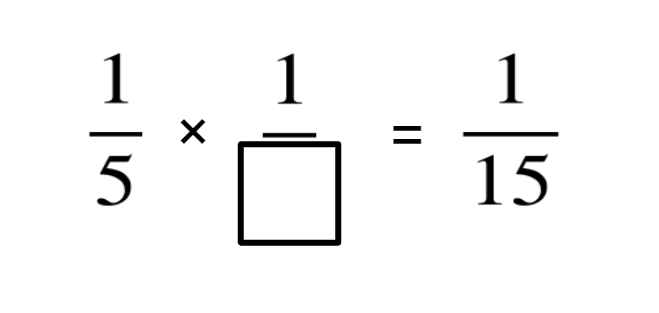
Use this equation to find the missing denominator:

An image in a quiz
Correct Answer: 3

Q3.
Tick the correct answer to the calculation $$ {1} \over {3}$$ ÷ 6 =

Correct answer: $$ {1} \over {18}$$
$$ {1} \over {9}$$
18
$$ {6} \over {3}$$

Q4.
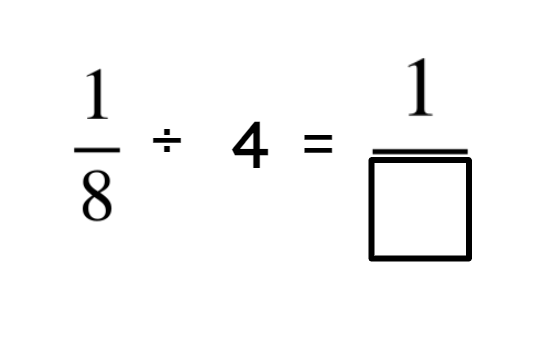
Write down the missing denominator.

An image in a quiz
Correct Answer: 32

Q5.
Tick the equivalent multiplication expression for $$ {1} \over {9}$$ ÷ 2

$$ {1} \over {9}$$ × 2
2 × $$ {1} \over {9}$$
Correct answer: $$ {1} \over {9}$$ × $$ {1} \over {2}$$
9 × 2

Q6.
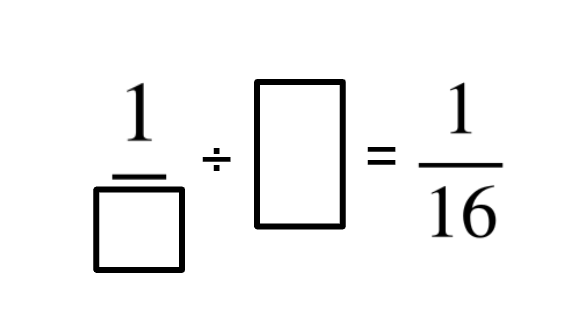
Tick the possible pairs of numbers that would make this equation correct:

An image in a quiz
2 and 3
3 and 4
Correct answer: 4 and 4
2 and 6
Correct answer: 8 and 2

6 Questions

Q1.
Tick the equivalent multiplication expressions for $$ {1} \over {4}$$ ÷ 2

Correct answer: $$ {1} \over {4}$$ × $$ {1} \over {2}$$
2 × $$ {1} \over {4}$$
Correct answer: $$ {1} \over {2}$$ × $$ {1} \over {4}$$
4 × 2

Q2.
Tick the equivalent multiplication expression for $$ {3} \over {4}$$ ÷ 2

Correct answer: $$ {3} \over {4}$$ × $$ {1} \over {2}$$
2 × $$ {3} \over {4}$$
$$ {3} \over {4}$$ × 2
34 × 2

Q3.
Tick the missing number $$ {4} \over {5}$$ × $$ {1} \over {3}$$ = $$ {4} \over {5}$$ ÷ ___

$$ {1} \over {3}$$
Correct answer: 3
4
13

Q4.
What is the result of $$ {2} \over {6}$$ ÷ 3?

$$ {2} \over {3}$$
$$ {2} \over {9}$$
Correct answer: $$ {2} \over {18}$$
$$ {6} \over {6}$$

Q5.
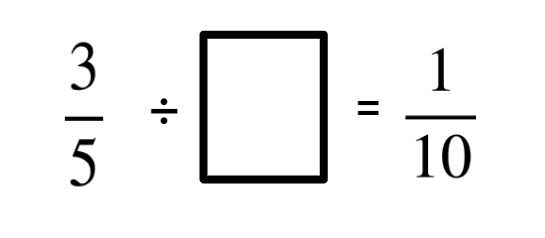
What is the missing divisor?

An image in a quiz
Correct Answer: 6

Q6.
Tick the possible answers. Jun walks for three-quarters of a mile. He listens to music for one-third of his walk. What fraction of a mile does Jun listen to music for?

$$ {3} \over {9}$$
Correct answer: $$ {3} \over {12}$$
$$ {1} \over {12}$$
Correct answer: $$ {1} \over {4}$$
$$ {3} \over {4}$$

To help you plan your 6 maths lesson on: Explain how to divide a non-unit fraction by a whole number, download all teaching resources for free and adapt to suit your pupils' needs...