Choose exam board for KS4 Computer Science (GCSE)
Choose exam board for KS4 English
Choose exam board for KS4 French
Choose exam board for KS4 Geography
Choose exam board for KS4 German
Choose exam board for KS4 History
Choose tier for KS4 Maths
Choose exam board for KS4 Music
Choose exam board for KS4 Physical education (GCSE)
Choose exam board for KS4 Religious education (GCSE)
Choose exam board for KS4 Spanish

      Explain how to multiply two unit fractions
      Lesson details

      Learning outcome

      I can explain how to multiply two unit fractions.

      Key learning points

      1. When you multiply by a unit fraction you find that fraction of the other factor.
      2. Multiplication can be represented by the word of.
      3. One-half multiplied by one-quarter is the same as one half of one-quarter.
      4. Multiplying by a proper fraction will give a product smaller than the value of the other factor.

      Keywords

      • Commutative - Commutative law states that you can write the values of a calculation in a different order without changing the calculation; the result is still the same. It applies for addition and multiplication.

      Common misconception

      Pupils procedurally multiply the numerators together and then multiply the denominators together to find the product.

      It's important pupils understand the magnitude of the fraction in relation to one another. Encourage pupils to draw images to represent each equation and notice that the magnitude of the product is decreasing in size each time.

      Teacher tip

      Whilst using language such as 'thirded' and 'fifthed' is not used commonly, it can be helpful to help describe how a number has been multiplied by a unit fraction with a 3 or a 5 as its denominator. It can also help demonstrate the commutativity of both fractions being multiplied together.

      Licence

      This content is © Oak National Academy Limited (2025), licensed on Open Government Licence version 3.0
      except where otherwise stated. See Oak's terms & conditions
      (Collection 2).

      Lesson video

      Loading...

      Prior knowledge starter quiz

      6 Questions

      Q1.
      35 is a common multiple of:

      1 and 2
      2 and 3
      4 and 5
      5 and 6
      Correct answer: 5 and 7

      Q2.
      Tick the factors of 24 in this list.

      Correct answer: 2
      Correct answer: 3
      Correct answer: 4
      5
      Correct answer: 6

      Q3.
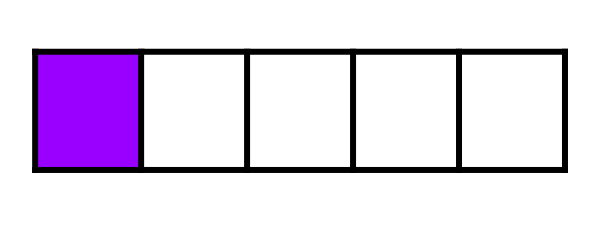
      What fraction of the whole has been shaded?

      An image in a quiz
      Correct answer: $$ {1} \over {5}$$
      $$ {1} \over {6}$$
      $$ {4} \over {5}$$
      $$ {4} \over {1}$$

      Q4.
      Tick the equations that exemplify the commutative law.

      Correct answer: 4 × 6 = 24
      4 × 3 × 2 = 24
      Correct answer: 6 × 4 = 24
      24 ÷ 4 = 6

      Q5.
      Tick the smallest fraction.

      $$ {3} \over {5}$$
      $$ {1} \over {5}$$
      $$ {7} \over {8}$$
      Correct answer: $$ {1} \over {7}$$

      Q6.
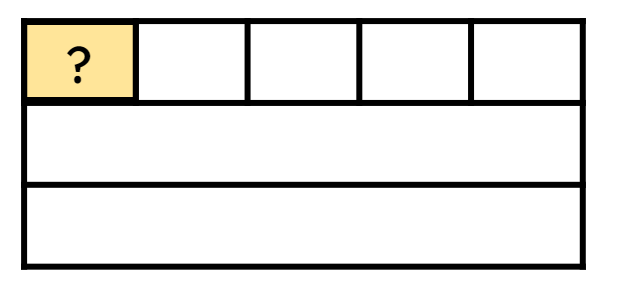
      The large rectangle is the whole. What fraction of the whole has been shaded?

      An image in a quiz
      $$ {1} \over {5}$$
      $$ {1} \over {7}$$
      $$ {1} \over {4}$$
      Correct answer: $$ {1} \over {15}$$

      6 Questions

      Q1.
      Which expressions could represent one-half of one-quarter?

      Correct answer: $$ {1} \over {2}$$ × $$ {1} \over {4}$$
      $$ {1} \over {2}$$ + $$ {1} \over {4}$$
      Correct answer: $$ {1} \over {4}$$ × $$ {1} \over {2}$$
      $$ {1} \over {4}$$ + $$ {1} \over {2}$$

      Q2.
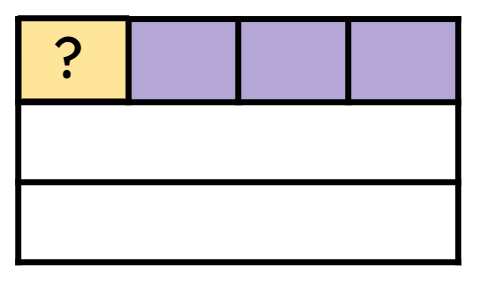
      Tick the equations that could represent this image.

      An image in a quiz
      Correct answer: $$ {1} \over {3}$$ × $$ {1} \over {4}$$ = $$ {1} \over {12}$$
      $$ {1} \over {12}$$ × $$ {1} \over {4}$$ = $$ {1} \over {12}$$
      $$ {1} \over {4}$$ × $$ {1} \over {3}$$ = $$ {1} \over {12}$$
      $$ {1} \over {4}$$ + $$ {1} \over {3}$$ = $$ {1} \over {12}$$

      Q3.
      To find the product of two unit fractions, you can _________.

      multiply the numerators
      add the numerators
      Correct answer: multiply the denominators
      add the denominators

      Q4.
      Tick the product of $$ {1} \over {5}$$ × $$ {1} \over {2}$$

      $$ {1} \over {20}$$
      Correct answer: $$ {1} \over {10}$$
      $$ {2} \over {7}$$
      $$ {2} \over {10}$$

      Q5.
      Tick the product of $$ {1} \over {6}$$ × $$ {1} \over {3}$$

      $$ {1} \over {9}$$
      $$ {2} \over {9}$$
      $$ {2} \over {18}$$
      Correct answer: $$ {1} \over {18}$$

      Q6.
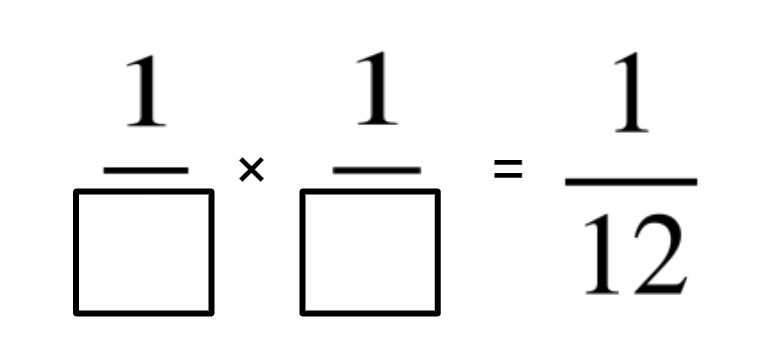
      What could the missing digits be?

      An image in a quiz
      2 and 3
      Correct answer: 3 and 4
      1 and 6
      Correct answer: 2 and 6
      12 and 2

      To help you plan your 6 maths lesson on: Explain how to multiply two unit fractions, download all teaching resources for free and adapt to suit your pupils' needs...