Choose exam board for KS4 Computer Science (GCSE)
Choose exam board for KS4 English
Choose exam board for KS4 French
Choose exam board for KS4 Geography
Choose exam board for KS4 German
Choose exam board for KS4 History
Choose tier for KS4 Maths
Choose exam board for KS4 Music
Choose exam board for KS4 Physical education (GCSE)
Choose exam board for KS4 Religious education (GCSE)
Choose exam board for KS4 Spanish

      Interior angles of a polygon

      Lesson details

      Learning outcome

      I can find the interior angle of any polygon.

      Key learning points

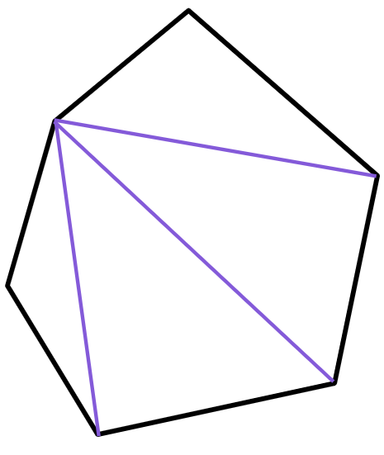
      1. Any polygon can be split into triangles.
      2. Using these triangles you can demonstrate the rule for the interior angle sum of a polygon.
      3. A missing interior angle in any polygon can be found.

      Keywords

      • Polygon - A polygon is a flat (2D), closed figure made up of straight line segments.

      • Interior angle - An interior angle is an angle formed inside a polygon by two of its edges.

      • Sum - The sum is the total when numbers are added together.

      Common misconception

      When splitting a polygon into triangles, pupils may draw line segments that cross inside the shape.

      By choosing a single common vertex for all the triangles, the line segments will not cross inside the shape.

      Teacher tip

      There are often many different ways of approaching a question. Encourage pupils to use words to explain their steps. Checking the angles all add up at the end can be a useful self-checking technique once all angles in a polygon are found.

      Licence

      This content is © Oak National Academy Limited (2025), licensed on Open Government Licence version 3.0
      except where otherwise stated. See Oak's terms & conditions
      (Collection 2).

      Lesson video

      Loading...

      Prior knowledge starter quiz

      6 Questions

      Q1.
      An angle is an angle formed inside a polygon by two of its edges.

      acute
      alternate
      exterior
      Correct answer: interior
      obtuse

      Q2.
      The interior angles of a triangle sum to °.

      Correct Answer: 180, one hundred and eighty

      Q3.
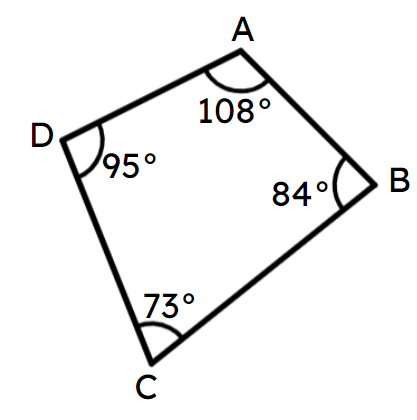
      What is the size of ∠ABC?

      An image in a quiz
      73°
      Correct answer: 84°
      95°
      108°

      Q4.
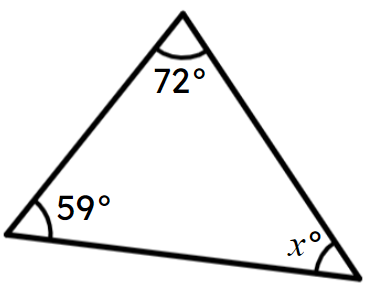
      What is the value of $$x$$? $$x=$$ .

      An image in a quiz
      Correct Answer: 49, forty-nine, 49 degrees, 49°, forty-nine degrees

      Q5.
      Starting with the smallest, sort the angles in ascending order of size.

      1 - acute
      2 - right angle
      3 - obtuse
      4 - reflex

      Q6.
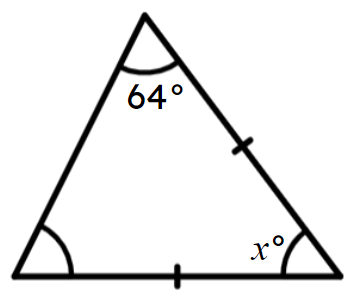
      What is the size of the angle $$x$$°?

      An image in a quiz
      Correct answer: 52°
      58°
      64°

      6 Questions

      Q1.
      A pentadecagon has 15 sides. The minimum number of triangles that it could be split into is .

      Correct Answer: 13, thirteen

      Q2.
      An octadecagon has 18 sides. Which calculation would find the sum of its interior angles?

      Correct answer: $$16 \times 180$$
      $$18 \times 180$$
      $$20 \times 180$$

      Q3.
      The interior angles in the hexagon sum to °.

      An image in a quiz
      Correct Answer: 720, 720°

      Q4.
      The interior angles of a pentagon sum to °.

      Correct Answer: 540, five hundred and forty, 540°, five hundred and forty degrees

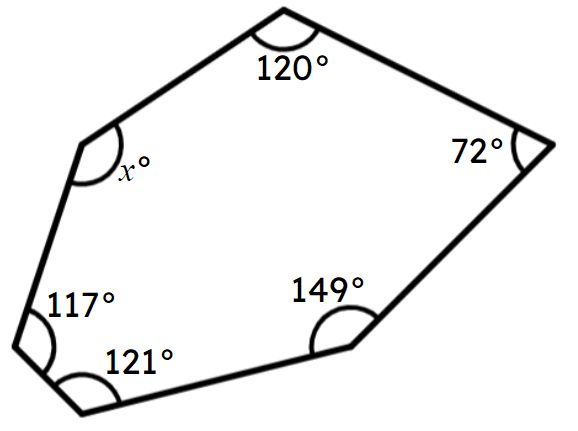
      Q5.
      The size of the angle $$x$$° is °.

      An image in a quiz
      Correct Answer: 141, one hundred and forty one, 141°, x=141, x = 141

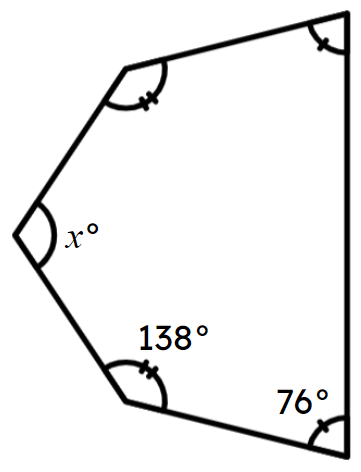
      Q6.
      The size of the angle $$x$$° is °.

      An image in a quiz
      Correct Answer: 112, one hundred and twelve, 112°, x=112, x = 112

      To help you plan your 8 maths lesson on: Interior angles of a polygon, download all teaching resources for free and adapt to suit your pupils' needs...