Myths about teaching can hold you back
- Year 8
Constructing scatter graphs by utilising technology
I can construct scatter graphs from data presented in a number of different ways using technology.
- Year 8
Constructing scatter graphs by utilising technology
I can construct scatter graphs from data presented in a number of different ways using technology.
Lesson details
Key learning points
- Scatter graphs can be constructed quickly using spreadsheets.
- Scatter graphs can be constructed quickly using Desmos.
- Changing which axis is used for which variable affects how the scatter graph appears.
Keywords
Scatter graph - A visual representation for bivariate data. It can be useful when determining the nature of the relationship between the two variables
Common misconception
Pupils may struggle to assign the correct variable to the y-axis when graphing on a spreadsheet.
Explain that the word "series" is used to mean the y-axis in this software.
To help you plan your year 8 maths lesson on: Constructing scatter graphs by utilising technology, download all teaching resources for free and adapt to suit your pupils' needs...
To help you plan your year 8 maths lesson on: Constructing scatter graphs by utilising technology, download all teaching resources for free and adapt to suit your pupils' needs.
The starter quiz will activate and check your pupils' prior knowledge, with versions available both with and without answers in PDF format.
We use learning cycles to break down learning into key concepts or ideas linked to the learning outcome. Each learning cycle features explanations with checks for understanding and practice tasks with feedback. All of this is found in our slide decks, ready for you to download and edit. The practice tasks are also available as printable worksheets and some lessons have additional materials with extra material you might need for teaching the lesson.
The assessment exit quiz will test your pupils' understanding of the key learning points.
Our video is a tool for planning, showing how other teachers might teach the lesson, offering helpful tips, modelled explanations and inspiration for your own delivery in the classroom. Plus, you can set it as homework or revision for pupils and keep their learning on track by sharing an online pupil version of this lesson.
Explore more key stage 3 maths lessons from the Graphical representations of data unit, dive into the full secondary maths curriculum, or learn more about lesson planning.
Licence
Lesson video
Loading...
Prior knowledge starter quiz
6 Questions
Q1.Which two options below are examples of spreadsheet software?
Q2.Which type of graph is a visual representation for bivariate data?
Q3.Which is another term to describe the response variable in bivariate data?
Q4.Which two terms describe a measure in bivariate data whose value is predicted to affect the other measure?
Q5.Which variable should be represented on the horizontal axis of a scatter graph?
Q6.A set of bivariate data measures hours of daylight in a day and maximum temperature for each day. Which variable is most likely to be the independent variable?
Assessment exit quiz
6 Questions
Q1.Google Sheets and Microsoft Excel are examples of software.
Q2.Which is a correct description for a scatter graph?
Q3.Which keyboard short cut allows you to copy data that has been highlighted in a spreadsheet?
Q4.When plotting a scatter graph on a spreadsheet, what do you need to select to edit the vertical axis?
Q5.What steps do you need to take to plot a scatter graph in Desmos, after you have inputted a set of bivariate data?
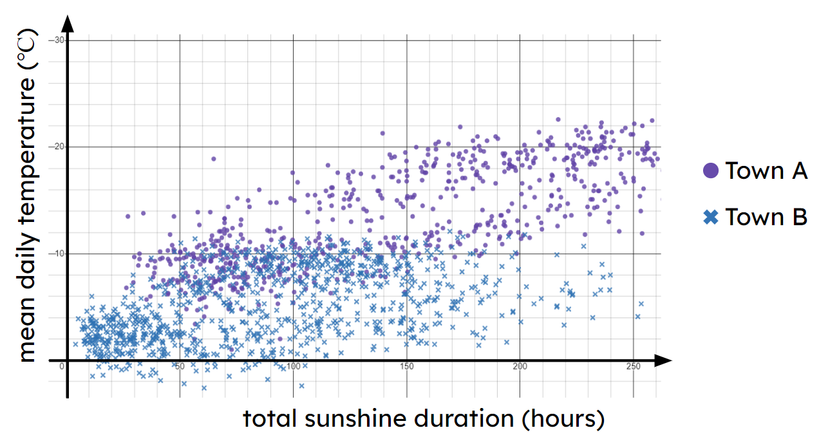
Q6.Look at the scatter graph. Which of the two towns tends to be warmer?