Choose exam board for KS4 Computer Science (GCSE)
Choose exam board for KS4 English
Choose exam board for KS4 French
Choose exam board for KS4 Geography
Choose exam board for KS4 German
Choose exam board for KS4 History
Choose tier for KS4 Maths
Choose exam board for KS4 Music
Choose exam board for KS4 Physical education (GCSE)
Choose exam board for KS4 Religious education (GCSE)
Choose exam board for KS4 Spanish

      Choosing the right trigonometric ratio
      Lesson details

      Learning outcome

      I can choose the appropriate trigonometric ratio to use to solve problems in right-angled triangles.

      Key learning points

      1. When selecting the appropriate trigonometric ratio, consider what information you have been given.
      2. When selecting the appropriate trigonometric ratio, consider what you are trying to find.
      3. If you do not have enough information, consider what you need and how you will get it.
      4. Trigonometric ratios involve two lengths and an angle.

      Keywords

      • Trigonometric ratios - The trigonometric ratios are ratios between each pair of lengths in a right-angled triangle.

      Common misconception

      Pupils may believe the horizontal edge of the triangle is always the adjacent.

      Emphasise that the labelling of the triangle is based around the focus angle and use right-angled triangles with various orientations.

      Teacher tip

      Encourage pupils to identify the given information before attempting the question. This will help them to consider which of the trigonometric ratios they can use and what they might need to answer the question in hand.

      Licence

      This content is © Oak National Academy Limited (2025), licensed on Open Government Licence version 3.0
      except where otherwise stated. See Oak's terms & conditions
      (Collection 2).

      Lesson video

      Loading...

      Prior knowledge starter quiz

      6 Questions
      Q1.
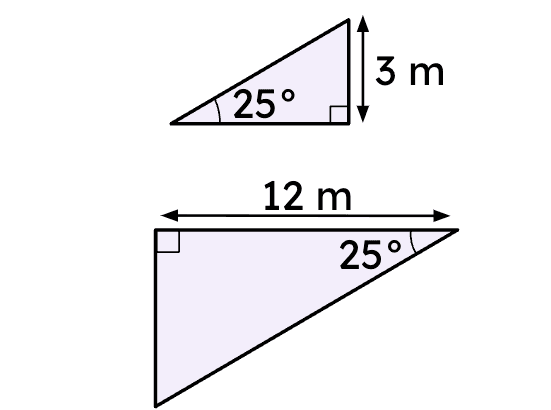
      Which of the following statements is true for these triangles?

      An image in a quiz
      Correct answer: The triangles are similar.
      The triangles are not similar.
      It is not possible to know whether the triangles are similar or not.

      Q2.
      What is the value of θ for tan(θ) = 1

      Correct answer: 45ᵒ
      90ᵒ
      30ᵒ
      0ᵒ

      Q3.
      What is cos(0ᵒ)?

      Correct answer: 1
      0
      undefined
      0.5

      Q4.
      What is sin(30ᵒ)?

      1
      0
      undefined
      Correct answer: 0.5

      Q5.
      For sin(xᵒ) = y, which of these statements is true?

      Correct answer: cos(90 - xᵒ) = y
      tan(90 - xᵒ) = y
      cos(yᵒ) = x
      tan(yᵒ) = x

      Q6.
      In a right triangle, if the hypotenuse is 50 cm and a second side is 30 cm, what is the area? (Use a calculator to help you.)

      $$700 cm^2 $$
      Correct answer: $$600 cm^2 $$
      $$900 cm^2 $$

      6 Questions

      Q1.
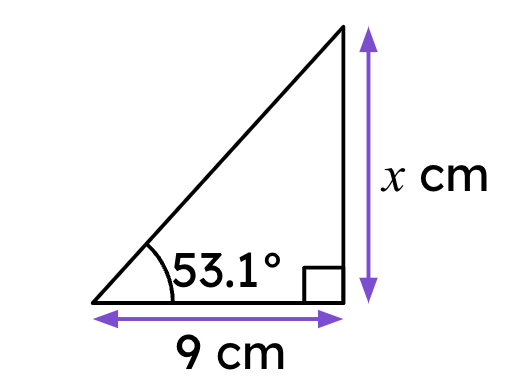
      Tick which approaches could be used to find $$x$$ without finding further sides or angles given the information provided in the diagram.

      An image in a quiz
      $$a^2+b^2=c^2$$
      There is not enough information to solve this problem.
      $$sin(θ)=\frac{opp}{hyp}$$
      $$cos(θ)=\frac{adj}{hyp}$$
      Correct answer: $$tan(θ)=\frac{opp}{adj}$$

      Q2.
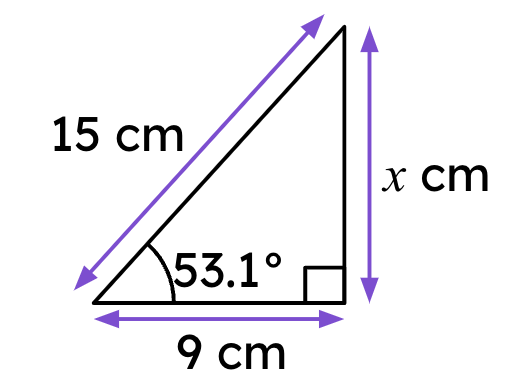
      Tick which approaches could be used to find $$x$$ given the information provided in the diagram.

      An image in a quiz
      Correct answer: $$a^2+b^2=c^2$$
      There is not enough information to solve this problem.
      Correct answer: $$sin(θ)=\frac{opp}{hyp}$$
      $$cos(θ)=\frac{adj}{hyp}$$
      Correct answer: $$tan(θ)=\frac{opp}{adj}$$

      Q3.
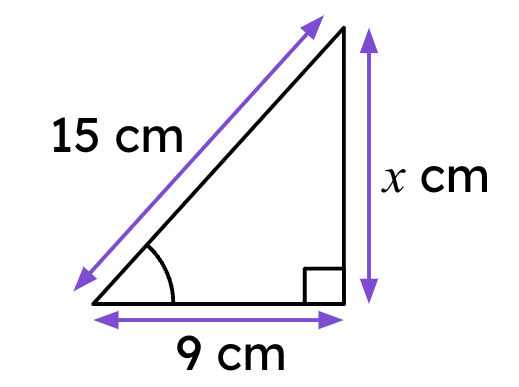
      Tick which approaches could be used to find $$x$$ without finding more angles and given the information provided in the diagram.

      An image in a quiz
      Correct answer: $$a^2+b^2=c^2$$
      There is not enough information to solve this problem.
      $$sin(θ)=\frac{opp}{hyp}$$
      $$cos(θ)=\frac{adj}{hyp}$$
      $$tan(θ)=\frac{opp}{adj}$$

      Q4.
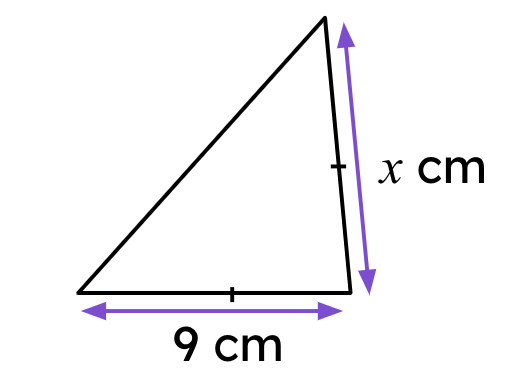
      Tick which approaches could be used to find $$x$$ given the information provided in the diagram.

      An image in a quiz
      $$a^2+b^2=c^2$$
      Correct answer: Basic properties of triangles
      $$sin(θ)=\frac{opp}{hyp}$$
      $$cos(θ)=\frac{adj}{hyp}$$
      $$tan(θ)=\frac{opp}{adj}$$

      Q5.
      Tick which approaches could be used to find the angle without finding the remaining side, given the information provided in the diagram.

      An image in a quiz
      $$a^2+b^2=c^2$$
      Correct answer: Basic properties of triangles
      $$sin(θ)=\frac{opp}{hyp}$$
      Correct answer: $$cos(θ)=\frac{adj}{hyp}$$
      $$tan(θ)=\frac{opp}{adj}$$

      Q6.
      Tick which approach is the simplest to find $$x$$ given the information provided in the diagram.

      An image in a quiz
      $$a^2+b^2=c^2$$
      Correct answer: Basic properties of triangles
      $$sin(θ)=\frac{opp}{hyp}$$
      $$cos(θ)=\frac{adj}{hyp}$$
      $$tan(θ)=\frac{opp}{adj}$$

      To help you plan your 9 maths lesson on: Choosing the right trigonometric ratio, download all teaching resources for free and adapt to suit your pupils' needs...