


Problem solving with further sequences


Lesson details
Learning outcome
I can use my enhanced knowledge of sequences to solve problems.
Key learning points
- Compound interest can be thought of as a geometric sequence.
- You can apply your knowledge of geometric sequences to solve compound interest problems.
Keywords
Interest - Interest is money added to savings or loans.
Compound interest - Compound interest is calculated on the original amount and the interest accumulated over the previous period.
Geometric sequence - A geometric sequence is a sequence with a constant multiplicative relationship between successive terms.
Common ratio - In a geometric sequence, the constant multiplier between successive terms is called the common ratio.
Common misconception
A multiplier of 1.3 is used to increase a value by 3%
A multiplier of 1.3 is used to increase a value by 30%
Teacher tip
The final question in Task B has a large version of Pascal's triangle on the final page of the worksheet. This could be printed and laminated to allow pupils to investigate shading the triangle without each pupil needing multiple copies of the triangle.

Licence

Lesson video
Loading...
Prior knowledge starter quiz
6 Questions
Q1.Interest which is calculated on the original amount and the interest accumulated over the previous period is called __________ interest.
Q2.Match the type of sequence with its description.

Q3.Which of these could be the first 5 terms in an arithmetic sequence?
Q4.Which of these could be the first 5 terms in a geometric sequence?
Q5.If a geometric sequence starts 20, 60, 180, ... what is the common ratio (common multiplier)?
Q6.If a geometric sequence starts 50, 60, 72, ... what is the common ratio? Give your answer as a decimal.
Assessment exit quiz
6 Questions
Q1.What type of sequence has been shaded on Pascal's triangle?
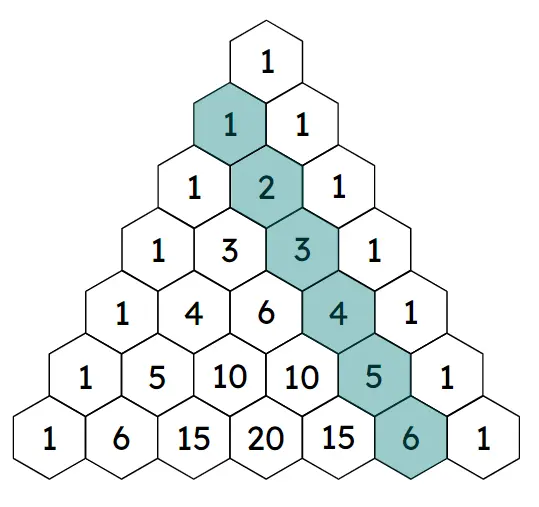
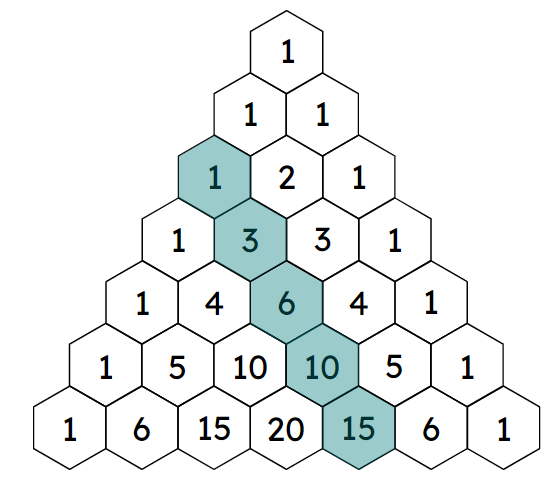
Q2.Which of these best describes the sequence of numbers shaded on Pascal's triangle?
Q3.£24 000 is borrowed at a compound interest rate of 5% a month. How much is owed after 3 months?
Q4.£800 is borrowed with yearly compound interest and after a year £1040 is owed. What is the yearly interest rate?
Q5.A loans company charges 6% interest a month. If £2650 was owed after one month, how much was borrowed?
Q6.£750 was borrowed with compound interest and after 2 years making no repayments £1080 was owed. What was the yearly interest rate?
To help you plan your 11 maths lesson on: Problem solving with further sequences, download all teaching resources for free and adapt to suit your pupils' needs...
To help you plan your 11 maths lesson on: Problem solving with further sequences, download all teaching resources for free and adapt to suit your pupils' needs.
The starter quiz will activate and check your pupils' prior knowledge, with versions available both with and without answers in PDF format.
We use learning cycles to break down learning into key concepts or ideas linked to the learning outcome. Each learning cycle features explanations with checks for understanding and practice tasks with feedback. All of this is found in our slide decks, ready for you to download and edit. The practice tasks are also available as printable worksheets and some lessons have additional materials with extra material you might need for teaching the lesson.
The assessment exit quiz will test your pupils' understanding of the key learning points.
Our video is a tool for planning, showing how other teachers might teach the lesson, offering helpful tips, modelled explanations and inspiration for your own delivery in the classroom. Plus, you can set it as homework or revision for pupils and keep their learning on track by sharing an online pupil version of this lesson.
Explore more key stage 4 maths lessons from the Further sequences unit, dive into the full secondary maths curriculum, or learn more about lesson planning.