Choose exam board for KS4 Computer Science (GCSE)
Choose exam board for KS4 English
Choose exam board for KS4 French
Choose exam board for KS4 Geography
Choose exam board for KS4 German
Choose exam board for KS4 History
Choose tier for KS4 Maths
Choose exam board for KS4 Music
Choose exam board for KS4 Physical education (GCSE)
Choose exam board for KS4 Religious education (GCSE)
Choose exam board for KS4 Spanish

      The opposite angles of a cyclic quadrilateral sum to 180°
      Lesson details

      Learning outcome

      I can derive and use the theorem: the opposite angles of a cyclic quadrilateral sum to 180°.

      Key learning points

      1. A theorem is a statement that can be demonstrated to be true by accepted mathematical operations and arguments
      2. Theorems can be thought of as puzzles to solve, you are showing how to find a result
      3. In order to use this theorem, you may need to draw a diagram or add more information to an existing one

      Keywords

      • Cyclic quadrilateral - A cyclic quadrilateral is a quadrilateral where all four of its vertices lie on a single circle.

      Common misconception

      Pupils may conflate cyclic quadrilaterals with cases of "the angle at the centre of a circle is twice the angle at the circumference" theorem, when the angle at the centre is a reflex angle.

      While the two diagrams may look similar at a glance, pay extra attention to whether all four points of the quadrilateral are on the circumference or if one of the points is in the centre.

      Teacher tip

      The lesson demonstrates how this circle theorem could be explored practically by using a circular geoboard and using dynamic geometry software. Pupils may wish to explore these further for themselves.

      Licence

      This content is © Oak National Academy Limited (2025), licensed on Open Government Licence version 3.0
      except where otherwise stated. See Oak's terms & conditions
      (Collection 2).

      Lesson video

      Loading...

      Prior knowledge starter quiz

      6 Questions
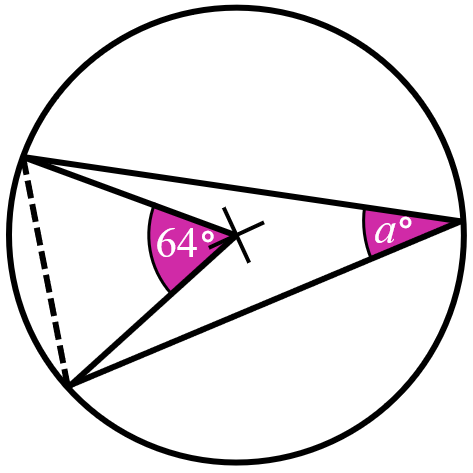
      Q1.
      Calculate the size of angle $$a$$°.

      An image in a quiz
      26°
      Correct answer: 32°
      58°
      64°
      128°

      Q2.
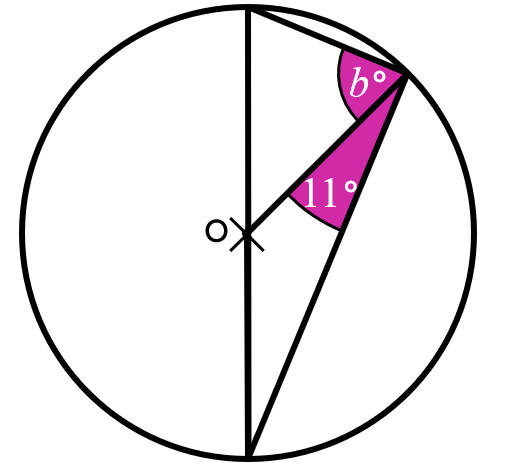
      The size of the angle labelled $$b$$° is °.

      An image in a quiz
      Correct Answer: 79, 79°, 79 degrees

      Q3.
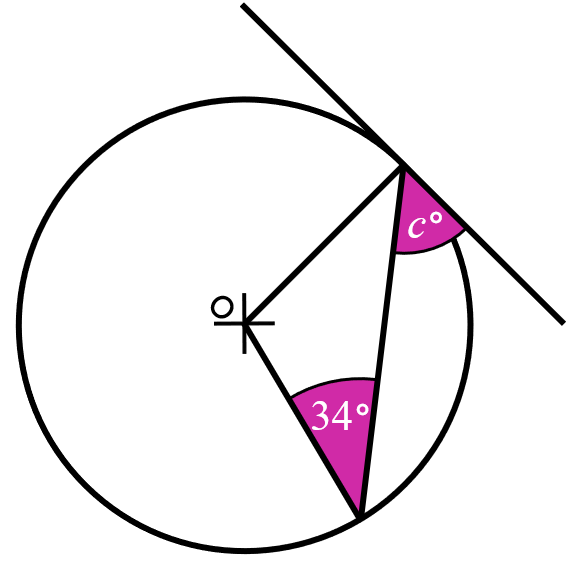
      The size of the angle labelled $$c$$° is °.

      An image in a quiz
      Correct Answer: 56, 56°, 56 degrees

      Q4.
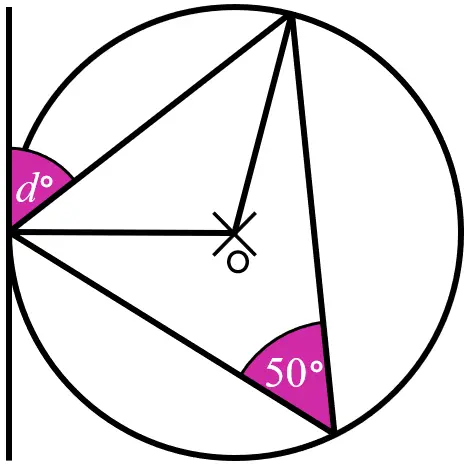
      The size of the angle labelled $$d$$° is °.

      An image in a quiz
      Correct Answer: 50, 50°, 50 degrees

      Q5.
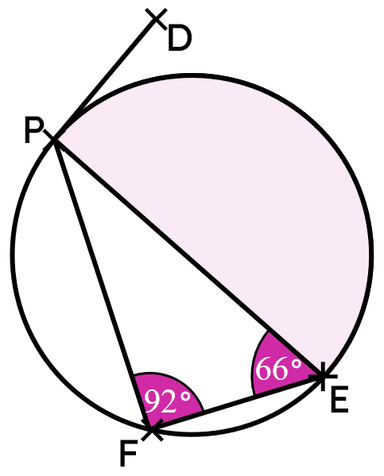
      ∠PEF is subtended by the chord PF. ∠PFE is subtended by the chord PE. Find ∠EPD (in degrees).

      An image in a quiz
      Correct Answer: 92, 92°, 92 degrees

      Q6.
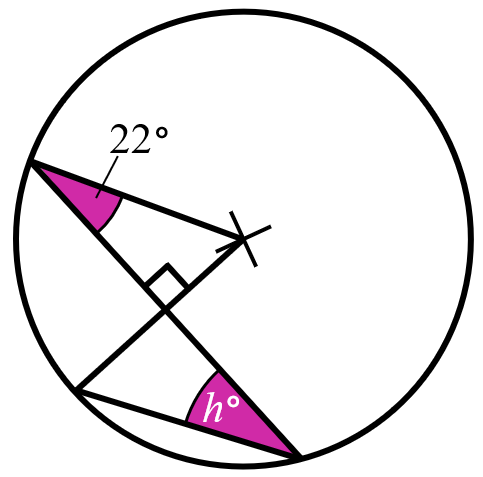
      Calculate the size of angle $$h$$°.

      An image in a quiz
      Correct Answer: 39, 39°, 39 degrees

      6 Questions

      Q1.
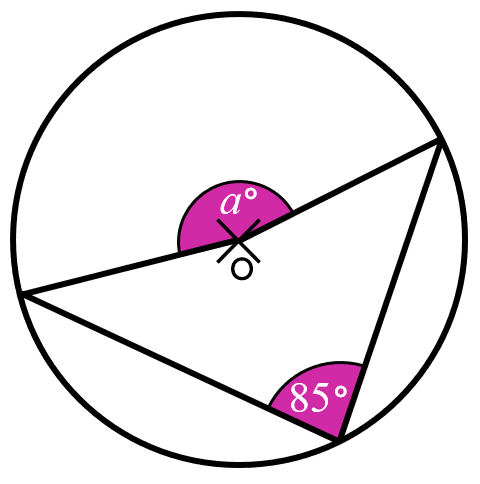
      The size of the angle labelled $$a$$° is °.

      An image in a quiz
      Correct Answer: 170, 170°, 170 degrees

      Q2.
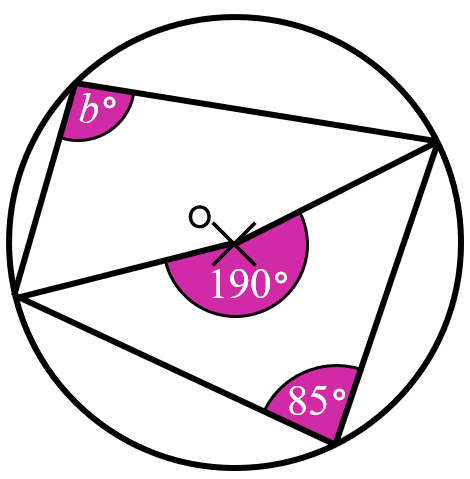
      Find the size of angle $$b$$°.

      An image in a quiz
      85°
      90°
      Correct answer: 95°
      170°
      190°

      Q3.
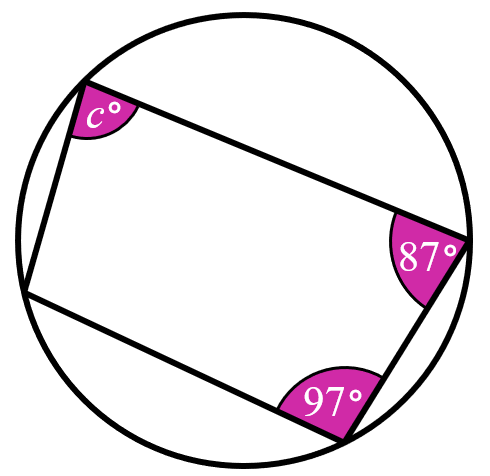
      Find the size of angle $$c$$°.

      An image in a quiz
      Correct answer: 83°
      87°
      93°
      97°
      Not enough information.

      Q4.
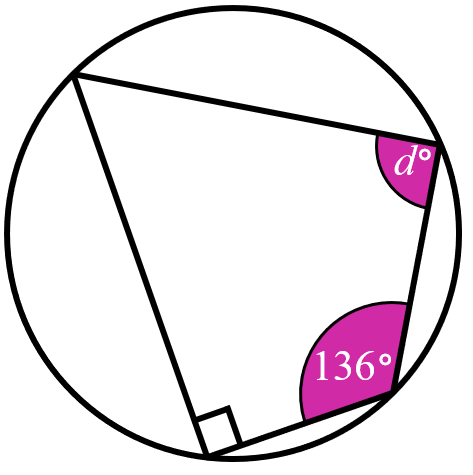
      The size of the angle labelled $$d$$° is °.

      An image in a quiz
      Correct Answer: 90, 90°, 90° degrees, right-angle

      Q5.
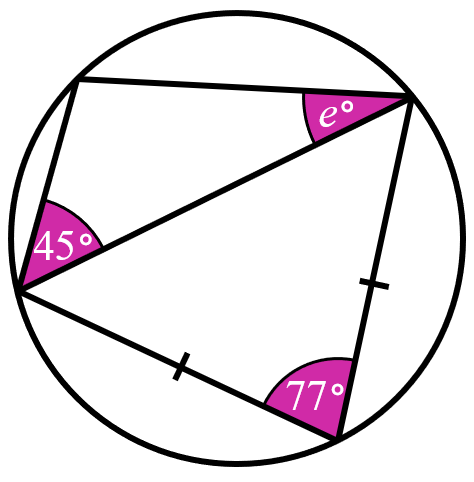
      The size of the angle labelled $$e$$° is °.

      An image in a quiz
      Correct Answer: 32, 32°, 32 degrees

      Q6.
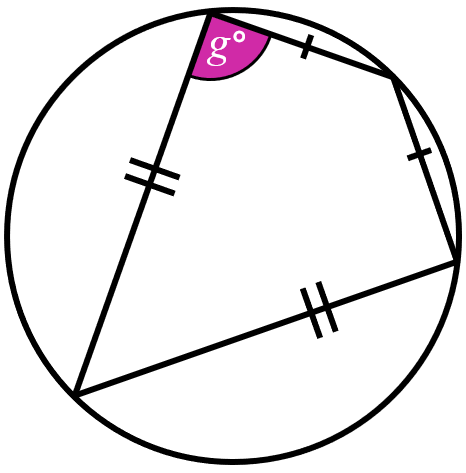
      Find the size of angle $$g$$° (in degrees).

      An image in a quiz
      Correct Answer: 90, 90°, 90 degrees

      To help you plan your 10 maths lesson on: The opposite angles of a cyclic quadrilateral sum to 180°, download all teaching resources for free and adapt to suit your pupils' needs...