Choose exam board for KS4 Computer Science (GCSE)
Choose exam board for KS4 English
Choose exam board for KS4 French
Choose exam board for KS4 Geography
Choose exam board for KS4 German
Choose exam board for KS4 History
Choose tier for KS4 Maths
Choose exam board for KS4 Music
Choose exam board for KS4 Physical education (GCSE)
Choose exam board for KS4 Religious education (GCSE)
Choose exam board for KS4 Spanish

      Problem solving with iteration
      Lesson details

      Learning outcome

      I can use my knowledge of iteration to solve problems.

      Key learning points

      1. Quadratics can have their solutions estimated using iteration
      2. This can be helpful to quickly determine where the solutions are likely to be
      3. It can be used to check any solutions

      Keywords

      • Iteration - Iteration is the repeated application of a function or process in which the output of each iteration is used as the input for the next iteration.

      Common misconception

      An iterative formula can always be used to find the solutions to an equation.

      This lesson addresses limitations of iteration. Some formulas will cause an error becasue we are unable to evaluate the square root of a negative or divide by 0. Other formulas may not converge. Different values of $$x_0$$ produce different results.

      Teacher tip

      This lesson is all about exploring the limitations of iteration. Graphing software will be useful for pupils to explore different formulae and differnt values on $$x_0$$. These equations are all quadratics so pupils can use calculators or the quadratic formula to find or check solutions.

      Licence

      This content is © Oak National Academy Limited (2026), licensed on Open Government Licence version 3.0
      except where otherwise stated. See Oak's terms & conditions
      (Collection 2).

      Lesson video

      Loading...

      Prior knowledge starter quiz

      6 Questions

      Q1.
      What are the solutions to the quadratic equation $$x^2-3x-10=0$$?

      $$x=-3$$ and $$x=-10$$
      $$x=3$$ and $$x=-10$$
      $$x=-2$$ and $$x=-5$$
      $$x=2$$ and $$x=-5$$
      Correct answer: $$x=-2$$ and $$x=5$$

      Q2.
      What are the approximate solutions to the quadratic equation $$x^2+2x-5=0$$ ?

      $$x=1.22$$ and $$x=-2.68$$ to 3 significant figures
      $$x=-1.22$$ and $$x=2.68$$ to 3 significant figures
      Correct answer: $$x=1.45$$ and $$x=-3.45$$ to 3 significant figures
      $$x=-1.45$$ and $$x=3.45$$ to 3 significant figures

      Q3.
      Which value does the iterative formula $$x_{n+1}=\frac{8}{x_n-2}$$ converge on to 1 significant figure when $$x_0=5$$ ?

      -3
      Correct answer: -2
      -1
      0.8
      12

      Q4.
      Using the iterative formula $$x_{n+1}=\frac{(x_n)^3+1}{2}$$ and $$x_0=0$$ , which of these is a solution to $$x^3-2x+1=0$$ correct to 2 significant figures?

      $$x=0.56$$
      $$x=0.59$$
      Correct answer: $$x=0.62$$
      $$x=0.67$$

      Q5.
      Between which sets of values is there definitely a solution to $$x^2-5x-1=0$$ ?

      Between $$x=-2$$ and $$x=-1$$
      Correct answer: Between $$x=-1$$ and $$x=0$$
      Between $$x=4.8$$ and $$x=4.9$$
      Correct answer: Between $$x=5.1$$ and $$x=5.2$$

      Q6.
      Which of these are solutions to $$x^2+2x-6=0$$ correct to the stated degree of accuracy?

      Correct answer: $$x=2$$ to 1 significant figure
      $$x=1.5$$ to 2 significant figure
      $$x=-3$$ to 1 significant figure
      Correct answer: $$x=-4$$ to 1 significant figure

      6 Questions

      Q1.
      Laura has used the equation $$x^2+x-12=0$$ to write the iterative formula $$x_{n+1}=12-(x_n)^2$$. If 3 is an exact solution, what should happen when she uses $$x_0=3$$?

      An error will occur.
      The first iteration will equal 0.
      Correct answer: The first iteration will equal 3.
      The outputs of the formula will eventually converge on 3.
      The iterative formula will not converge.

      Q2.
      Which of these could be iterative formulae to find a solution to the equation $$x^2-5x+4=0$$?

      $$x_{n+1} = \sqrt{4-5x_n}$$
      $$x_{n+1} = -\sqrt{5x_n+4}$$
      $$x_{n+1}=\frac{(x_n)^2}{5} +4$$
      Correct answer: $$x_{n+1}=-\frac{4}{x_n-5}$$

      Q3.
      Which of these could be iterative formulae to find a solution to the equation $$x^2+2x-6=0$$?

      Correct answer: $$x_{n+1}=\frac{6}{x_n+2} $$
      Correct answer: $$x_{n+1}=3-\frac{(x_n)^2}{2} $$
      $$x_{n+1} = \sqrt{2x_n-6}$$
      $$x_{n+1} = (x_n)^2+2(x_n)-6$$

      Q4.
      Using the iterative formula $$x_{n+1}=\frac{6}{x_n+2} $$ which values of $$x_0$$ converge on a solution to the equation $$x^2+2x-6=0$$ ?

      $$x_0=-5$$
      Correct answer: $$x_0=-3$$
      $$x_0=-2$$
      Correct answer: $$x_0=0$$
      Correct answer: $$x_0=2$$

      Q5.
      Which of these iterative formulae converge on the approximate solution $$x=0.459$$ to the equation $$x^2-7x+3=0$$ when $$x_0=2$$?

      Correct answer: $$x_{n+1}=-\frac{3}{x_n-7}$$
      $$x_{n+1}=\sqrt{7x_n-3}$$
      $$x_{n+1}=-\sqrt{7x_n-3}$$
      Correct answer: $$x_{n+1}=\frac{(x_n)^2+3}{7}$$

      Q6.
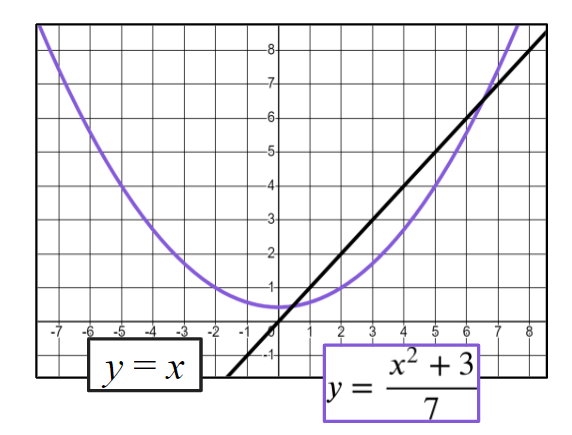
      Using the graph (or otherwise) which values of $$x_0$$ will converge on a solution to the equation $$x^2-7x+3=0$$ using the iterative formula $$x_{n+1}=\frac{(x_n)^2+3}{7}$$?

      An image in a quiz
      $$x_0=-7$$
      Correct answer: $$x_0=-5$$
      Correct answer: $$x_0=0$$
      Correct answer: $$x_0=5$$
      $$x_0=8$$

      To help you plan your 11 maths lesson on: Problem solving with iteration, download all teaching resources for free and adapt to suit your pupils' needs...