


Changing ratios


Lesson details
Learning outcome
I can find quantities given a change in the ratio.
Key learning points
- It is important to preserve the relationship between the parts of a ratio.
- Changing this relationship would change the ratio.
- When the ratio changes, the quantities can be worked out by using equivalent ratios.
Keywords
Proportion - A part to whole (sometimes part to part) comparison. If two things are proportional then the ratio of part to whole is maintained and the multiplicative relationship between parts is also maintained.
Ratio - A ratio shows the relative sizes of 2 or more values and allows you to compare a part with another part in a whole.
LCM - LCM is an abbreviation for lowest common multiple.
Lowest common multiple - The lowest common multiple is the lowest number that is a multiple of two or more numbers.
Common misconception
Treating the ratio as the total amount. For example sweets : chocolates in the ratio 6 : 7 and 2 chocolates are eaten, thinking the ratio must now be 6 : 5
Looking at how these problems are formed in learning cycle 1 will help and getting pupils to explore how the ratio changes when things are added or removed.
Teacher tip
Learning cycle 1 gives pupils a chance to consider how to solve problems where the ratio between things changes. Paying attention to equivalent ratios and what changes and what stays the same should help pupils to understand the process

Licence

Lesson video
Loading...
Prior knowledge starter quiz
6 Questions
Q1.To combine ratios they must have a component.

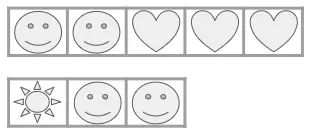
Q2.Given these bar models. What is the ratio of hearts to suns?
Q3.Given that squares : circles = 6 : 5 and circles : triangles = 1 : 3. Find the ratio of squares : triangles.
Q4.a : b = 3 : 4, b : c = 5 : 9. Find the ratio a : b : c
Q5.A box contains 185 sweets which are either hearts (h), stars (s) or bottles (b). The ratio of hearts to stars is 2 : 3. The ratio of stars to bottles is 5 : 4. How many bottles are in the box?
Q6.b = 2a, c = 7b, find the ratio of a : c
Assessment exit quiz
6 Questions
Q1.Which of the following is used as a separator in a ratio?
Q2.There are 30 cans of drink and bags of sweets in a vending machine. The ratio of cans : bags is 2 : 1. 5 cans and 1 packet is sold. What is the ratio of cans : bags now? (In its simplest form)
Q3.There are 24 vehicles in a car park. The ratio of cars : vans is 5 : 1. 4 more cars enter the car park. What is the ratio of cars : vans now? (Give your answer in its simplest form)
Q4.The ratio of adults to children at an athletics club is 7 : 5. 2 more children join, the ratio is now 4 : 3. How many adults are members of the club?
Q5.3 bags contain counters in the ratio 3 : 2 : 4. Some counters are taken out of 1 bag and put into the other 2. The ratio of counters is now 1 : 1 : 2. What is the minimum number of counters removed?
Q6.The ratio of the number of £1 coins to £2 in Sam’s money box is 2 : 3. Their gran gives them 4 more £1 coins, the ratio is now 5 : 6. How much money was in Sam’s money box originally?
To help you plan your 10 maths lesson on: Changing ratios, download all teaching resources for free and adapt to suit your pupils' needs...
To help you plan your 10 maths lesson on: Changing ratios, download all teaching resources for free and adapt to suit your pupils' needs.
The starter quiz will activate and check your pupils' prior knowledge, with versions available both with and without answers in PDF format.
We use learning cycles to break down learning into key concepts or ideas linked to the learning outcome. Each learning cycle features explanations with checks for understanding and practice tasks with feedback. All of this is found in our slide decks, ready for you to download and edit. The practice tasks are also available as printable worksheets and some lessons have additional materials with extra material you might need for teaching the lesson.
The assessment exit quiz will test your pupils' understanding of the key learning points.
Our video is a tool for planning, showing how other teachers might teach the lesson, offering helpful tips, modelled explanations and inspiration for your own delivery in the classroom. Plus, you can set it as homework or revision for pupils and keep their learning on track by sharing an online pupil version of this lesson.
Explore more key stage 4 maths lessons from the Ratio unit, dive into the full secondary maths curriculum, or learn more about lesson planning.