


Function of blood vessels


Lesson details
Learning outcome
I can describe what blood vessels are and what they do.
Key learning points
- Blood vessels transport blood all around the body, to and from your heart.
- Arteries are blood vessels. Most arteries deliver blood rich in oxygen to all the parts of the body.
- Veins are blood vessels. Most veins return blood low in oxygen to the heart.
- Blood is always red. Blood travelling through veins may appear blue because of how light travels through our skin.
- Scientists use scientific diagrams to describe different systems in the human body.
Keywords
Blood vessels - Blood vessels are tubes through which blood flows around the body.
Arteries - Arteries are blood vessels that carry blood away from the heart.
Veins - Veins are blood vessels that carry blood back to the heart.
Oxygenated - Oxygenated blood is blood rich in oxygen.
Deoxygenated - Deoxygenated blood is blood low in oxygen.
Common misconception
Pupils often think that blood sloshes around inside the body rather than travelling through different types of blood vessels. Pupils may also think that blood can be red or blue.
The learning cycle focusing on representing blood vessels in the human body helps pupils to understand that blood vessels are often drawn in different colours merely to help us distinguish between them and understand their different functions.
Teacher tip
If blowing paint, to represent blood vessels 'branching off' into smaller and smaller tubes, it is advised to use paint that has been watered down to make it a little more runny.

Equipment
See additional materials for further guidance.

Content guidance
Exploration of objects

Supervision
Adult supervision recommended

Licence

Lesson video
Loading...
Prior knowledge starter quiz
6 Questions
Q1.Your heart is protected by a frame of bones attached to the breastbone, called the .
Q2.The heart is made up of several __________ which relax and squeeze to pump blood.
Q3.Which statement about blood is true?
Q4.What are the functions of blood?
Q5.Which of these are parts of the blood?
Q6.Which part of the blood helps the blood to clot forming scabs?
Assessment exit quiz
6 Questions
Q1.Which statements about blood are true?
Q2.Match these keywords to their descriptions.

Q3.Blood carry blood all around the body, to and from your heart.
Q4.In this model of the circulatory system, which colour represents blood vessels carrying oxygen rich blood?
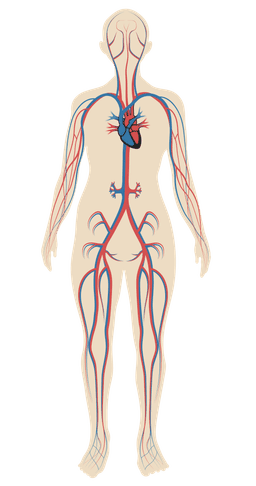
Q5.Why are models used in science?
Q6.Match these keywords to their descriptions.
To help you plan your 6 science lesson on: Function of blood vessels, download all teaching resources for free and adapt to suit your pupils' needs...
To help you plan your 6 science lesson on: Function of blood vessels, download all teaching resources for free and adapt to suit your pupils' needs.
The starter quiz will activate and check your pupils' prior knowledge, with versions available both with and without answers in PDF format.
We use learning cycles to break down learning into key concepts or ideas linked to the learning outcome. Each learning cycle features explanations with checks for understanding and practice tasks with feedback. All of this is found in our slide decks, ready for you to download and edit. The practice tasks are also available as printable worksheets and some lessons have additional materials with extra material you might need for teaching the lesson.
The assessment exit quiz will test your pupils' understanding of the key learning points.
Our video is a tool for planning, showing how other teachers might teach the lesson, offering helpful tips, modelled explanations and inspiration for your own delivery in the classroom. Plus, you can set it as homework or revision for pupils and keep their learning on track by sharing an online pupil version of this lesson.
Explore more key stage 2 science lessons from the The human circulatory system unit, dive into the full primary science curriculum, or learn more about lesson planning.