


Where people go: ask questions with 'ir' in singular persons




Lesson details
Learning outcome
I can use singular forms of 'ir' to ask and answer questions about where another person goes or is going.
Vocabulary and transcripts for this lessons
Key learning points
- Ir is an irregular verb meaning 'to go, going'.
- Its singular forms are: 'voy' ('I go'), 'vas' ('you go') and 'va' ('she, he, it goes').
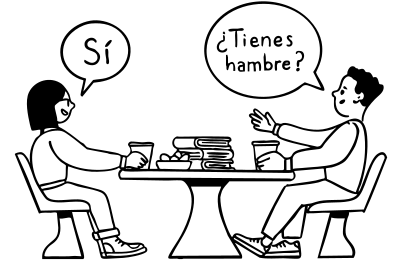
- Spanish closed (yes/no) questions use the same words in the same order as Spanish statements.
- To make a statement into a spoken Spanish, use raised intonation.
- To make a statement into a written question use two question marks; the one at the start is upside down.
Keywords
Ir - irregular verb meaning 'to go, going'
Vas - verb meaning 'you go', part of the verb 'ir'
Closed question - question that can be answered with yes/no
Intonation - rise and fall of the voice in speaking; how to ask closed, yes/no questions in Spanish
Common misconception
I need Spanish words for 'do' and 'are' to ask yes/no questions, just like in English, e.g. 'Do you go to town?', 'Are you going to the park?'.
Spanish yes/no questions use the same words in the same order as Spanish statements. To make a statement into a spoken question, use raised intonation. Written questions use two question marks; the one at the start is upside down.
Teacher tip
Teachers may find it helpful to support their teaching of intonation questions by using hand gestures to model rising intonation. Some pupils may find it helpful to use the same gestures themselves initially, as they practise.

Licence

Lesson video
Loading...
Some of our videos, including non-English language videos, do not have captions.
Prior knowledge starter quiz
6 Questions
Q1.Match the Spanish and English.

Q2.Which of these words are regular -er/-ir verbs?
Q3.Match the words in suitable pairs.
Q4.Which words could follow 'aprender'?
Q5.Write the Spanish for 'January'.
Q6.Write in Spanish: 'I go to the neighbourhood.'
Assessment exit quiz
6 Questions
Q1.Match the noun to an article.
Q2.Match the Spanish to the English.
Q3.To turn a statement into a closed (yes/no) question you need to ...
Q4.Complete the sentence: 'Lucía va a la __________.'
Q5.Order the words to say: 'Is she going to Spain in February?'
Q6.Write in Spanish: 'Do you go to the beach by train?'
To help you plan your 7 Spanish lesson on: Where people go: ask questions with 'ir' in singular persons, download all teaching resources for free and adapt to suit your pupils' needs...
To help you plan your 7 Spanish lesson on: Where people go: ask questions with 'ir' in singular persons, download all teaching resources for free and adapt to suit your pupils' needs.
The starter quiz will activate and check your pupils' prior knowledge, with versions available both with and without answers in PDF format.
We use learning cycles to break down learning into key concepts or ideas linked to the learning outcome. Each learning cycle features explanations with checks for understanding and practice tasks with feedback. All of this is found in our slide decks, ready for you to download and edit. The practice tasks are also available as printable worksheets and some lessons have additional materials with extra material you might need for teaching the lesson.
The assessment exit quiz will test your pupils' understanding of the key learning points.
Our video is a tool for planning, showing how other teachers might teach the lesson, offering helpful tips, modelled explanations and inspiration for your own delivery in the classroom. Plus, you can set it as homework or revision for pupils and keep their learning on track by sharing an online pupil version of this lesson.
Explore more key stage 3 Spanish lessons from the Places and plans: 'ir' for present and future plans unit, dive into the full secondary Spanish curriculum, or learn more about lesson planning.