Choose exam board for KS4 Computer Science (GCSE)
Choose exam board for KS4 English
Choose exam board for KS4 French
Choose exam board for KS4 Geography
Choose exam board for KS4 German
Choose exam board for KS4 History
Choose tier for KS4 Maths
Choose exam board for KS4 Music
Choose exam board for KS4 Physical education (GCSE)
Choose exam board for KS4 Religious education (GCSE)
Choose exam board for KS4 Spanish
      New
      New

      A practical exploration of balance, co-ordination, agility and reaction time fitness tests

      I can apply protocols of specific fitness tests that measure balance, co-ordination, agility and reaction time and compare results to normative data.

      Lesson 7 of 8
      New
      New
      • Year 10
      • OCR

      A practical exploration of balance, co-ordination, agility and reaction time fitness tests

      I can apply protocols of specific fitness tests that measure balance, co-ordination, agility and reaction time and compare results to normative data.

      Lesson details

      Key learning points

      1. Balance is measured by the stork stand test.
      2. Co-ordination is measured by the alternate hand wall throw test.
      3. Agility is measured by the Illinois agility test.
      4. Reaction time is measured by the ruler drop test.

      Keywords

      • Balance - the ability to stay upright or stay in control of body movement

      • Co-ordination - the ability to move two or more body parts under control, smoothly and efficiently

      • Agility - the ability to change direction at speed; nimbleness

      • Reaction time - the ability to respond quickly to a stimulus

      Common misconception

      When conducting the ruler drop test, the partner or assistant will countdown so the performer knows when the ruler is going to be dropped.

      Remind students that they need to drop the ruler randomly, rather than when the performer knows they will drop it, to really ensure validity to test reaction time.

      This could be taught as a carousel while students are taking part in the Illinois agility test, one at a time. The other tests could be managed by students in groups.
      Teacher tip

      Equipment

      Stack of cones, stopwatches x 15, ruler x 15, tennis ball x 15.

      Content guidance

      • Risk assessment required - physical activity

      Supervision

      Adult supervision required

      Licence

      This content is © Oak National Academy Limited (2026), licensed on Open Government Licence version 3.0 except where otherwise stated. See Oak's terms & conditions (Collection 2).

      Lesson video

      Loading...

      Prior knowledge starter quiz

      6 Questions

      Q1.
      Identify the correct definition of balance.

      the ability to stay still
      the ability to move two or more body parts under control
      the ability to do a handstand on the beam
      Correct answer: the ability to stay upright or in control of body movement

      Q2.
      Which example would require the most reaction time?

      swimming over a long distance
      Correct answer: responding quickly in boxing to an opponent's mistake
      kicking a conversion in rugby
      going down the ski slalom smoothly

      Q3.
      'The ability to change direction at speed' is describing which component of fitness?

      Correct Answer: agility

      Q4.
      A dancer moves their arms and legs together in time with the music and with their partners. Which component of fitness do they need high levels of to do this?

      Correct Answer: co-ordination

      Q5.
      Which athlete would require the least amount of agility?

      a tennis player
      a cricket player
      a football player
      Correct answer: a weightlifter

      Q6.
      Match the fitness test to the correct component of fitness.

      Correct Answer:balance,stork stand test

      stork stand test

      Correct Answer:co-ordination,wall throw test

      wall throw test

      Correct Answer:agility,Illinois agility test

      Illinois agility test

      Correct Answer:reaction time,ruler drop test

      ruler drop test

      Assessment exit quiz

      6 Questions

      Q1.
      Information collected from a large group of people to show what's typical or average, so others can compare to it, is known as data.

      Correct Answer: normative

      Q2.
      Match the fitness test to the correct component of fitness.

      Correct Answer:balance,stork stand test

      stork stand test

      Correct Answer:co-ordination,wall throw test

      wall throw test

      Correct Answer:agility,Illinois agility run

      Illinois agility run

      Correct Answer:reaction time,ruler drop test

      ruler drop test

      Q3.
      When conducting the stork stand test, where should your arms be?

      in the air
      Correct answer: on your hips
      by your side
      it doesn't matter

      Q4.
      When conduction the Illinois agility test how should the participant start?

      Correct answer: lying face down
      lying face up
      on their knees
      sprint start position

      Q5.
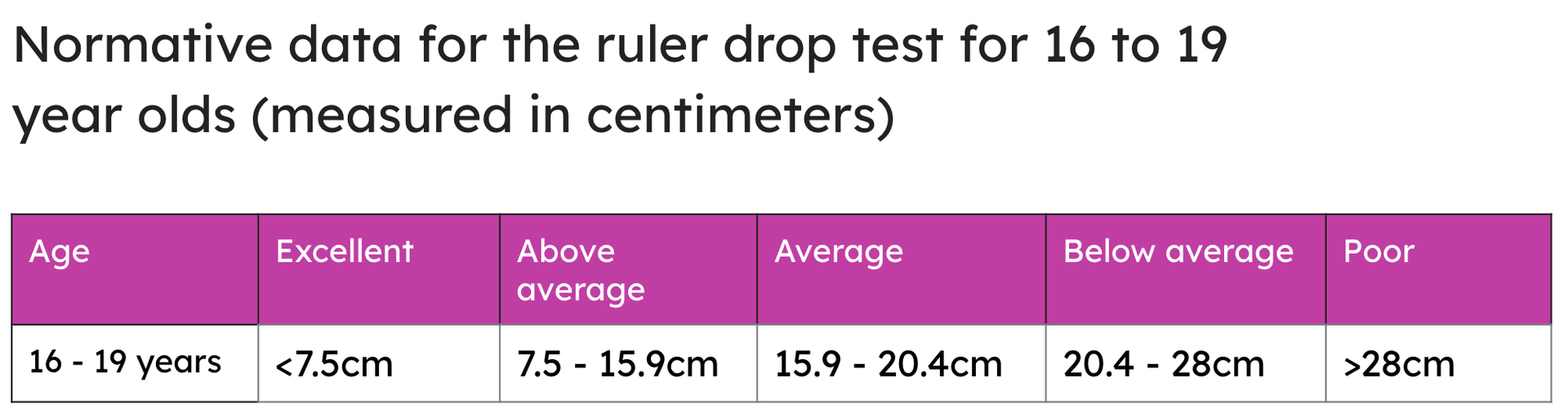
      Ksanet is a 16 year old female. She scores 6.9cm on the ruler drop test. Using the table of normative data rate Ksanet's reaction time?
      An image in a quiz
      Correct answer: Excellent
      Above average
      Average
      Below average
      Poor

      Q6.
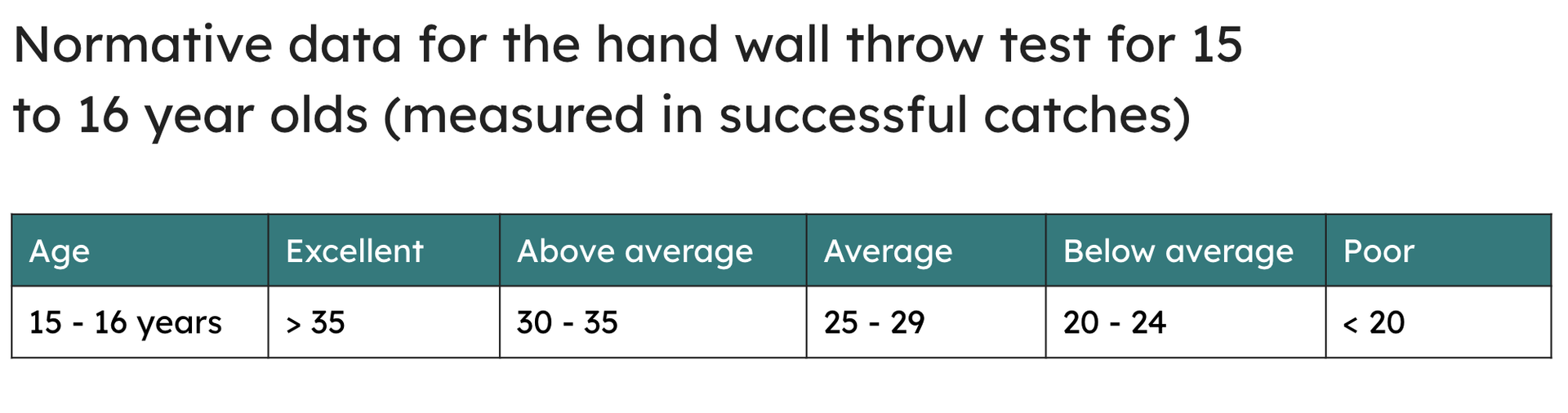
      Alistair is a 16 year old male. He scores 33 on the alternate hand wall throw test. Using the table of normative data rate Alistair's co-ordination.
      An image in a quiz
      Excellent
      Correct answer: Above average
      Average
      Below average
      Poor
      Q5 BrianMac Sports Coach www.brianmac.co.uk Q6 BrianMac Sports Coach www.brianmac.co.uk

      Lesson appears in

      UnitPhysical education / Physical training: health and fitness

      OCRPhysical education