


New
New
Adaptations of plants for photosynthesis: gas exchange and stomata
You can describe how plants are adapted to take in and release gases to support photosynthesis.


Lesson 4 of 4
New
New
- Year 9
Adaptations of plants for photosynthesis: gas exchange and stomata
You can describe how plants are adapted to take in and release gases to support photosynthesis.
Lesson details
Key learning points
- Plant leaves take in carbon dioxide gas from the air for photosynthesis
- The oxygen made by photosynthesis is released as a gas from leaves into the air
- This process is called gas exchange
- Leaves have small holes in their surface called stomata for gas exchange
- Molecules of gases move through open stomata by diffusion
Keywords
Gas exchange - Gas exchange in plants is when photosynthesising leaves take in carbon dioxide gas and release waste oxygen gas.
Stomata - Small holes in the surfaces of a leaf.
Guard cells - Cells next to stomata that can change shape to open and close the stomata.
Diffusion - Diffusion is caused by the continuous random movement of molecules of a gas (or of a liquid).
Net movement - When more molecules of a gas (or of a liquid) diffuse from an area of higher concentration to an area of lower concentration.
This lesson helps to develop the key cross-cutting idea in biology that the shapes and forms of biological structures are adapted for specific functions.

Teacher tip

Equipment

Licence
This content is © Oak National Academy Limited (2026), licensed on Open Government Licence version 3.0 except where otherwise stated. See Oak's terms & conditions (Collection 2).
Lesson video
Loading...
Prior knowledge starter quiz
6 Questions
Q1.Which part of a plant takes in gas for photosynthesis and releases gas made by photosynthesis?
Which part of a plant takes in gas for photosynthesis and releases gas made by photosynthesis?
flowers

roots
Q2.What is the name of the gas that plants take in for photosynthesis?
What is the name of the gas that plants take in for photosynthesis?
Q3.What is the name of the gas that plants make as a waste product from photosynthesis?
What is the name of the gas that plants make as a waste product from photosynthesis?
Q4.Carbon dioxide gas and oxygen gas are made up of _____ .
Carbon dioxide gas and oxygen gas are made up of _____ .
air
cells
minerals
Q5.When particles of a gas move from one place to another, this is called _____ .
When particles of a gas move from one place to another, this is called _____ .
adaptation
concentration
reproduction
Q6.The diagram shows particles of a gas. Which statement is correct?
The diagram shows particles of a gas. Which statement is correct?
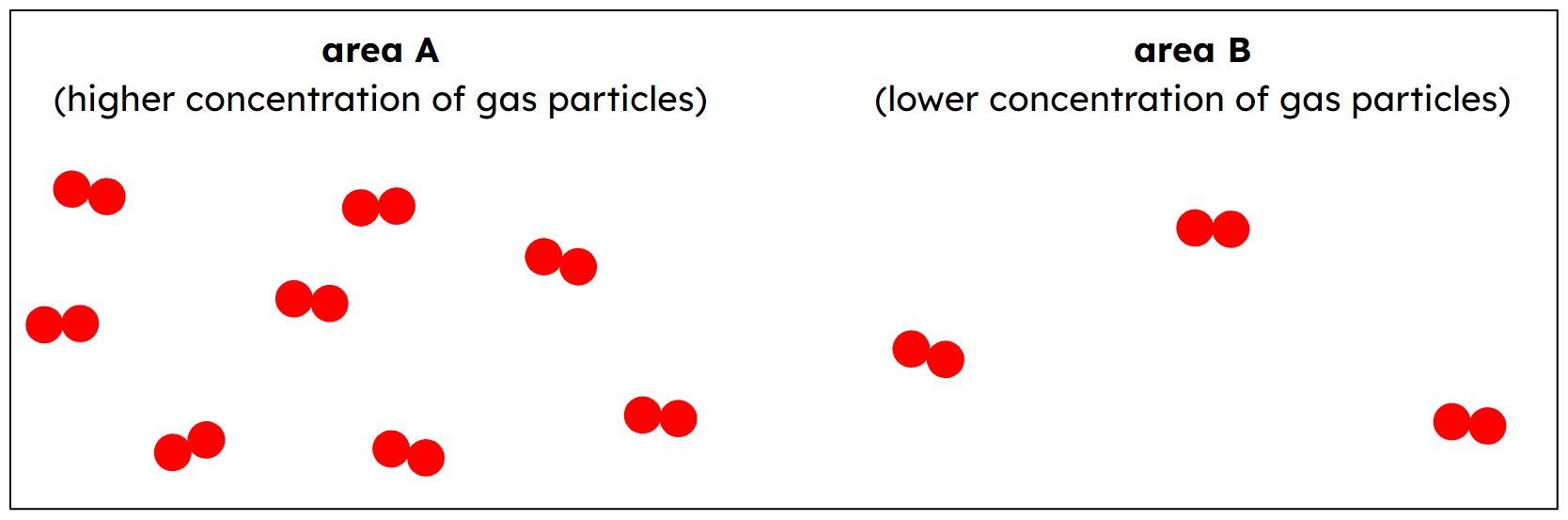
More of the particles will move from area B to area A.
The same number of particles will move between both areas.
The particles will not move.
Assessment exit quiz
6 Questions
Q1.What is the name of the tiny holes in the surface of a leaf?
What is the name of the tiny holes in the surface of a leaf?
chloroplasts
guard cells
vacuoles
Q2.The diagram shows some structures that make up a plant’s leaf. Which part of the diagram shows one of the leaf’s stomata?
The diagram shows some structures that make up a plant’s leaf. Which part of the diagram shows one of the leaf’s stomata?
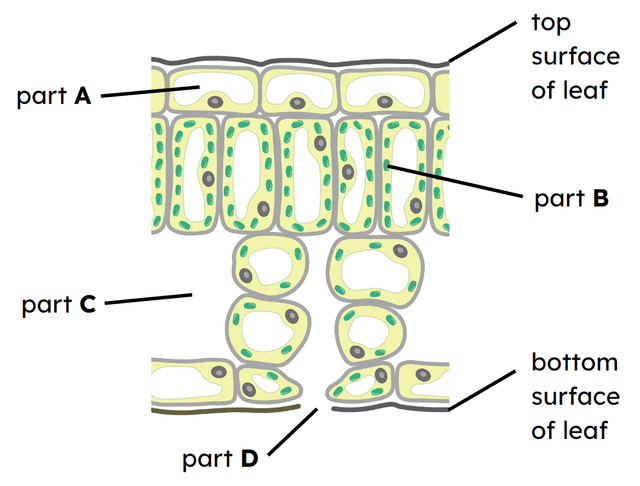
Part A
Part B
Part C
Q3. cells can change shape to open and close stomata.
cells can change shape to open and close stomata.
Q4.Which process allows gas exchange through open stomata during photosynthesis?
Which process allows gas exchange through open stomata during photosynthesis?
adaptation
concentration
respiration
Q5.Which diagram shows the correct concentration gradient of particles of oxygen gas when the cells inside the leaf are photosynthesising?
Which diagram shows the correct concentration gradient of particles of oxygen gas when the cells inside the leaf are photosynthesising?
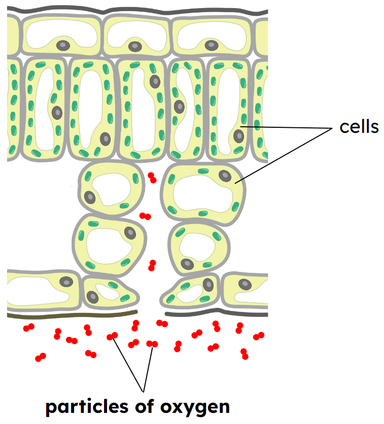
Diagram A
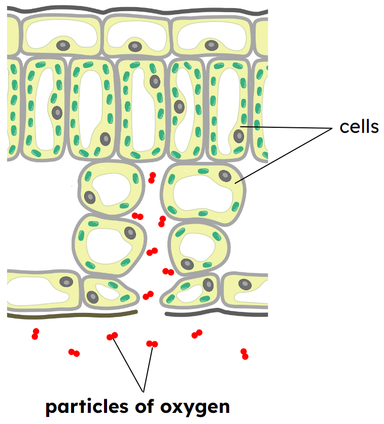
Diagram B
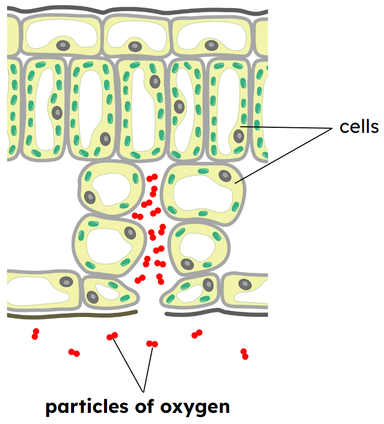
Q6.Which statement describes the net movement of carbon dioxide particles when the leaf cells are photosynthesising?
Which statement describes the net movement of carbon dioxide particles when the leaf cells are photosynthesising?
Net movement in both directions.
Net movement from inside the leaf to the outside.
No net movement in either direction.
