Adaptations of the human lungs for gas exchange
I can describe how the human lungs are adapted to increase the amount of gas exchange.


- Year 9
Adaptations of the human lungs for gas exchange
I can describe how the human lungs are adapted to increase the amount of gas exchange.
Lesson details
Key learning points
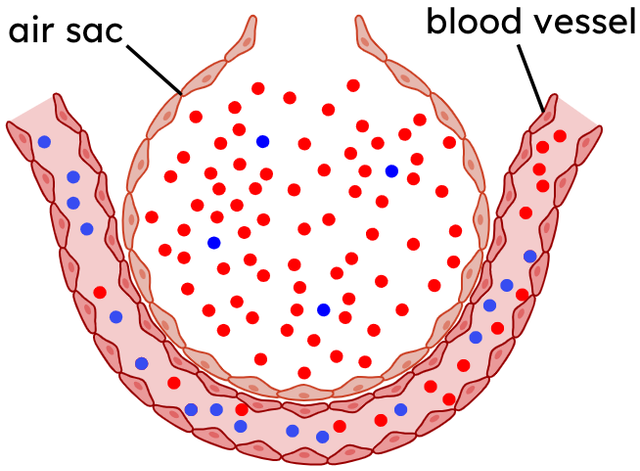
- The lungs are made up of tiny air sacs called alveoli.
- Gas exchange takes place between air in alveoli and blood in capillaries.
- There are millions of alveoli to increase the surface area of the lungs for gas exchange.
- The walls of the alveoli are one cell thick to create a short diffusion distance for gas exchange.
- The alveoli are surrounded by capillaries carrying blood, to maintain a concentration gradient for gas exchange.
Keywords
Alveoli - Alveoli are tiny air sacs in the lungs that carry out gas exchange.
Capillary - A capillary is a narrow blood vessel that allows the exchange of substances between tissues and blood.
Diffusion - The movement of particles from a high concentration to a low concentration is known as diffusion.
Surface area - Surface area is the total area of all the exposed surfaces of an object.
Common misconception
Pupils often refer to the walls of the alveoli as "cell walls".
This lesson makes the scale of different parts of the gas exchange system clear (e.g. whether a structure is a tissue or cell).


Equipment

Licence
Lesson video
Loading...
Prior knowledge starter quiz
6 Questions
Q1.Select the option which correctly finishes the sentence: Gas exchange is the process of…
Q2.The diagram shows the human gas exchange system. Which letter on the diagram represents the bronchioles?
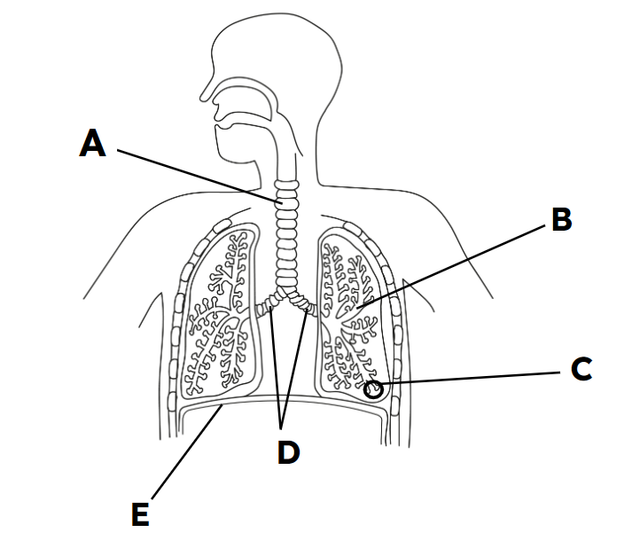
Q3.The diagram shows the human gas exchange system. Which letter on the diagram represents the alveoli?
Q4.A is a group of cells working together to perform a specific function.
Q5.In diffusion, the net movement of particles is...
Q6.Which of the following are features of diffusion?
Assessment exit quiz
6 Questions
Q1.The diagram shows two structures in the lungs. What is the name of structure A in the diagram?
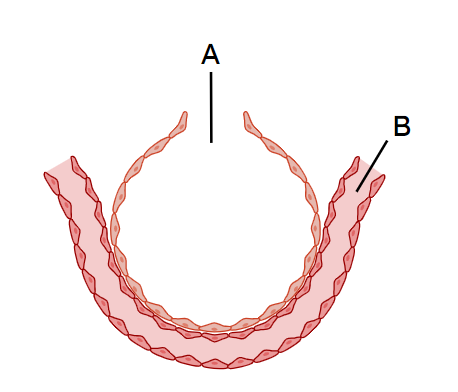
Q2.What type of blood vessel is labelled B?
Q3.What level of organisation are alveoli?
Q4.There are many alveoli in the lungs in order to increase the area of the lungs.
Q5.Select the option which correctly finishes the sentence: the walls of the alveoli are one cell thick in order to…
Q6.Match the adaptation to its property.