


Adapting a multistep chemical procedure for making a pure dry salt
I can describe and explain adaptations to a multistage chemical procedure to alter or improve the quality of the product.


- Year 10
- AQA
Adapting a multistep chemical procedure for making a pure dry salt
I can describe and explain adaptations to a multistage chemical procedure to alter or improve the quality of the product.
Lesson details
Key learning points
- Gently heating the acid speeds up the reaction, ensuring all acid reacts.
- The salt should be dried using an appropriate method (using filter paper, or in the oven).
- A pure sample should be prepared with equipment washed with distilled water to avoid contamination.
- Reacting a metal hydroxide with an acid also produces a salt and water.
- Reacting a metal carbonate with an acid can produce a desired salt with water, as well as carbon dioxide gas.
Keywords
Method - Describes how an experiment is carried out; it is a step-by-step procedure.
Apparatus - A piece of equipment that is designed for a particular use.
Evaluate - To evaluate something is to make a judgement about it with respect to a particular purpose.
Adapt - To make suitable for use or purpose, e.g. equipment or steps in an experimental procedure.
Common misconception
Pupils can sometimes mistake the excess base for the salt formed as it is a solid.
Emphasise at the beginning of the experiment what soluble means and that the salt will be initially obtained dissolved in water.


Licence
Lesson video
Loading...
Prior knowledge starter quiz
6 Questions
Q1.What is a pure salt formed in a chemical reaction?
Q2.The chemical reaction between an acid and a metal oxide, which makes a salt and water, is an example of a reaction.
Q3.How do we know for sure that the reaction between an acid and an insoluble metal oxide is complete?
Q4.What is the general name given to a solid caught in filter paper after a filtration?
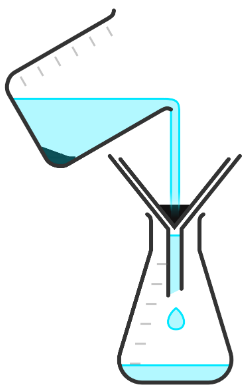
Q5.Evaporating water from a salt solution to leave a pure salt is called .
Q6.Match the following words, used to describe how to make pure salt samples, to their definitions.

