


Adding components to a parallel circuit
I can use the rules for current and potential difference in a parallel circuit and explain the effects of adding a component.


- Year 10
- Edexcel
Adding components to a parallel circuit
I can use the rules for current and potential difference in a parallel circuit and explain the effects of adding a component.
Lesson details
Key learning points
- The p.d. across each branch of a parallel circuit is the same as the p.d. across the battery.
- The current through each branch of a parallel circuit adds up to the current through the battery.
- Adding a component in a new branch of a parallel circuit reduces the resistance of the circuit.
- Adding a component to an existing branch of a parallel circuit increases the resistance of the circuit.
- The p.d. across the terminals of a battery does not change when components are added to a circuit.
Keywords
Electric charge - an electrical property; it can either be positive or negative
Parallel circuit - a circuit with separate branches connected to the battery
Electric field - the invisible field around a charged object that causes other charges to experience a force
Potential difference (p.d.) - the voltage or a measure of the ‘push’ on electrons in a circuit
Electric current - a measure of the amount of charge passing a given point in one second
Common misconception
To solve circuits you need only to put numbers into equations.
Talk through circuits with pupils before analysing them in order to develop an intrinsic understanding of how circuits work; research shows this improves pupils’ problem solving ability for electric circuits.


Equipment
1.5 V cells, identical bulbs in holders, ammeters and electrical leads

Content guidance
- Risk assessment required - equipment

Supervision
Adult supervision required

Licence
Lesson video
Loading...
Prior knowledge starter quiz
6 Questions
Q1.Electric current at a point in a circuit is the amount of charge passing that point…

Q2.P.d. is a shorter way of writing the electrical quantity .
Q3.Which of the following statements about batteries are correct?
Q4.Which of the following statements is correct?
Q5.A cell and a lamp are connected in series. A second, identical lamp is then connected in series with the first lamp. Which of the following statements describes what happens to the first lamp?
Q6.A series circuit contains a battery and three different resistors. Which of the following statements about the circuit are correct?
Assessment exit quiz
6 Questions
Q1.The circuit diagram shows a circuit with parallel branches. The branches have different resistances. Which of the following statements is correct?
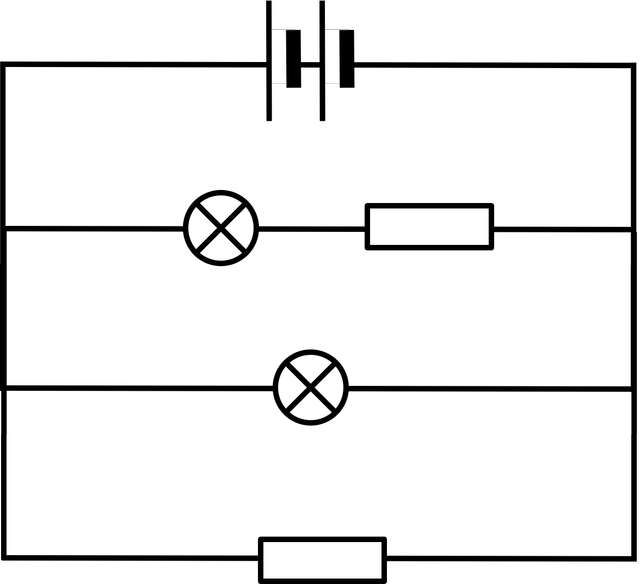
Q2.The circuit diagram shows a circuit with parallel branches. The branches have different resistances. Which of the following statements is correct?
