


Alleles, genotype, and phenotype
I can explain how the genotype affects the phenotype of an organism.


- Year 10
- Edexcel
Alleles, genotype, and phenotype
I can explain how the genotype affects the phenotype of an organism.
Lesson details
Key learning points
- An individual inherits two copies of each gene in a pair of chromosomes.
- Versions of genes are called alleles, they can be recessive or dominant, indicated with a capital or lowercase letter.
- The combination of alleles that an organism has is called its genotype.
- Different alleles of a gene are associated with different versions of the same characteristic called the phenotype.
- Some phenotypes are determined only by genotype, others are also affected by the environment.
Keywords
Allele - A genetic variant in a gene creates an allele (a different version of the gene), which produces a different phenotype.
Dominant - One or both dominant alleles in the genotype for the characteristic to be expressed in the phenotype.
Recessive - Two recessive alleles in the genotype for the characteristic to be expressed in the phenotype.
Genotype - The combination of alleles an organism has for a characteristic (i.e. phenotype).
Phenotype - Features that result, at least partly, from the genetic code of an organism’s genes.
Common misconception
A dominant condition is 'stronger' and that only the strongest characteristic is inherited from one parent.
Two genes are inherited, so both alleles contribute to the genotype. In some cases one is dominant and therefore will always be expressed (through protein structure) in the phenotype, the recessive allele is still present.


Equipment

Licence
Lesson video
Loading...
Prior knowledge starter quiz
6 Questions
Q1.Phenotype refers to an organism’s observable characteristics. Which factors can affect an organism’s phenotype?
Q2.Starting with the smallest, put these in size order.
Q3.What is the genome in a unicellular organism?
Q4.Which is the best description of a DNA molecule?
Q5.True or false? All genes code for enzymes.
Q6.Put these in order to describe the production of a red pigment in a petal.
Assessment exit quiz
6 Questions
Q1.Adult body cells contain two copies of each chromosome. Gametes are sex cells. Which statement about gametes is true?
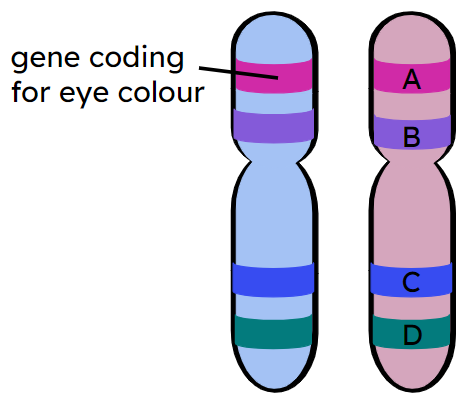
Q2.The diagram shows a chromosome pair. Four genes are shown. One gene is labelled on the left chromosome. Which position (A, B, C or D) shows the location of this gene on the right chromosome?
Q3.Alleles are ...
Q4.A plant’s flowers are either red or white. Plants with the genotypes RR and Rr have red flowers. Which allele is recessive?
Q5.Match each word to its correct meaning.

