Choose exam board for KS4 Computer Science (GCSE)
Choose exam board for KS4 English
Choose exam board for KS4 French
Choose exam board for KS4 Geography
Choose exam board for KS4 German
Choose exam board for KS4 History
Choose tier for KS4 Maths
Choose exam board for KS4 Music
Choose exam board for KS4 Physical education (GCSE)
Choose exam board for KS4 Religious education (GCSE)
Choose exam board for KS4 Spanish
      New
      New

      Animal life cycles

      I can make observations and describe how an animal grows and changes in its life cycle.

      Lesson 3 of 5
      New
      New
      • Year 2

      Animal life cycles

      I can make observations and describe how an animal grows and changes in its life cycle.

      Lesson details

      Key learning points

      1. All animals grow and change from birth to being an adult
      2. The journey of an animal from beginning until it is fully grown is called its life cycle
      3. Scientists can use observation skills to describe the stage an animal has reached in its life cycle

      Keywords

      • Animal - An animal is a living thing which moves, and eats other animals or plants.

      • Offspring - You can refer to a person's child or to an animal's young as their offspring.

      • Adult - The adult is a mature form of a plant or animal.

      • Life cycle - A life cycle shows the way in which a living thing changes as it grows.

      • Observe - To observe is to look very closely and use other senses too.

      Common misconception

      Children may think that there are only two stages in an animal's life; child and adult.

      Refer to other stages in animal's lives. For example, in humans we have children, teenagers, adults and the elderly.

      Alternative lesson ideas are to look at time lapse videos to demonstrate life cycles, look at photos of life cycles, and use playdough to create and compare animals at different stages in their life cycles.
      Teacher tip

      Content guidance

      • Depiction or discussion of sensitive content

      Supervision

      Adult supervision recommended

      Licence

      This content is © Oak National Academy Limited (2026), licensed on Open Government Licence version 3.0 except where otherwise stated. See Oak's terms & conditions (Collection 2).

      Lesson video

      Loading...

      Prior knowledge starter quiz

      6 Questions

      Q1.
      Match the offspring to their parent.

      Correct Answer:foal,horse

      horse

      Correct Answer:owlet,owl

      owl

      Correct Answer:cygnet,swan

      swan

      Q2.
      True or false? Offspring always look like their parents.

      Correct Answer: false, False, false.

      Q3.
      Which of these statements is true?

      Correct answer: Offspring change and grow into adult animals.
      Offspring do not grow or change.
      Offspring grow but do not change.

      Q4.
      Which of these groups only has animals that are offspring?

      foal, horse, zebra
      chick, penguin, hen
      Correct answer: tadpole, kitten, hatchling

      Q5.
      Which of these groups only has animals that are adults?

      caterpillar, butterfly, ladybird
      Correct answer: horse, crocodile, owl
      frog, tadpole, toad

      Q6.
      Izzy has some animal photos. She puts them into by looking at what is the same and what is different about them.

      Correct Answer: groups, group

      Assessment exit quiz

      6 Questions

      Q1.
      From when they are born to when they become an adult, all animals...

      Correct answer: grow and change
      have offspring
      stay the same

      Q2.
      The journey of an animal from beginning to when it is fully grown is called its...

      offspring
      Correct answer: life cycle
      parent

      Q3.
      Which of these help us to observe more closely?

      thermometer
      Correct answer: magnifying glass
      scissors

      Q4.
      Place these in order, youngest to oldest.

      1 - eggs
      2 - tadpole
      3 - froglet
      4 - frog

      Q5.
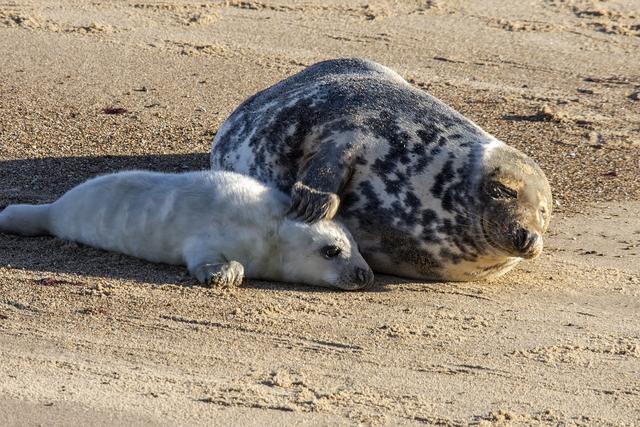
      When we observe this seal and its pup we notice that...
      An image in a quiz
      The pup is smaller and has darker fur. The seal is bigger and has white fur.
      The pup is bigger and has white fur. The seal is smaller and has spotty fur.
      Correct answer: The pup is smaller and has white fur. The seal is bigger and has spotty fur.

      Q6.
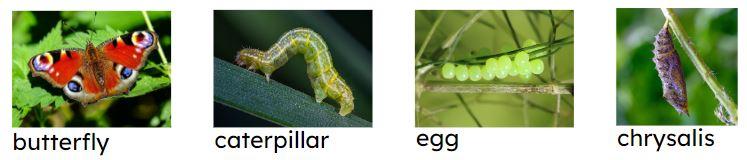
      Put these different stages of a butterfly's life cycle in order starting with the youngest.
      An image in a quiz
      1 - egg
      2 - caterpillar
      3 - chrysalis
      4 - butterfly

      Lesson appears in

      UnitScience / New life

      Science