


New
New


Lesson 13 of 17
New
New
- Year 8
Brackets in equations
I can appreciate the significance of the bracket in an equation.
Lesson details
Key learning points
- Multiplying both sides of an equation by the same term can be shown using brackets.
- An expression involving brackets can be expanded.
- Equations involving brackets can be expressed in words.
- Equations involving brackets can be represented using bar models.
Keywords
Equation - An equation is used to show two expressions that are equal to each other.
Common misconception
That "$$x$$ times five, plus three" is the same as "$$x$$ plus three, times five".
Use visual representations to demonstrate why and how they are different. Use algebra tiles if you have them, or get pupils to draw them.
In addition to using visual representations to show the difference between $${5x+3}=10$$ and $$5(x+3)=10$$ you can also work backwards. Give them visual representations and ask them to write the equation.

Teacher tip

Licence
This content is © Oak National Academy Limited (2025), licensed on Open Government Licence version 3.0 except where otherwise stated. See Oak's terms & conditions (Collection 2).
Lesson video
Loading...
Prior knowledge starter quiz
6 Questions
Q1.Turning the expression $$5(y-2)$$ into $$5y-10$$ is known as the brackets.
Turning the expression $$5(y-2)$$ into $$5y-10$$ is known as the brackets.

Correct answer: multiplying out
multiplying out
erasing
factorising
Correct answer: expanding
expanding
Q2.$$2(x+4)$$ and $$2x+4$$ are the equivalent expressions. True or false?
$$2(x+4)$$ and $$2x+4$$ are the equivalent expressions. True or false?
True. There is a $$2$$, an $$x$$, and a $$+4$$. That means they are the same.
Correct answer: False. $$2$$ lots of $$(x+4)$$ is $$(x+4)+(x+4)$$ which is $$2x+8$$ not $$2x+4$$
False. $$2$$ lots of $$(x+4)$$ is $$(x+4)+(x+4)$$ which is $$2x+8$$ not $$2x+4$$
You cannot know until you know the value of $$x$$.
Q3.Which of these are expressions for the perimeter of this square?
Which of these are expressions for the perimeter of this square?
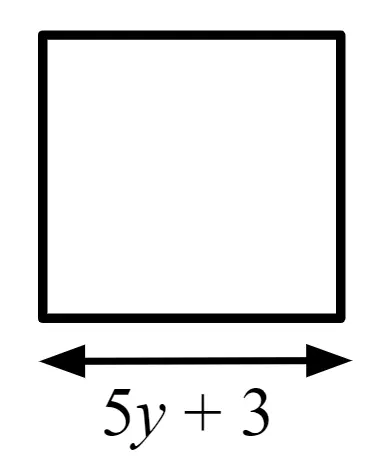
$$5y+3$$
$$4\times5y+3$$
Correct answer: $$4(5y+3)$$
$$4(5y+3)$$
$$20y+3$$
Correct answer: $$20y+12$$
$$20y+12$$
Q4.What equation does this bar model represent?
What equation does this bar model represent?
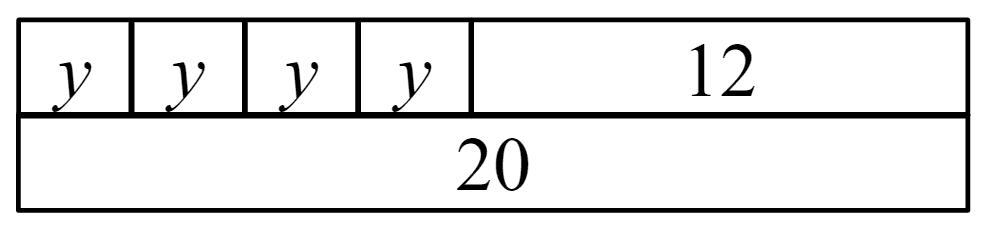
$$4y=12$$
$$4y=20$$
Correct answer: $$4y+12=20$$
$$4y+12=20$$
$$4y+20=12$$
$$4(y+12)=20$$
Q5.Expand $$7(y+8)$$.
Expand $$7(y+8)$$.
$$7y+8$$
$$7y+15$$
Correct answer: $$7y+56$$
$$7y+56$$
$$y+56$$
Q6.Expand $$-7(y+8)$$.
Expand $$-7(y+8)$$.
$$7y-56$$
Correct answer: $$-7y-56$$
$$-7y-56$$
$$-7y+56$$
$$7y+56$$
Assessment exit quiz
6 Questions
Q1.If you multiply both sides of an equation by $$2$$, you will maintain .
If you multiply both sides of an equation by $$2$$, you will maintain .
the value
Correct answer: equality
equality
equation
the expressions
Q2.True or false? Multiplying by $$5$$ and then adding $$10$$ is the same as adding $$10$$ then multiplying by $$5$$.
True or false? Multiplying by $$5$$ and then adding $$10$$ is the same as adding $$10$$ then multiplying by $$5$$.
True. Both have $$\times 5$$ and $$+10$$ so they are the same function.
Correct answer: False. Order matters.
False. Order matters.
Q3.What equation does this bar model represent?
What equation does this bar model represent?
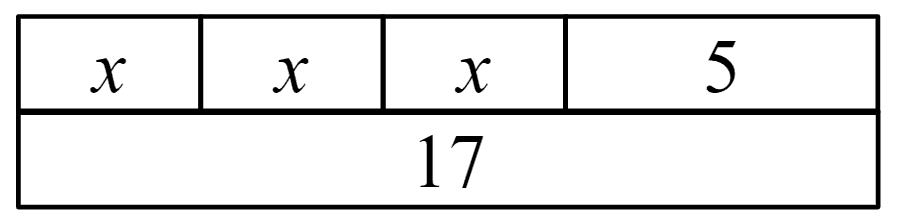
Correct answer: $$3\times x + 5 = 17$$
$$3\times x + 5 = 17$$
$$x + 5 \times 3 = 17$$
$$(x + 5) \times 3 = 17$$
$$x + 5 = 17$$
Correct answer: $$3x + 5 = 17$$
$$3x + 5 = 17$$
Q4.What does this bar model represent?
What does this bar model represent?

$$3\times x + 5 = 17$$
Correct answer: $$(x + 5) \times 3 = 17$$
$$(x + 5) \times 3 = 17$$
Correct answer: $$3(x + 5) = 17$$
$$3(x + 5) = 17$$
$$x + 5 \times 3 = 17$$
Correct answer: $$3x + 15 = 17$$
$$3x + 15 = 17$$
Q5.Multiply both sides of this equation $${1\over3}x-5 = 2x+7$$ by $$3$$.
Multiply both sides of this equation $${1\over3}x-5 = 2x+7$$ by $$3$$.
$$x-5=6x+7$$
Correct answer: $$x-15=6x+21$$
$$x-15=6x+21$$
$$3x-15=6x+21$$
Correct answer: $$3({1\over3}x-5) = 3(2x+7)$$
$$3({1\over3}x-5) = 3(2x+7)$$
Q6.Which of the below is the most efficient first step to solve the equation $${3\over{x}}= 10$$ ?
Which of the below is the most efficient first step to solve the equation $${3\over{x}}= 10$$ ?
$$3({3\over{x}})= 3(10)$$
Correct answer: $$x({3\over{x}})= x(10)$$
$$x({3\over{x}})= x(10)$$
$$10({3\over{x}})= 10(10)$$
$$10x({3\over{x}})= 10x(10)$$
