


New
New
Bridge 100 by subtracting in multiples of 10
I can use number facts to 20 to subtract multiples of 10 and bridge 100.


Lesson 9 of 10
New
New
- Year 3
Bridge 100 by subtracting in multiples of 10
I can use number facts to 20 to subtract multiples of 10 and bridge 100.
Lesson details
Key learning points
- The language of unitising helps us to use number facts to 20 to subtract multiples of 10 crossing the hundreds.
- If 14 subtract 6 is equal to 8 then 14 tens subtract 6 tens is equal to 8 tens or 80.
- Partitioning the subtrahend helps us to cross the 100s boundary.
Keywords
Subtrahend - The number that is to be subtracted. The second number in a subtraction.
Minuend - The first number in a subtraction. The number from which another number is to be subtracted.
Common misconception
Lack of fluency with number facts to 20 can hinder progress in applying them to multiples of ten.
Ensure that fluency with number facts to 20 and related subtraction facts is secure or supported so that pupils can apply them.
Rehearse number facts to 20 and the related subtraction facts ahead of this lesson and provide support with these if needed. Make use of base ten manipulatives to help pupils to see the structure especially when bridging through 100.

Teacher tip

Licence
This content is © Oak National Academy Limited (2025), licensed on Open Government Licence version 3.0 except where otherwise stated. See Oak's terms & conditions (Collection 2).
Lesson video
Loading...
Prior knowledge starter quiz
6 Questions
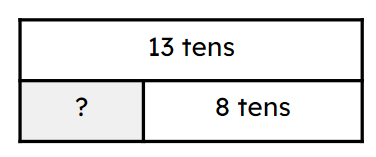
Q1.What is the missing value? 8 tens + tens = 13 tens.
What is the missing value? 8 tens + tens = 13 tens.
Q2.What are the addends in this calculation: 90 + 30 + 10 = 130
What are the addends in this calculation: 90 + 30 + 10 = 130
90, 10 and 130
130, 90 and 10
30, 10 and 130
Q3.If I know 6 + 7 = 13, what is 6 tens + 7 tens?
If I know 6 + 7 = 13, what is 6 tens + 7 tens?
Q4.Match the linked equations. Which number facts would you use to solve each equation with multiples of 10?
Match the linked equations. Which number facts would you use to solve each equation with multiples of 10?

Q5. What is the sum of these addends 40 + 60 + 50 =
What is the sum of these addends 40 + 60 + 50 =
Q6. What is the missing addend 80 + + 40 = 140?
What is the missing addend 80 + + 40 = 140?
Assessment exit quiz
6 Questions
Q1.Which number is the subtrahend in this calculation? 150 - 70 = 80
Which number is the subtrahend in this calculation? 150 - 70 = 80
Q2.Which number is the minuend in this calculation? 130 − 50 = 8 tens
Which number is the minuend in this calculation? 130 − 50 = 8 tens
Q3.Match the known number fact to its related multiple of ten.
Match the known number fact to its related multiple of ten.
Q4.Calculate 120 - = 80
Calculate 120 - = 80
20
80
Q5.Which partitioned subtrahend will help you to bridge 100?
Which partitioned subtrahend will help you to bridge 100?
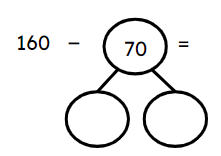
Q6.How would the subtrahend 70 be partitioned in this equation?
How would the subtrahend 70 be partitioned in this equation?
40 and 30
50 and 20
