


New
New
Calculate the value of parts and wholes using understanding of division
I can calculate the value of a part and a whole using understanding of division and knowledge of division facts.


Lesson 4 of 5
New
New
- Year 3
Calculate the value of parts and wholes using understanding of division
I can calculate the value of a part and a whole using understanding of division and knowledge of division facts.
Lesson details
Key learning points
- The whole can be a set of objects.
- To calculate the value of a part, we need to divide the whole by the number of equal parts.
- To calculate the the number of equal parts, we need to divide the whole by the value of each part.
- To calculate the whole, we need to multiply the number of equal parts by the value of each part.
- Drawing a bar model helps us to visualise the problem.
Keywords
Divide - When we divide, we split something into equal parts or groups. We use the ÷ symbol to mean divide.
Common misconception
Children may struggle to make connections between division and the value of a part.
Support children to understand and describe what they know from the information given, for example, the whole, the size of a part, or the number of parts. Also, what it is that they are trying to find. Encourage representation as a bar model.
Note, no reference is made in this lesson to 'fractions'. When calculating, use times table facts that children are confident with to reduce cognitive overload. Use practical examples where possible.

Teacher tip

Licence
This content is © Oak National Academy Limited (2025), licensed on Open Government Licence version 3.0 except where otherwise stated. See Oak's terms & conditions (Collection 2).
Lesson video
Loading...
Prior knowledge starter quiz
6 Questions
Q1.Identify the whole amount in this problem. Sofia has 18 grapes and wants to share them between herself and 2 friends. They get 6 grapes each.
Identify the whole amount in this problem. Sofia has 18 grapes and wants to share them between herself and 2 friends. They get 6 grapes each.
3
6
Q2.Identify the number of parts in this problem. Sofia has 18 grapes and wants to share them between herself and 2 friends. They get 6 grapes each.
Identify the number of parts in this problem. Sofia has 18 grapes and wants to share them between herself and 2 friends. They get 6 grapes each.
6
18
Q3.Match the division expressions to their quotient.
Match the division expressions to their quotient.

Q4.Look at the image and equation. What does the 3 represent?
Look at the image and equation. What does the 3 represent?
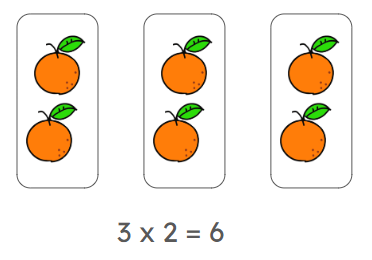
The 3 represents the whole number of oranges.
The 3 represents the number of oranges in each group.
Q5.Look at the image and equation. What does the 2 represent?
Look at the image and equation. What does the 2 represent?
The 2 represents the whole number of oranges.
The 2 represents the number of groups.
Q6.Look at the bar model. What does the 30 represent?
Look at the bar model. What does the 30 represent?
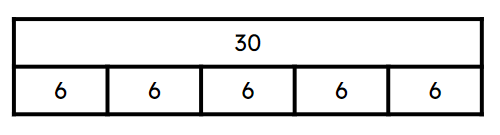
The 30 represents the number of parts.
The 30 represents the size of each part.
Assessment exit quiz
6 Questions
Q1.When we divide, we split something into parts or groups.
When we divide, we split something into parts or groups.
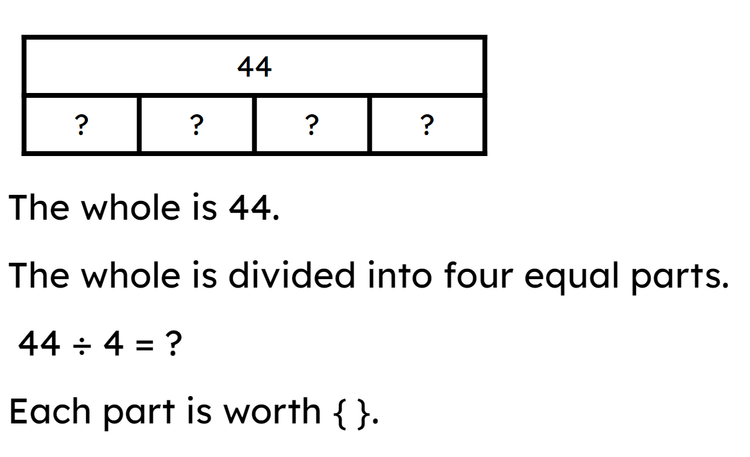
Q2.Look at this bar model and complete the sentence.
Look at this bar model and complete the sentence.
Q3.12 marbles are shared equally between Izzy and 3 friends. How many marbles do they get each?
12 marbles are shared equally between Izzy and 3 friends. How many marbles do they get each?
4
36
48
Q4.Izzy and 4 friends win £35 and share it equally. How much money do they get each?
Izzy and 4 friends win £35 and share it equally. How much money do they get each?
Q5.Izzy and her 3 friends have 8 cherries each.
How many cherries do they have in total?
Izzy and her 3 friends have 8 cherries each.
How many cherries do they have in total?
12
24
40
Q6.Alex wants to buy 24 pens. Pens are sold in packs of 4. How many packs does he need to buy?
Alex wants to buy 24 pens. Pens are sold in packs of 4. How many packs does he need to buy?
4
20
28
