Choose exam board for KS4 Computer Science (GCSE)
Choose exam board for KS4 English
Choose exam board for KS4 French
Choose exam board for KS4 Geography
Choose exam board for KS4 German
Choose exam board for KS4 History
Choose tier for KS4 Maths
Choose exam board for KS4 Music
Choose exam board for KS4 Physical education (GCSE)
Choose exam board for KS4 Religious education (GCSE)
Choose exam board for KS4 Spanish
      New
      New

      Calculating theoretical probabilities from Venn diagrams (one event)

      I can find theoretical probabilities from a Venn diagram showing the possible outcomes for one event.

      Lesson 6 of 13
      New
      New
      • Year 9

      Calculating theoretical probabilities from Venn diagrams (one event)

      I can find theoretical probabilities from a Venn diagram showing the possible outcomes for one event.

      Lesson details

      Key learning points

      1. The probability of an outcome can be found by considering a Venn diagram showing all possible outcomes.
      2. The probability of a set of outcomes can be found by considering a Venn diagram showing all possible outcomes.
      3. A Venn diagram can help us find a probability, even when the outcomes are not equally likely.

      Keywords

      • Venn diagram - Venn diagrams are a representation used to model statistical/probability questions. Commonly circles are used to represent events.

      • Theoretical probability - A theoretical probability is a probability based on counting the number of desired outcomes from a sample space where all individual outcomes are equally likely.

      Common misconception

      Pupils may count the number of outcomes and state this as the probability.

      Remind pupils that the probability scale is between 0 and 1, so an answer of 3 is not correct.

      Pupils could design questions for their peers where some probabilities are given and a partially completed Venn diagram. They should think about how much information is necessary for the question to be completed.
      Teacher tip

      Licence

      This content is © Oak National Academy Limited (2026), licensed on Open Government Licence version 3.0 except where otherwise stated. See Oak's terms & conditions (Collection 2).

      Lesson video

      Loading...

      Prior knowledge starter quiz

      6 Questions

      Q1.
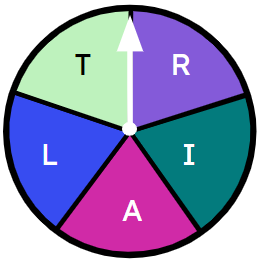
      What is the probability that this spinner will land on either L or T?

      An image in a quiz
      Correct answer: 0.4
      0.2
      0.6

      Q2.
      A coin is flipped twice. How many possible outcomes will be in the sample space?

      2
      Correct answer: 4
      3

      Q3.
      If the probability of an event (A) is 1/6, and the experiment is repeated 78 times, what is the theoretical number of times (A) will occur?

      Correct answer: 13
      6
      36
      18

      Q4.
      In a bag with 5 red counters and 3 green counters, what is the probability of randomly selecting a red counter?

      $$/frac{5}{3}$$
      Correct answer: $$/frac{5}{8}$$
      $$/frac{2}{5}$$

      Q5.
      In a bag with 5 red counters, 2 blue counters and 3 green counters, what is the probability of randomly selecting a blue counter?

      Correct answer: $$/frac{1}{5}$$
      $$/frac{2}{9}$$
      $$/frac{7}{10}$$

      Q6.
      In a fair six-sided die, what is the probability (as a decimal) of rolling an even number and getting a head in a single toss of a fair coin?

      Correct Answer: 0.25

      Assessment exit quiz

      6 Questions

      Q1.
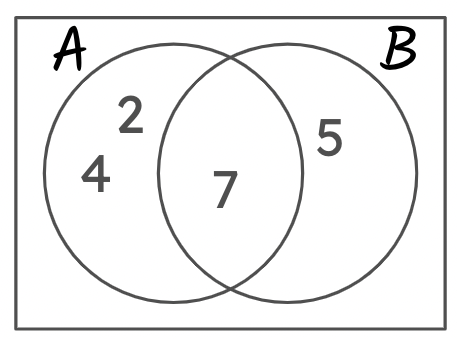
      Which of the following is the correct data set for A?

      An image in a quiz
      Correct answer: {2, 4, 7}
      {2, 4}
      {7}
      {2,4,5,7}

      Q2.
      When throwing a fair sided die, what is the probability of not getting a 6?

      $$\frac{1}{6}$$
      $$\frac{6}{6}$$
      Correct answer: $$\frac{5}{6}$$

      Q3.
      What is the intersection of the sets A {𝜷, 𝜸, 𝜹} and B {𝜷, 𝜽}

      Correct answer: {𝜷}
      {𝜷, 𝜸, 𝜹, 𝜽}
      {𝜷, 𝜷, 𝜸, 𝜹, 𝜽}

      Q4.
      Which of the following is the correct data set for B?

      An image in a quiz
      {4,2}
      {4,2,7}
      {7}
      {5}
      Correct answer: {5,7}

      Q5.
      When throwing a fair sided die, what is the probability of not getting a multiple of 3?

      Correct answer: $$\frac{2}{3}$$
      $$\frac{1}{6}$$
      $$\frac{1}{4}$$
      $$\frac{5}{6}$$

      Q6.
      What is the correct set of outcomes, ξ , shown in this Venn diagram?

      An image in a quiz
      Correct answer: ξ = {2,4,5,7}
      ξ = {2,4,7}
      ξ = {7}

      Lesson appears in

      UnitMaths / Probability: theoretical probabilities