


New
New


Lesson 4 of 18
New
New
- Year 9
Catering
I can understand how maths is used in the catering industry.
Lesson details
Key learning points
- A chef may need to convert between U.S. and metric measurements
- Many foods require preparation before they can be used in cooking
- Calculating the edible portion can be done using percentages
Keywords
Metric - Metric units are based around the standard units of metre, gram and litre.
Percentage loss - Percentage loss is the decrease when referencing something that loses cost/mass/length, etc. given as a percentage of the original amount.
Common misconception
Pupils may think the mathematical conventions for rounding should apply.
This is rounding in a practical context and pupils should consider what the effects of rounding up and down are and how they affect the answer.
Percentage yields vary greatly (as mentioned in the lesson) so you may wish to ask pupils to investigate what the effect of changing the percentage yield has on cost.

Teacher tip

Equipment

Licence
This content is © Oak National Academy Limited (2025), licensed on Open Government Licence version 3.0 except where otherwise stated. See Oak's terms & conditions (Collection 2).
Lesson video
Loading...
Prior knowledge starter quiz
6 Questions
Q1.Metric units are based around the standard units of...
Metric units are based around the standard units of...

yard
pound
Q2.Select the metric units for distance.
Select the metric units for distance.
Inch
Foot
Q3.Select the metric units for mass.
Select the metric units for mass.
ounce
pound
stone
Q4.Select the metric units for capacity.
Select the metric units for capacity.
Pint
Gallon
Q5.How many millilitres are there in one litre?
How many millilitres are there in one litre?
10
100
10 000
Q6.1.2 km is equivalent to...
1.2 km is equivalent to...
120 m
12 000 cm
Assessment exit quiz
6 Questions
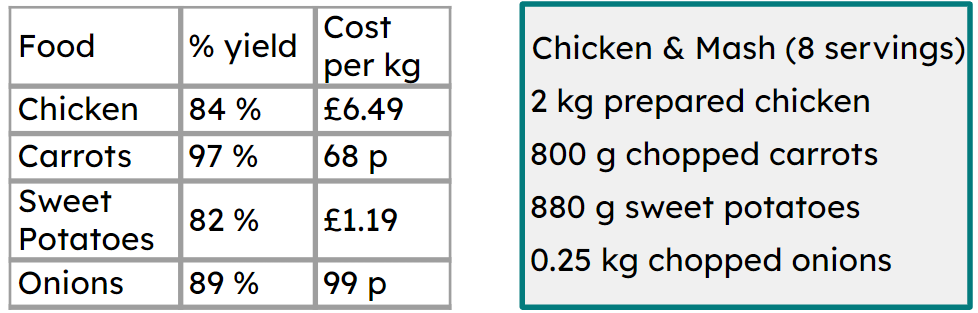
Q1.Laura is cooking for her family. Calculate the mass (to the nearest gram) for the chicken that she needs to buy.
Laura is cooking for her family. Calculate the mass (to the nearest gram) for the chicken that she needs to buy.
281 g
825 g
1074 g
1940 g
Q2.Laura is cooking for her family. Calculate the mass (to the nearest gram) for the carrots that she needs to buy.
Laura is cooking for her family. Calculate the mass (to the nearest gram) for the carrots that she needs to buy.
281 g
1074 g
1940 g
2381 g
Q3.Laura is cooking for her family. Calculate the mass (to the nearest gram) for the sweet potatoes that she needs to buy.
Laura is cooking for her family. Calculate the mass (to the nearest gram) for the sweet potatoes that she needs to buy.
281 g
825 g
1940 g
2381 g
Q4.Laura is cooking for her family. Calculate the mass (to the nearest gram) for the onions that she needs to buy.
Laura is cooking for her family. Calculate the mass (to the nearest gram) for the onions that she needs to buy.
825 g
1074 g
1940 g
2381 g
Q5.Laura needs to buy 2.381 kg of chicken to ensure she has enough chicken after preparation. Assuming the cost is proportional to the mass, what will this cost her?
Laura needs to buy 2.381 kg of chicken to ensure she has enough chicken after preparation. Assuming the cost is proportional to the mass, what will this cost her?
Q6.Laura needs to buy 281 g of onions to ensure she has enough onion after preparation. Assuming the cost is proportional to the mass, what will this cost her?
Laura needs to buy 281 g of onions to ensure she has enough onion after preparation. Assuming the cost is proportional to the mass, what will this cost her?
