Choose exam board for KS4 Computer Science (GCSE)
Choose exam board for KS4 English
Choose exam board for KS4 French
Choose exam board for KS4 Geography
Choose exam board for KS4 German
Choose exam board for KS4 History
Choose tier for KS4 Maths
Choose exam board for KS4 Music
Choose exam board for KS4 Physical education (GCSE)
Choose exam board for KS4 Religious education (GCSE)
Choose exam board for KS4 Spanish
      New
      New

      Checking and further securing understanding of direct proportion in context

      I can recognise direct proportion in a range of contexts, including compound measures.

      Lesson 1 of 9
      New
      New
      • Year 11

      Checking and further securing understanding of direct proportion in context

      I can recognise direct proportion in a range of contexts, including compound measures.

      Lesson details

      Key learning points

      1. Direct proportion can be used in a number of contexts, for example in currency conversion.
      2. Proportional relationships can be expressed as ratios, often in unitary form.
      3. A ratio is in unitary form if one of the parts is equal to one.
      4. It is useful to be able to recognise which contexts involve direct proportion.

      Keywords

      • Rate - A rate is a relationship between two units. For example miles per hour (mph) is a rate called speed which relates distance and time.

      • Exchange rate - An exchange rate is the rate at which one currency is exchanged for another. The two currencies are in proportion because they have a constant multiplicative relationship.

      • Direct proportion - Two variables are in direct proportion if they have a constant multiplicative relationship.

      Common misconception

      When considering meter readings, using the 'new reading' rather than the units used to calculate the cost.

      Emphasise that it is the change in readings that indicates the units used during a time period. The 'new reading' alone shows the total number of units used since the meter was installed.

      If pupils struggle with Task A, question 3. They can be encouraged to just choose a number of pounds, for example £100 and convert that using both exchange rates and then compare.
      Teacher tip

      Licence

      This content is © Oak National Academy Limited (2025), licensed on Open Government Licence version 3.0 except where otherwise stated. See Oak's terms & conditions (Collection 2).

      Lesson video

      Loading...

      Prior knowledge starter quiz

      6 Questions

      Q1.
      An rate is the rate at which one currency is exchanged for another. The two currencies are in proportion because they have a constant multiplicative relationship.

      Correct Answer: exchange

      Q2.
      For every 1 nugget you get 3 chips. Use this statement to decide which of the following are true?

      2 nuggets and 4 chips
      Correct answer: 2 nuggets and 6 chips
      5 nuggets and 7 chips
      Correct answer: 5 nuggets and 15 chips

      Q3.
      The ratio of A : B is 1 : 6. What is the multiplicative relationship between A and B?

      B = $$1\over6$$A
      B = A + 5
      Correct answer: B = A × 6
      A = B $$-$$ 5

      Q4.
      The ratio of A : B is 2 : 3. What is the multiplicative relationship between A and B?

      B = A + 1
      Correct answer: B = A × 1.5
      A = B $$-$$ 1
      B = $$2\over3$$A

      Q5.
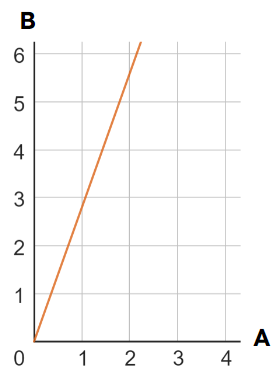
      Does this graph show direct proportion?

      An image in a quiz
      Correct answer: Yes
      No

      Q6.
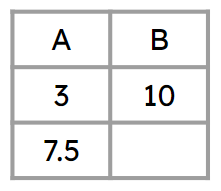
      What is the missing value in this ratio table?

      An image in a quiz
      Correct Answer: 25

      Assessment exit quiz

      6 Questions

      Q1.
      What does 'mpg' stand for?

      Correct Answer: miles per gallon

      Q2.
      Which of these ratios represents this sentence? For every 1 dollar you get 56 pence

      $1 : 56
      Correct answer: 56 p : $1
      Correct answer: $1 : £0.56
      £1 : $0.56
      $1 : £56

      Q3.
      Izzy says, "I changed £200 and got $254". What is this as a unit ratio in pounds?

      £200 : $254
      £100 : $127
      Correct answer: £1 : $1.27
      £0.79 : $1

      Q4.
      Andeep says, "I changed £300 and got €400". What is this as a unit ratio in euros?

      £1 : €1.33
      £300 : €400
      €100 : £75
      Correct answer: £0.75 : €1

      Q5.
      A tap fills at a rate of 16 litres per minute. How long will it take to fill a paddling pool with a capacity of 400 litres?

      Correct Answer: 25 minutes, 25 mins, 25 min, 25

      Q6.
      Calculate the cost of electricity. Give your answer to the nearest penny.

      An image in a quiz
      Correct Answer: £203.87, 20387p

      Lesson appears in

      UnitMaths / Compound measures