Checking and securing understanding of polygons
I can recognise and name polygons with five or more sides and recognise the difference between regular and irregular shapes.


- Year 10
Checking and securing understanding of polygons
I can recognise and name polygons with five or more sides and recognise the difference between regular and irregular shapes.
Lesson details
Key learning points
- The prefix is derived from Ancient Greek.
- A regular polygon has sides that are all equal and interior (inside) angles that are all equal.
- An irregular polygon has sides that are not equal or interior (inside) angles that are not equal.
Keywords
Polygon - A polygon is a flat (2D), closed figure made up of straight line segments.
Regular - A regular polygon has sides that are all equal and interior (inside) angles that are all equal.
Irregular - An irregular polygon has sides that are not equal or interior (inside) angles that are not equal.
Common misconception
The name for a shape only applies to the regular version of that shape. E.g. An irregular pentagon is just a shape, as pentagons must have 5 equal sides.
The name of a shape is known based on the number of sides and these do not have to be regular.


Licence
Lesson video
Loading...
Prior knowledge starter quiz
6 Questions
Q1.An equilateral triangle has __________ equal angles.

Q2.A rhombus always has __________.
Q3.A rectangle always has __________.
Q4.A square always has __________.
Q5.A square has length 5 cm. Its perimeter is cm.
Q6.A rhombus has a base of length 5 cm. Which statement is true about its perimeter?
Assessment exit quiz
6 Questions
Q1.A polygon has sides that are all equal and interior (inside) angles that are all equal.
Q2.An polygon has sides that are not equal or interior (inside) angles that are not equal.
Q3.Which quadrilaterals are always regular?
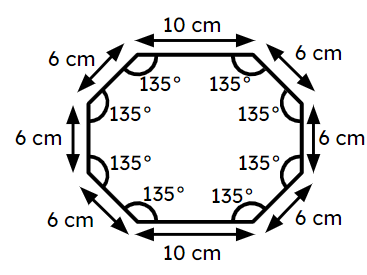
Q4.Why is the octagon in the image not regular?
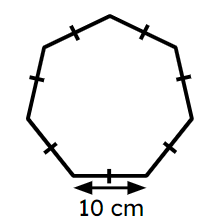
Q5.The perimeter of the heptagon is cm.